



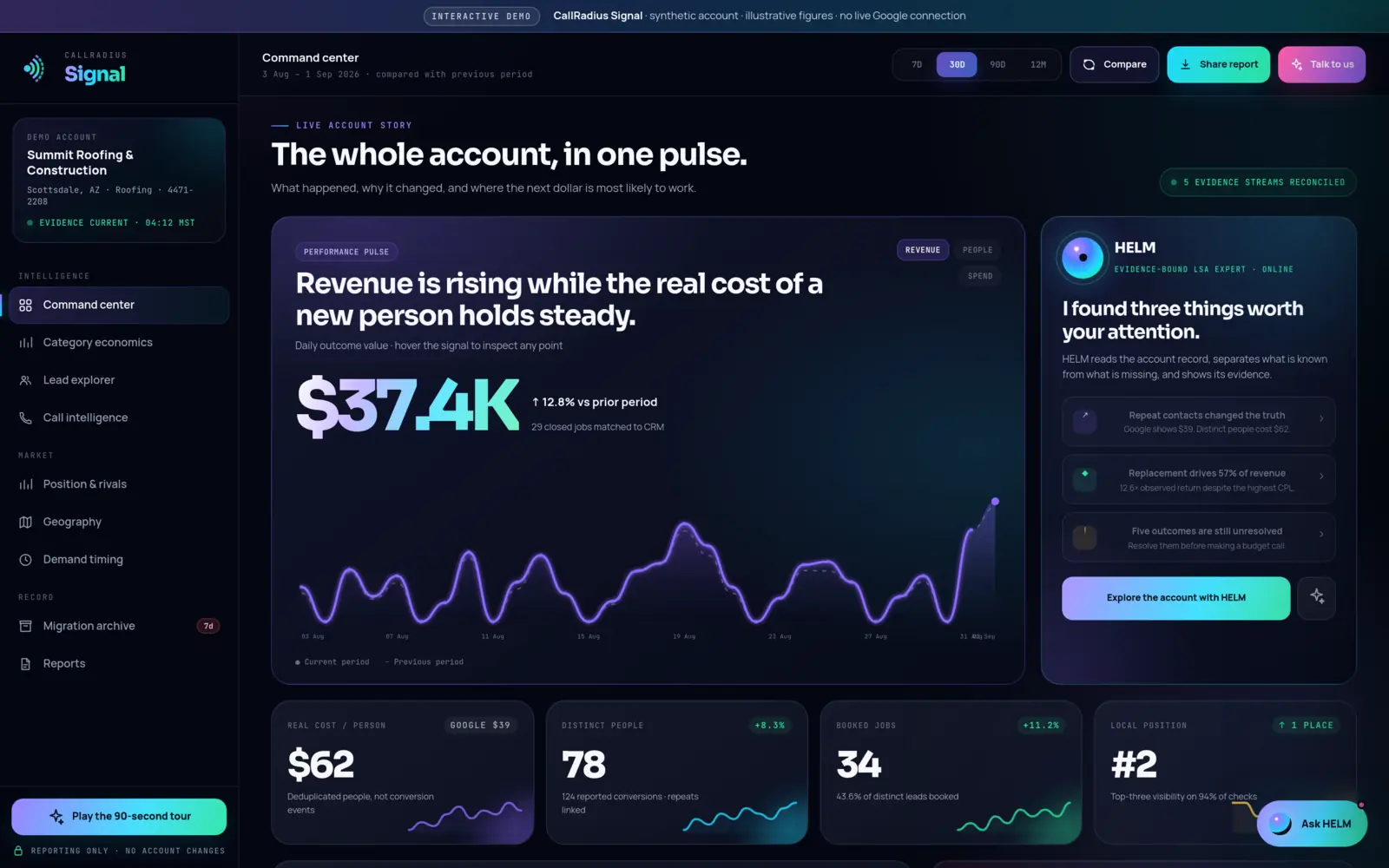
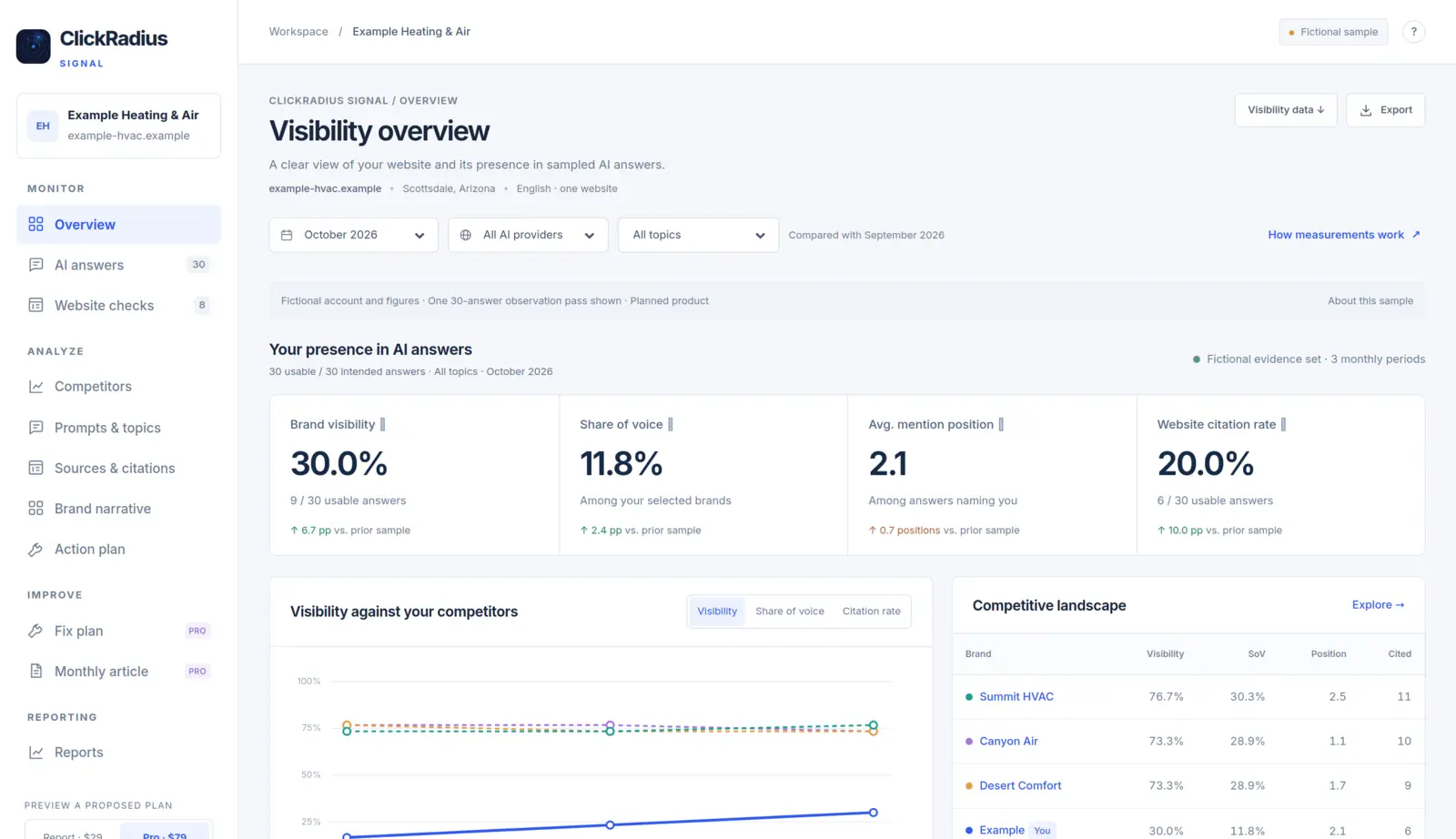


- A local business wins or loses customers at four moments: being found on Google, being recommended by AI, the conversation that closes the deal, and staying visible every week after.
- We built one product for each moment, plus self-serve Signal versions of the first two. They hand off to each other instead of overlapping.
- Every product started from the same question: what would this look like if it actually did the work, and could prove it?
- "Rewrote the book" isn't a slogan. It's a list of specific design choices, and this post names them.
Two shifts, one gap
Two shifts changed the game for local businesses. Local Services Ads moved the best leads to the top of Google, and AI started answering "who should I call?" Neither could be won with a monthly check-in and a report, so we built the platforms ourselves.
What would this look like if it actually did the work, and could prove it?
Those two shifts became CallRadius and ClickRadius. But once you watch how a customer actually hires a local business, the job doesn't end when they find you. They book a time to talk. The conversation either moves forward or it stalls. And after the job, they either remember your name or they don't.
So we kept going, one moment at a time.
One product per moment
| Moment | Product | Status today |
|---|---|---|
| Found on Google | CallRadius, managed Google Local Services Ads | Enrolling now |
| Recommended by AI | ClickRadius, managed AI search visibility | Available now, 14-day trial |
| The conversation | RadiusLocal.ai Meet: booking, video, AI notes and webinars | Free plan available |
| Every week after | RadiusLocal.ai Social: social posting on autopilot | Launching soon |
Then there's Signal. CallRadius Signal and ClickRadius Signal are the do-it-yourself versions of the first two: the same intelligence as a read-only view, for owners who run their own ads and website. CallRadius Signal enrollment is opening soon, and ClickRadius Signal is planned for 2027. Signal, explained covers the idea behind both.
Because each product owns a different moment, none competes with another. A business can start with one and add the next when it's ready. Managed or Signal isn't a rivalry either. It's a choice about who does the work. Which RadiusLocal.ai product fits? lays out all six side by side.
What "rewrote the book" means, concretely
Every product began with the same question: what would this look like if it actually did the work, and could prove it? Here is what that question produced.
Ads management that grades its own decisions
CallRadius reviews every Local Services account every two hours, 84 optimization cycles a week. Every budget change is scored about a week later as a win, a loss or neutral against real leads. A rule that loses more than it wins is demoted to advisory until its record recovers. When a growth rule and a protective rule disagree, protection wins. And junk leads are flagged for honest feedback to Google only above an 85% confidence threshold; ambiguous ones go to a person. Google decides every credit.
AI visibility that changes the site, not just the report
ClickRadius doesn't stop at a list of recommendations. It writes the fix, deploys it through WordPress, Shopify, a JavaScript snippet or Cloudflare, then re-scans to confirm the public page actually changed. Every change is versioned with one-click revert.
An expert AI that reads the record first
HELM, the expert layer in CallRadius and CallRadius Signal, reads the account record before it advises. It separates what's known from what's missing, flags unresolved outcomes before answering a question that depends on them, and works inside a register of 36 things it must never recommend. Its doctrine has 265 Local Services concepts, distilled from more than two million words of reviewed expert material.
Meetings without the bot in the room
Meet replaces four tools: video meetings, scheduling links, an AI note-taker and webinar software. The pre-call brief gathers your earlier notes and open tasks before you join. Next steps are typed on screen during the call, the client acknowledges each one, and each becomes a task when the meeting ends. The AI notes are part of the meeting itself, not a stranger called "Notetaker".
Social posts written from real facts
Social writes every post from the business facts you saved, and holds any claim those facts don't support for review. An approved post is locked: change a word and it needs approval again. It is built to connect directly to 11 networks, with no third-party scheduler in the middle.
Self-serve reporting that counts people, not events
CallRadius Signal links repeat contacts to the same person, so you see what a new customer actually costs, and archives your history so it doesn't disappear when Google's interface changes. It is read-only: it can't change bids, budgets, campaigns or settings.
Automation that knows its limits
Across the managed products, automation is risk-tiered. Routine, reversible changes run within approved guardrails and are logged. Material or hard-to-undo changes wait for a person. Ambiguous situations stop and alert someone.
The two managed platforms are each protected by a US patent application. Both are patent pending, and that's exactly how we describe them.
The evidence standard runs through all of it
Building products that claim to prove their work only means something if the proof is honest. So every number we publish is measured, illustrative or proposed, and we say which. Demo screens use fictional businesses and say so. Gaps are shown as gaps, not filled with estimates. The full standard is in How we label numbers.
Here is that standard applied to this post. Measured on our production systems in October 2026, across all accounts, the platforms had synced and analysed 26,673 Local Services leads, transcribed and graded 8,557 customer calls, logged 23,668 budget and performance optimizer runs and completed 6,999 AI citation checks. Those are counts of work done, not claims about anyone's results.
And here is what we won't claim. We don't guarantee rankings, leads or AI recommendations, because results depend on Google and on each AI provider. We guarantee transparency: you see what was done and what changed.
One team behind every product
RadiusLocal.ai is one company in Scottsdale, Arizona. The team that builds the platforms is the team behind every account, so nothing gets lost between products. radiuslocal.ai, callradius.io, clickradius.io, meet.radiuslocal.ai and social.radiuslocal.ai all lead to the same people.
The takeaway
We didn't set out to build a better version of what was already out there. We asked what each moment in a customer's journey would look like if the software did the work and could show it, and built from there. If that's the standard you want from the people helping you get found, start with a free LSA Score or AI Readiness Score, or talk to a person.
Questions about anything in this article? Talk to a person. We answer every message.