






Local intelligence, defined.
61 terms from Google Local Services Ads, AI search and honest measurement, in plain English. Each one says how we use it in our products and reports.
No terms match. Try a shorter word, or ask us.
A
AI answer
A response from an AI assistant such as ChatGPT, Gemini or Perplexity. For local questions, answers often name a short list of businesses and may link to sources.
Answer position
The order in which a business is mentioned within an AI answer. It is not a Google or Maps ranking.
Auto-fix
ClickRadius's managed process: generate a fix, deploy it, verify the result, with one-click revert. Changes are versioned.
B
Blended average
One figure averaged across very different services, areas or times. It's tidy but often misleading, because a strong segment can hide a weak one.
Booked job
A lead that became scheduled, paid work. Booked jobs, not leads, are the outcome most owners care about.
Booking rate
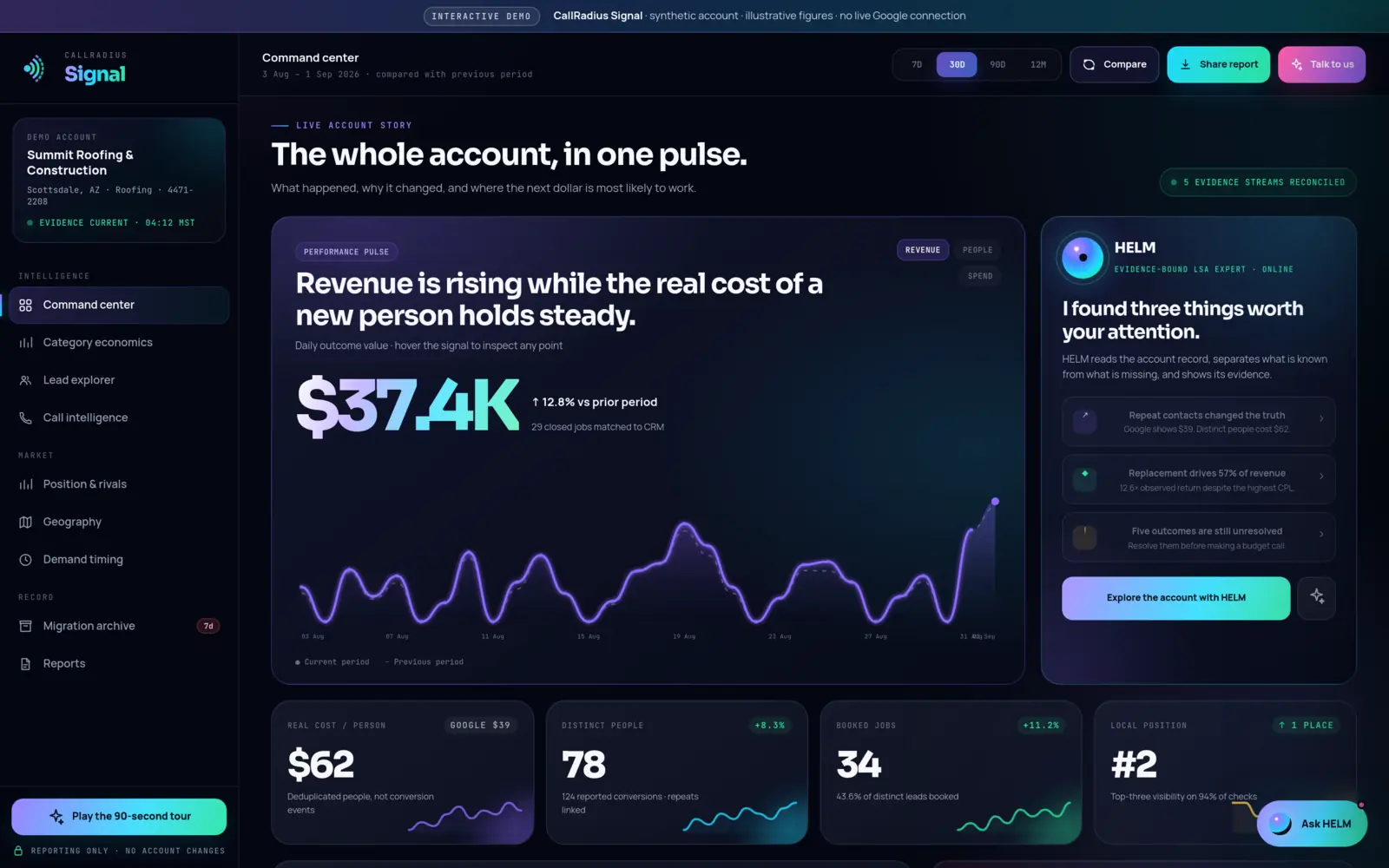
The share of distinct leads that became booked jobs. In the CallRadius Signal demo, 34 of 78 distinct leads booked, a rate of 43.6% (fictional business).
Brand mention
A usable AI answer that names your business. Counted separately from citations.
Brand narrative
How AI answers describe your business: the language, claims and tone. Sentiment is an interpretation of that language and is separate from whether you were mentioned.
Business facts
Your name, address, phone, hours, services, service area and credentials. They feed ads, maps, directories and AI answers, so they should match everywhere.
Buying question
A question a customer asks before they know your name, such as “Who can fix my AC today in Phoenix?” Measuring AI visibility starts with a fixed list of them.
C
Call intelligence
Signal Pro's view of recorded calls: transcripts, handling quality, caller intent and outcomes. Signal keeps transcripts, analysis and recording references, not the audio files.
Caller intent
What a caller wants, grouped into types such as emergency, estimate or research. It helps separate urgent demand from early shopping.
Category economics
Lead cost, booking rate, revenue and return broken out by service category, so a blended average can't hide which services pay.
Charge state
Whether Google charged for a lead, credited it back, or whether it still needs review. Signal keeps the charge state on every lead so you can see what you actually paid for.
Citing source
A website an AI answer linked to or relied on: your site, a competitor's, a directory, an editorial site or a community. In ClickRadius Signal, a domain counts at most once per answer.
Comparison set
The specific competitors you choose to measure against. It's the denominator behind share of voice.
Conversion event
A single recorded contact, such as one call or one message. Several conversion events can belong to the same person.
Cost per booked job
Spend divided by booked jobs. It combines lead cost and booking rate into the number that decides whether advertising pays.
Cost per lead
Spend divided by the number of leads. The figure Google reports counts conversion events, so a customer who calls three times can count three times. Also written CPL.
Crawler access
Whether search and AI crawlers can reach and read your pages. A page that can't be read can't be cited.
D
Demand timing
When leads arrive, across the 168 hour-long blocks of a week. It shows when to staff the phone and when slow responses cost bookings.
Denominator
What a rate is a rate of. We state it every time: per distinct person rather than per event, out of usable answers rather than all attempts, among the competitors you chose.
Distinct person
One real customer, counted once no matter how many times they called or messaged. In the CallRadius Signal demo (a fictional business), 124 reported conversions map to 78 distinct people.
E
Entity
A distinct thing that search engines and AI systems recognize, such as your business. Consistent facts across the web help them recognize you as one clear entity.
G
Generative engine optimization
Work that helps AI assistants find, understand and cite a business: clear website information, structured data, consistent facts and presence on trusted sources. Often shortened to GEO.
Google Verified badge
The badge Google shows next to approved Local Services advertisers. Since October 2025, every approved business carries one unified Google Verified badge.
H
Handling quality
A score for how well calls are handled, broken into stages such as greeting, discovery and agreeing a next step.
HELM
Our evidence-bound expert AI for Local Services Ads. It reads the record first, separates what's known from what's missing, then advises, within a doctrine of 265 concepts and 36 rules it must never break.
HELM deep review
A full HELM read of your account. The $29 Signal plan includes one per complete reporting window, plus five questions a month. Unlimited HELM is a $14 add-on, and is included in Signal Pro.
K
Known vs missing
Our rule for reports: show what's known, flag what's missing, and say so before any conclusion depends on the missing part.
L
Lead
A customer contact that comes through your Local Services ad, such as a phone call or a message. In Local Services Ads, the lead is what you pay for.
Lead credit
A charge Google reverses for a lead that shouldn't have been billed, for example a job you don't offer or a customer outside your service area. CallRadius triages leads for credit with a confidence gate of 85% or higher.
Local position
Where your business appears among the Local Services providers shown for a search. Signal records position checks over time rather than relying on a single look.
Local Services Ads
Google's ads for local service businesses, shown at the very top of search results for eligible business types. Advertisers pay per lead, such as a call or message, rather than per click. Google lists 114 eligible business types in the US.
M
Matched revenue
Revenue from booked jobs that has been tied to a specific lead. Signal uses the job values you record. Revenue that isn't matched yet is shown as a gap rather than estimated.
Measured, illustrative, proposed
The three labels every number on our site carries. Measured: counted on production systems. Illustrative: from a demo with fictional data. Proposed: a plan or price that isn't final.
Migration archive
Signal's record of the account history Google shows only for a limited time, so earlier reporting stays viewable in Signal instead of disappearing.
N
Never-recommend rules
A register of 36 things HELM must never recommend, regardless of how a question is asked.
O
Observation pass
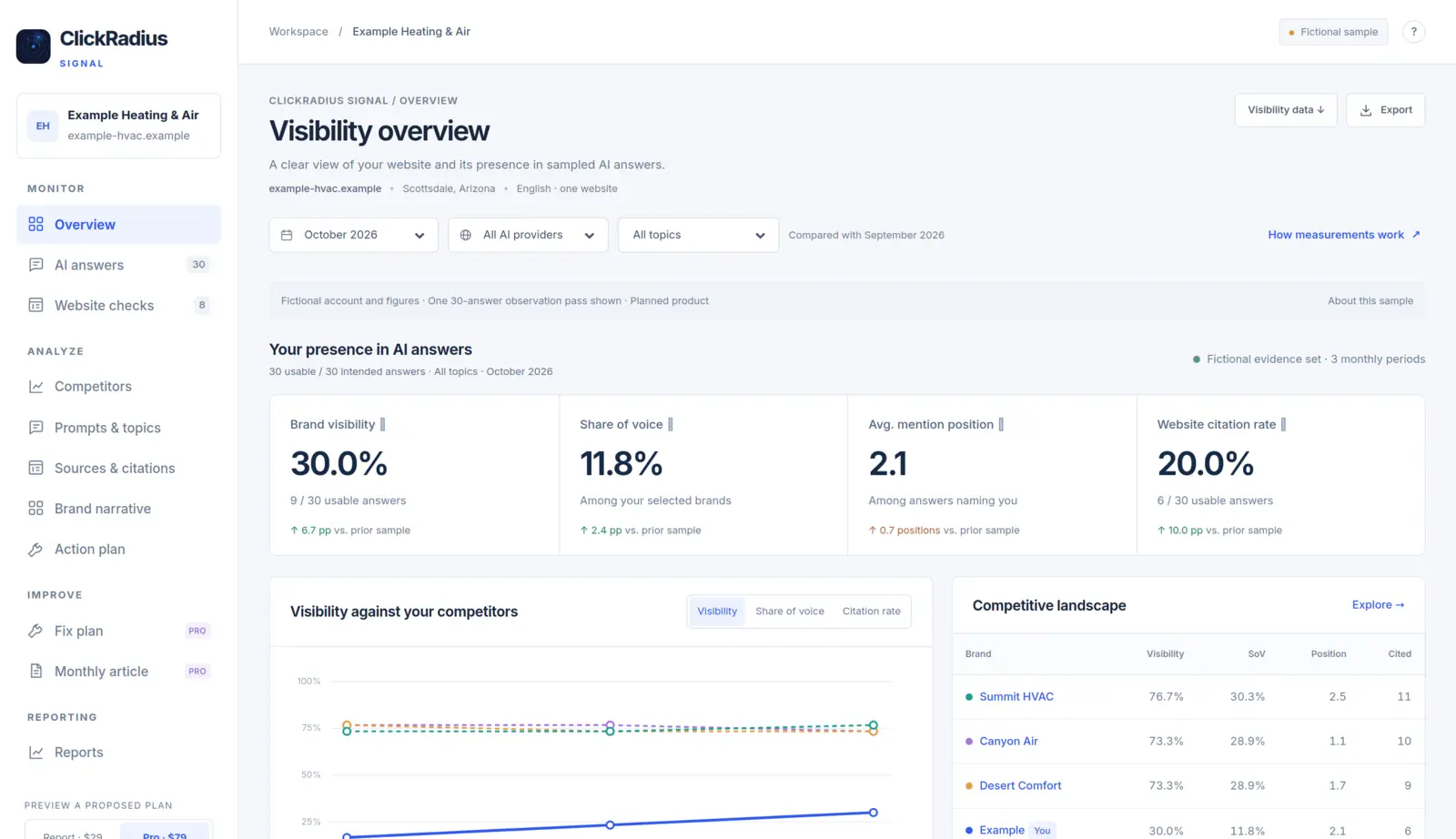
One round of asking a fixed set of buying questions to each AI provider. In the ClickRadius Signal demo, one pass is 10 questions across 3 providers: 30 intended observations.
Observed return
Matched revenue divided by spend, for the jobs that have been matched. It's observed rather than projected: unmatched jobs could raise it later.
P
Prepared fix
An improvement written and ready to install, with the affected page, proposed text and steps. Prepared is not installed, and installed is not verified: we keep the three separate.
R
Read-only access
A connection that can see account data but cannot change it. CallRadius Signal is technically restricted to observation only: it cannot change bids, budgets, campaigns or settings.
Readiness families
The five weighted parts of the ClickRadius Signal readiness score: off-site foundations 28%, on-page information 26%, structured business data 18%, business and author clarity 18%, and crawler access and hygiene 10%.
Real cost per person
Spend divided by distinct people rather than conversion events. In the CallRadius Signal demo, the reported cost per lead is $39 and the real cost per person is $62. The business is fictional and the figures are synthetic.
Repeat contact
A second or later contact from a person who has already reached you. Repeat contacts are real activity, but they're not new customers. Signal links them to the person instead of hiding them.
Reporting gap
The difference between a platform's reported cost per lead and the real cost per distinct person. In the CallRadius Signal demo, the real figure is 59% higher than the reported one (fictional business).
Response gap
A time of the week when replies are slowest and booking suffers. In the CallRadius Signal demo, Friday at 5 p.m. has the longest median reply time and the weakest booking rate (fictional business).
Responsiveness
How reliably and quickly a business answers and responds to leads. It matters in Local Services Ads, and every customer an AI assistant sends you still has to reach someone.
Review velocity
How quickly new reviews arrive. Signal Pro's rival tracking watches it for competitors as well as for you.
Risk-tiered autonomy
How our managed products decide what may happen automatically. Reversible, high-confidence actions run within guardrails, material changes need approval, and ambiguous situations alert a person.
S
Signal
Our self-serve products. CallRadius Signal reports on your Google Local Services account (enrollment opening soon). ClickRadius Signal reports on AI answers and website readiness (planned for 2027).
Source gap
A source that keeps appearing in answers and names your competitors but not you. It's often a practical place to start.
Structured data
Code on a web page that labels facts for machines, such as business name, address, hours and services. Often called schema markup.
T
Top-three visibility
The share of recorded position checks in which your business appeared in the top three. In the CallRadius Signal demo, it's 94%: 55 of 58 checks (fictional business).
U
Unresolved outcome
A booked job whose revenue isn't matched to a lead yet. HELM flags unresolved outcomes before answering any question that depends on return, because they can change the answer.
URL citation
A usable AI answer that links to a page on your website. You can be mentioned without being cited, and cited without being named first.
Usable answer
An AI answer that was actually received and retained for measurement. Rates are calculated against usable answers.
W
Website readiness
A weighted assessment of the website foundations that help AI understand and cite a business. It's measured separately from AI answers and is not a probability of being recommended.
White label
Products and reports delivered under an agency's own brand. Our agency programs provide white-label dashboards, portals and reports, and the agency sets its own retail price.
See the terms at work.
The Knowledge Center explains how each product measures and reports, guide by guide.