







- Signal reads your Local Services data and cannot change bids, budgets, campaigns or settings. That restriction is enforced in our systems, not just promised.
- You can disconnect inside Signal or revoke access in your Google account settings at any time.
- We don't sell your data. You stay responsible to your customers, and CallRadius acts as your processor for their personal information.
- Google keeps Local Services history for a limited period. Signal archives it, and keeps the reports it collected if you cancel.
- You can download the current month of lead data and request a complete export when closing your account.
Connecting a reporting tool to your ad account is a reasonable thing to be careful about. This guide sets out, in plain English, what CallRadius Signal does with that connection. It's based on the Signal Subscription Agreement (version CR-SIGNAL-2026-09), mainly sections 2, 5, 6, 8 and 10. The agreement is the binding text, and you accept it during sign-up. Enrollment is opening soon.
Read-only, enforced technically
To use Signal, you connect your Google account and grant access. Signal uses that connection to read your Local Services data and for nothing else.
Signal will not change your bids, budgets, campaigns, account settings or anything else in your Google account. The agreement is specific that this is enforced in our systems, not merely promised: a Signal-connected account is technically restricted to observation.
Signal reads and archives. It cannot change bids, budgets, campaigns or settings.
That also applies to HELM. On a Signal account, HELM can recommend, but it has no way to act. See HELM: what it does and won't do.
Disconnecting and revoking access
You stay in control of the connection. You can:
- Disconnect from inside Signal at any time.
- Revoke access in your Google account settings, without going through Signal at all.
Either way, disconnecting stops new data from being collected.
One more thing you control: Signal signs you in by an emailed one-time link. That means anyone with access to your sign-in mailbox can reach your reports, so keep that mailbox secure.
What data Signal processes
Signal works from two sources:
- The data Google gives us from your Local Services account. In the public demo, the archive is organized as daily performance, lead records (with category, service, charge and credit state), call transcripts with their handling analysis and recording references, ratings and report artifacts.
- Figures you enter yourself, for example what a job was worth.
Where a figure is an estimate or an allocation rather than a direct measurement, Signal says so on screen. We report the data Google provides, but we can't warrant that Google's underlying data is complete or correct. Our wider approach to labeling numbers is in How we label numbers.
Call transcripts are kept as text, analysis and a reference to the recording. Signal does not store audio files. Call intelligence, explained has more on that.
How your data is used, and who is responsible
| Question | What the agreement says |
|---|---|
| Why do you process it? | To provide Signal to you. |
| Do you sell it? | No. |
| Is it used for anything else? | We may use aggregated, de-identified information that cannot reasonably identify you or your customers to improve our products. |
| Who is responsible for my customers' personal information? | You remain responsible for your obligations to your customers. CallRadius acts as your processor for that data. |
| Can I have it deleted? | Yes, on request, subject to any records we're legally required to keep. |
Each side also keeps the other's non-public information confidential and uses it just for the purposes of the agreement.
The archive: keeping the history Google stops showing
Google keeps Local Services history for a limited period. Signal archives your account data, so your reporting doesn't disappear when Google's interface changes or older history drops out of view. That's what the signup page means by "keep the history Google stops showing."
The migration archive in the demo
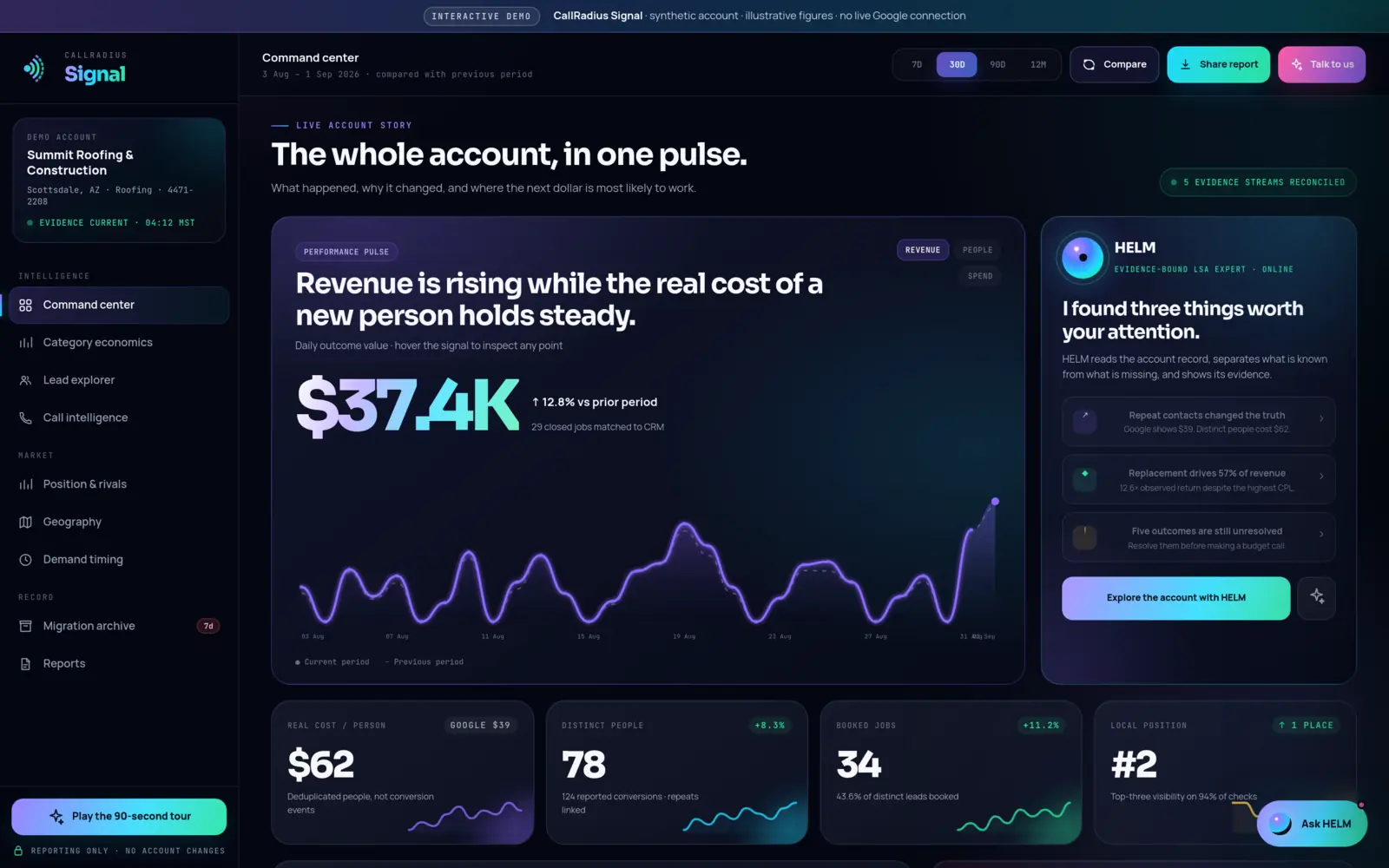
The public demo shows how this works when Google changes its reporting surface. Its fictional roofing company has a migration scheduled, with seven days left on the old dashboard. Signal captures the old reporting surface into one durable timeline, then continues the account story after the migration. Evidence that isn't available is identified rather than hidden.
In that demo, the captured record covers 37 months of daily performance (1,126 granular days), 6,940 lead records, 3,318 transcripts and 37 monthly report artifacts rebuilt from the captured series. The business is fictional and every figure is synthetic. The demo also notes that its Google migration and retention statements are based on Google's published documentation as reviewed on 2 September 2026.
Downloads, cancellation and coming back
- Downloads. While your trial or paid subscription permits downloads, you can download the current month of your lead data at any time. Earlier months remain viewable in Signal while your account has archive access.
- If the trial ends without a card. New reporting and data collection pause, your existing archive remains readable, and adding a card resumes service.
- If a payment fails. There's a three-day grace period. After that, Signal stops collecting new data but does not lock you out: existing reports stay visible.
- If you cancel. Cancellation ordinarily takes effect at the end of your current trial or paid billing period. We retain the reports Signal collected.
- If you come back. The reports we retained are available again, rather than starting from an empty archive.
- If you're closing for good. Ask us and we'll provide a complete export of your data. You can also ask us to delete it, subject to records we must legally keep.
The billing side is covered in Trial, billing and cancellation.
What Signal depends on
Signal reports on what happens in your Google account, and it depends on Google for that. If Google changes, limits, delays or withdraws access to Local Services data, Signal's reporting may be reduced or interrupted. Signal does not guarantee leads, calls, bookings, revenue, ranking or any particular outcome.
Common questions
Could Signal ever change my ads by mistake?
The agreement says a Signal-connected account is technically restricted to observation, enforced in our systems. Signal cannot change bids, budgets, campaigns or settings.
Does disconnecting delete my archive?
Disconnecting stops new data from being collected. If you want your data deleted, ask us and we'll process the request, subject to records we're legally required to keep.
Can I download everything at any time?
You can download the current month of lead data at any time while your subscription permits downloads. Earlier months are viewable in Signal, and a complete export is available on request when you close your account.
Do you sell or share my customer data?
We don't sell it. We may use aggregated, de-identified information that cannot reasonably identify you or your customers to improve our products.
Where can I ask a question that isn't answered here?
Use the contact page, or see the FAQ.
Questions about anything in this guide? Talk to a person. We answer every message.