






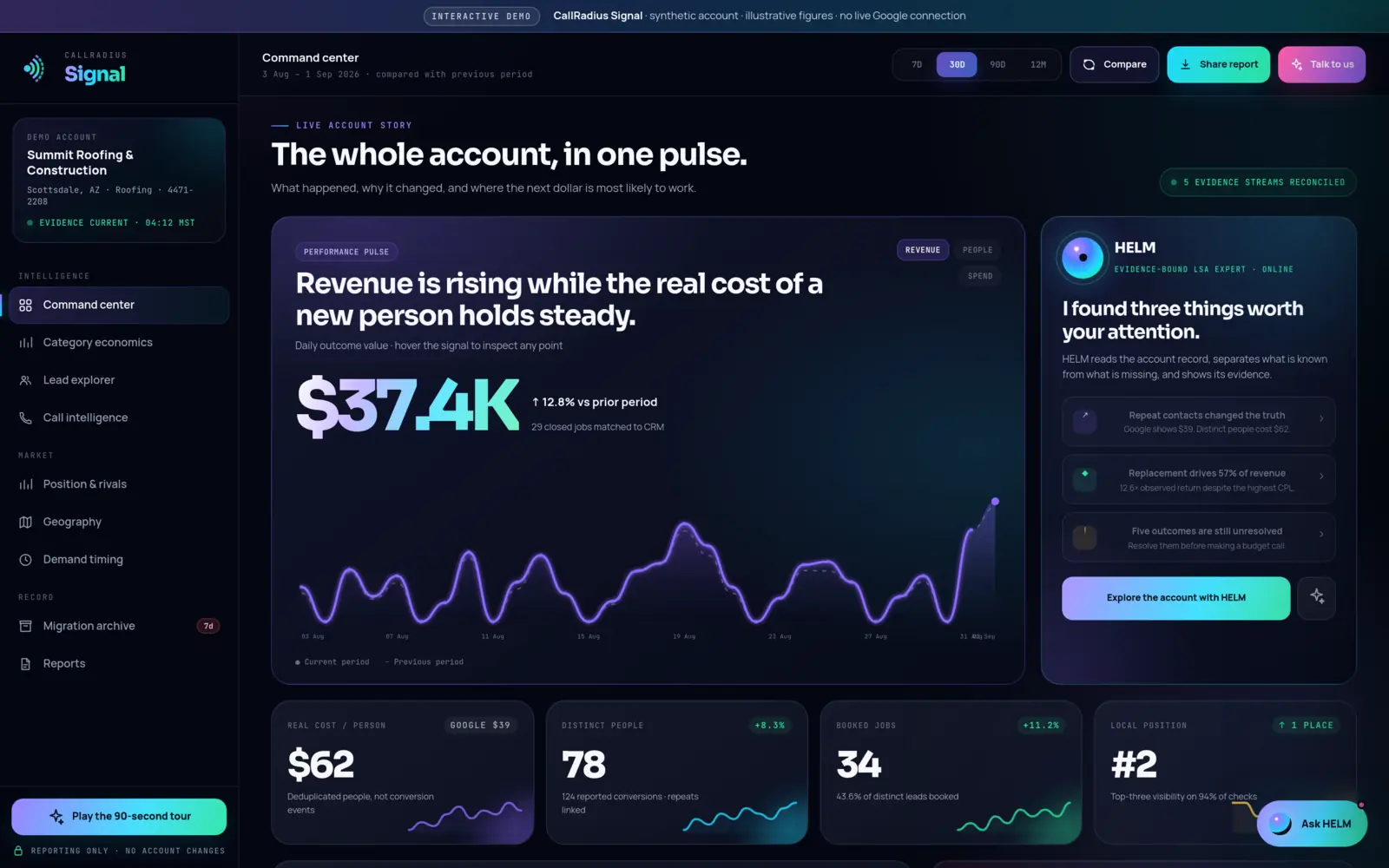
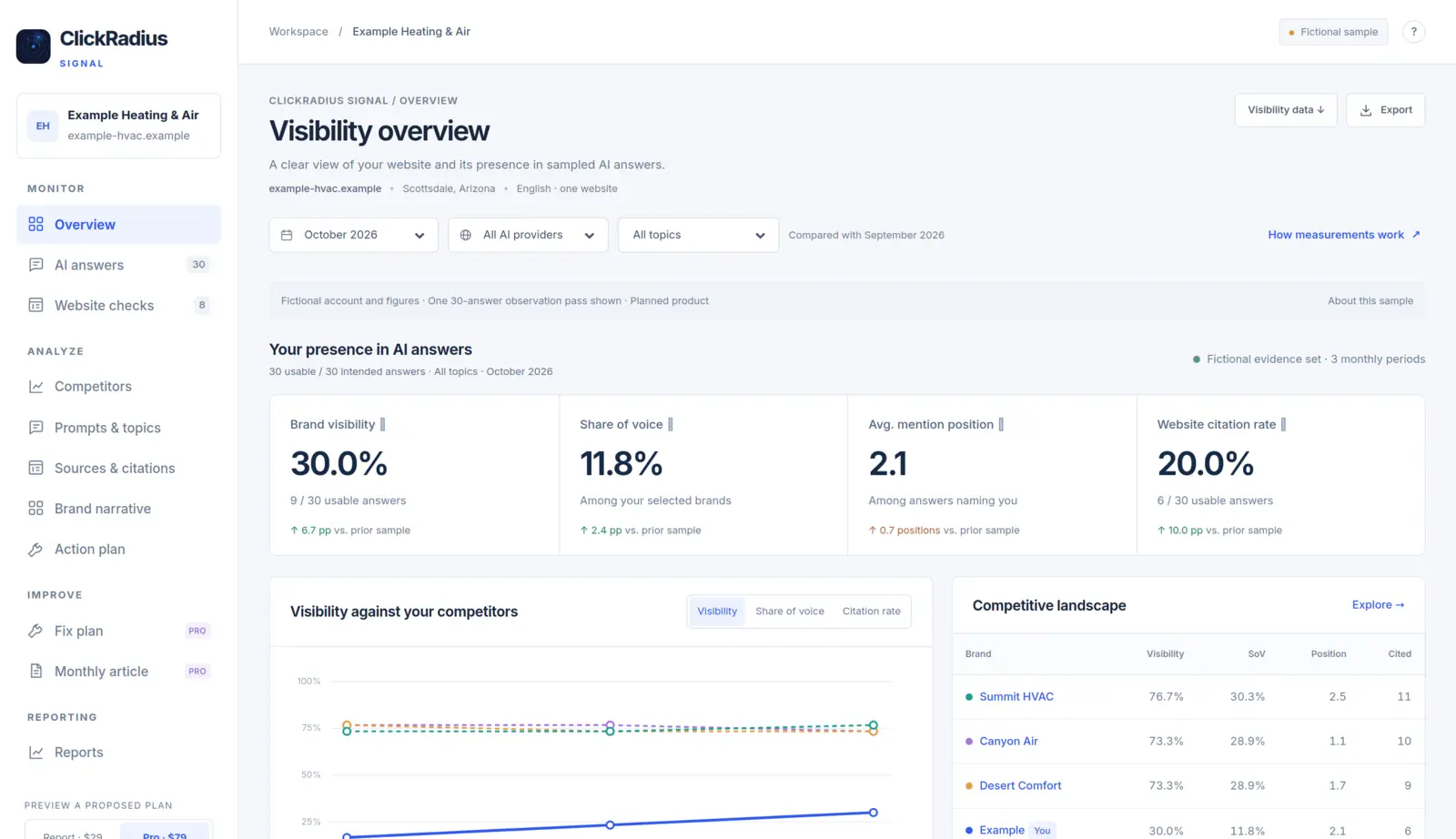

- Signal's market screens answer three questions: where you appear against rivals, which postcodes work and when in the week demand arrives.
- Position is shown as a share of recorded checks, not a single snapshot. Rival tracking is a Signal Pro feature.
- Geography separates settled reads from areas still gathering evidence, so a postcode with five leads isn't judged like one with fifty.
- Demand timing splits the week into 168 hourly blocks and shows when leads arrive and when response behavior changes the outcome.
- All three reward patience. Small samples swing, so look for patterns that hold across weeks.
The command center tells you what happened across the whole account. The market screens tell you where and when. In the CallRadius Signal demo they sit together under "Market": position and rivals, geography and demand timing. Every example below comes from that demo, where Summit Roofing & Construction is a fictional Scottsdale roofer and every figure is synthetic.
Position and rivals
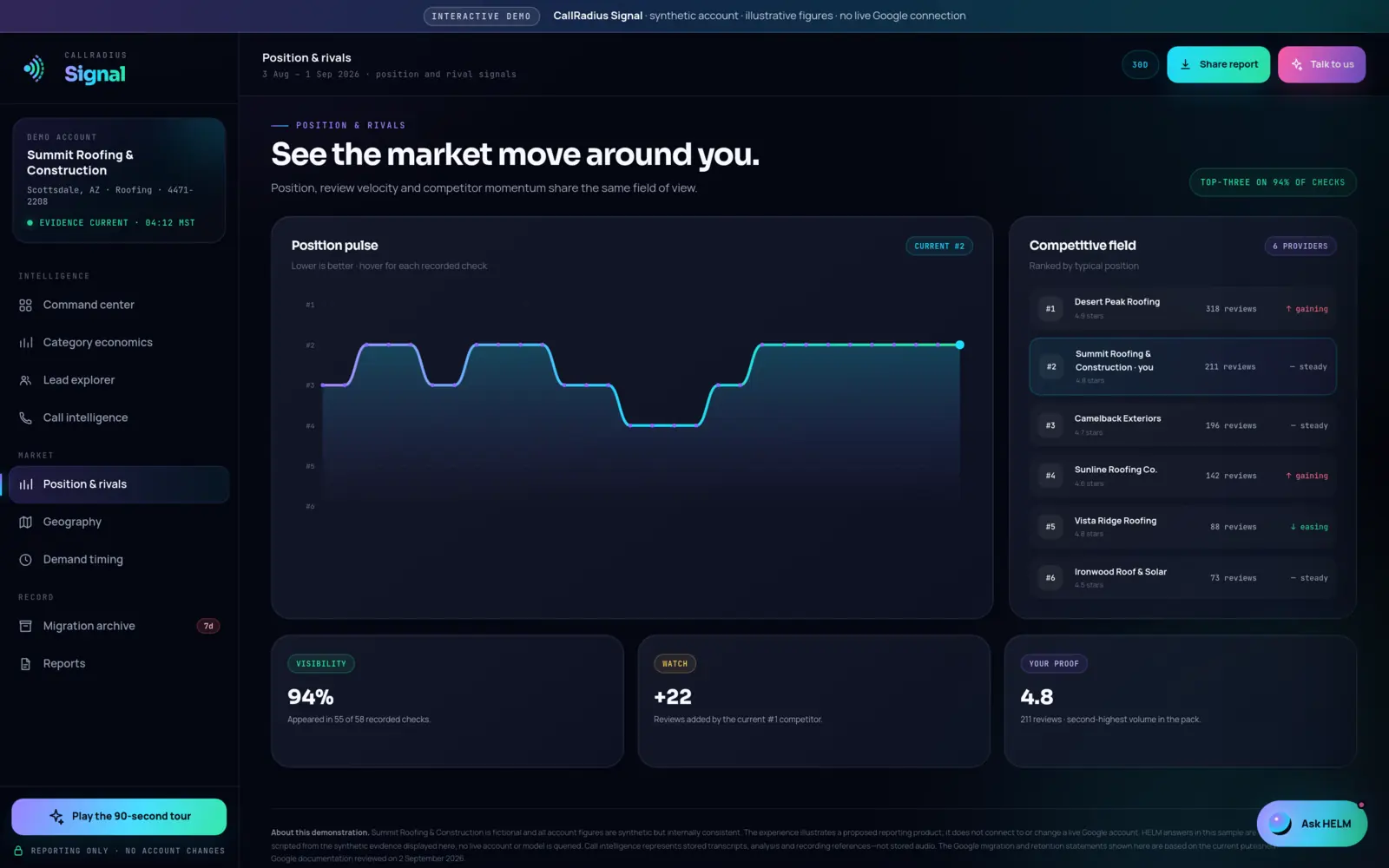
This screen puts three things in one view: your position, review momentum and competitor movement.
- Position pulse. A chart of your position across recorded checks. Lower is better, and you can hover any check to see it.
- Competitive field. The providers you appear alongside, ranked by typical position. The demo shows six.
- Summary cards. Visibility, a competitor worth watching and your own proof.
In the demo, the business is currently #2 and shows a top-three position on 94% of checks: it appeared in 55 of 58 recorded checks. The "watch" card notes that the competitor currently in the top position added 22 reviews. The "your proof" card shows a 4.8 rating from 211 reviews, the second-highest volume in the pack.
Rival tracking is included in Signal Pro ($79 a month), along with unlimited HELM and call intelligence. See CallRadius Signal plans, explained for what each plan includes.
How to read it
A share of checks is steadier than any single look. If you search for yourself once and see #4, that's one moment. Appearing in the top three on most recorded checks over a month is a much better description of where you stand. Read movement in the competitive field the same way: a rival gaining reviews quickly is worth watching over several weeks, not reacting to in a day.
Geography by postcode
The geography screen shows your service area postcode by postcode. Bubble size is lead volume and color is outcome quality. Select an area to see its volume, economics and how confident the outcome read is.
In the demo, the strongest area is 85254, Scottsdale North, described as the strongest combination of lead volume and confirmed booking outcomes: 19 leads, a 58% booking rate and a $58 cost per lead.
Settled reads vs gathering evidence
The demo's header reads "6 settled reads, 3 gathering evidence." That label is the most important thing on the screen. A settled read is an area where there's enough evidence to describe how it performs. An area still gathering evidence may look excellent or terrible, and either way the honest answer is "not yet."
Demand timing
The week has a shape. Demand timing splits it into 168 time blocks, one for each hour of each day, and shows a heatmap of when leads arrive. Brightness represents demand density. The demo covers 12 weeks of observations and highlights three blocks:
| Highlight | Block | What the demo shows |
|---|---|---|
| Peak window | Tuesday 08:00 | Highest arrival density, 4.1 leads a week, with 51% of confirmed outcomes booked |
| Response gap | Friday 17:00 | Longest median reply time and the weakest observed booking rate |
| Weekend signal | Saturday 08:00 to 12:00 | Third-densest block, with above-average conversion |
The useful part is the pairing. Arrival density tells you when the phone rings. Reply time and booking rate tell you what happens next. A busy block with a slow response is where staffing, not advertising, is likely the first thing to look at. If you also use call intelligence, check whether the HELM call brief points at the same part of the week.
We go further into reading the shape of weekly demand in a separate article.
Reading the three together
Each screen is more convincing when another one agrees with it.
- A postcode with a weak booking rate might be a geography problem, or it might be that its calls tend to land in a slow-response block. Check timing before deciding the area is the issue.
- A slip in position might line up with a rival's review push. Look at the competitive field before assuming something changed in your own account.
- A strong time block in a strong postcode is where your capacity matters most. Make sure someone is free to answer then.
If a question crosses screens, it's a good one to ask HELM. The demo includes an "Ask HELM about geography" prompt for exactly that. Asking HELM good questions covers how to frame it.
How not to over-read the market screens
- Check the sample first. Before reading any rate, look at how many leads, checks or weeks sit behind it.
- Respect "gathering evidence". When Signal says an area isn't settled, don't act on it as if it were.
- Compare like with like. Compare this month with last month using the same period length, or with the same season last year.
- Don't confuse timing with cause. A change that follows an action is not proof the action caused it. We cover this in our article on whether a change worked.
- Write down what you changed. If you adjust hours or service areas, note the date so later reads have context.
What Signal can and can't do here
Signal is read-only. It can show you that a postcode is underperforming or that Friday evenings go unanswered, but it can't change your service areas, schedule or budget. You make those changes in your own Google account, or, if you'd rather have them handled, that's what managed CallRadius does, with targeting changes kept human-authorized.
Signal also reports on what happens in your Google account. It doesn't guarantee position, leads or bookings.
Common questions
Is rival tracking in the $29 plan?
No. Rival tracking is part of Signal Pro at $79 a month, together with unlimited HELM and call intelligence.
Why does an area say it's gathering evidence?
It means there isn't yet enough evidence to describe how that area performs. The numbers are shown, but they shouldn't be treated as settled.
What are the 168 time blocks?
One for each hour of each day of the week: 24 hours times 7 days. Each block shows how densely leads arrive at that time.
Can Signal move my budget toward my strongest postcode?
No. Signal can't change bids, budgets, campaigns or settings. It shows the evidence, and you decide what to change.
Questions about anything in this guide? Talk to a person. We answer every message.