






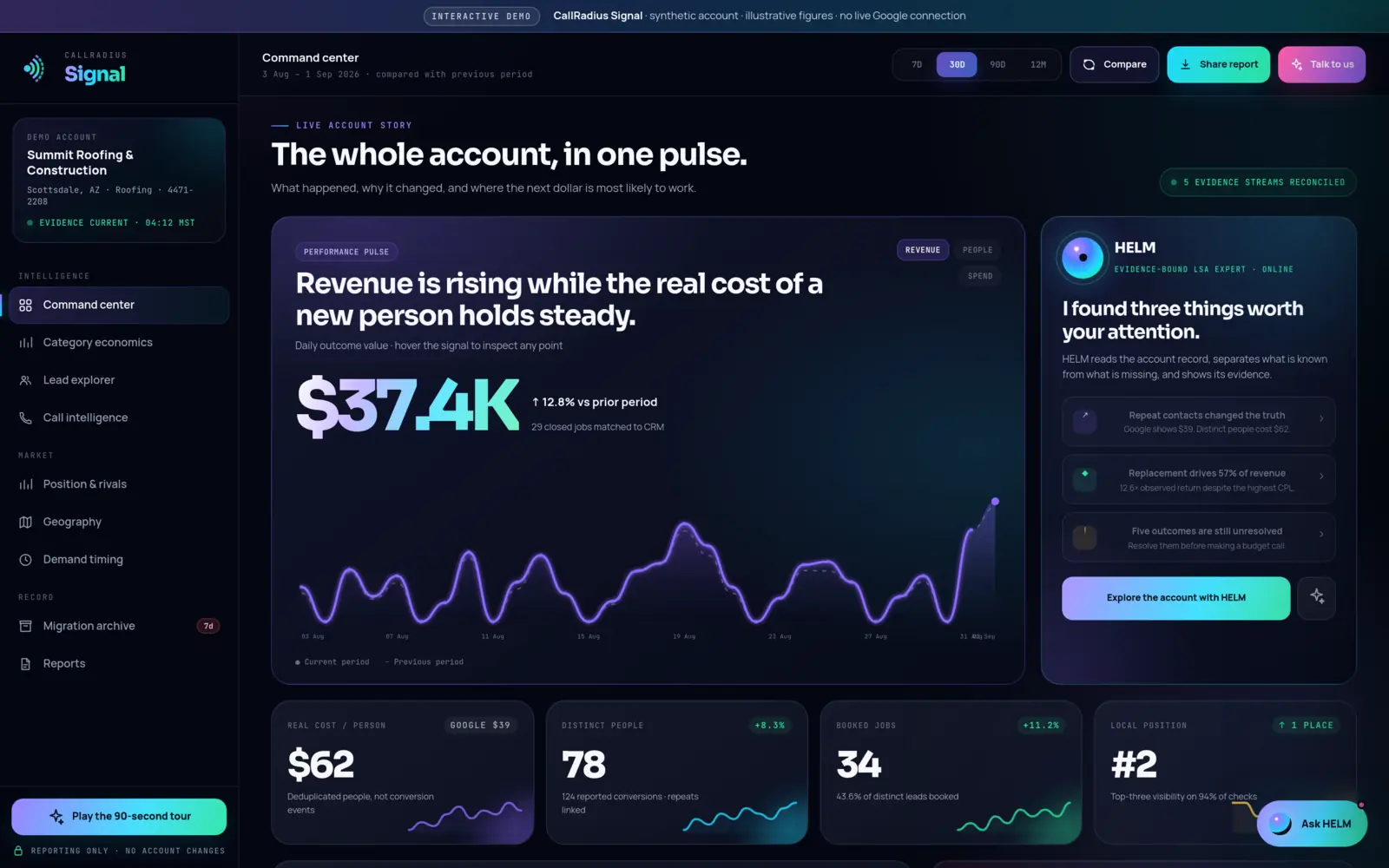

- The command center answers three questions: what happened, why it changed, and where the next dollar is most likely to work.
- Read the cost tile first. Signal shows Google's cost per lead next to the real cost per distinct person, and the gap between them.
- Then follow the chain: distinct people, booked jobs, and revenue matched to those jobs.
- HELM's findings point to what deserves attention, including outcomes that are still unresolved.
- Every figure in this guide comes from the public demo, which uses a fictional roofing company and synthetic figures.
The command center is the first screen you see in CallRadius Signal. It puts the whole account in one view, and every tile leads to the detail behind it. To make this concrete, we'll walk through the public demo. The business, Summit Roofing & Construction in Scottsdale, is fictional, and all of its figures are synthetic but internally consistent. The demo period is 3 August to 1 September 2026, compared with the previous period.
Start with the period
At the top you choose the window: 7 days, 30 days, 90 days or 12 months, with an option to compare against the previous period. The command center reports on the window you choose. Thirty days is a sensible default for most local businesses. Seven days is useful for spotting a sudden change, but a single week can swing on a few calls, so don't make budget decisions from it alone.
The performance pulse
The large chart is the performance pulse. It plots daily outcome value, and you can switch it between revenue, people and spend. The current period is drawn as a solid line and the previous period as a dotted one, and you can hover over any day to inspect it.
In the demo, the headline reads: "Revenue is rising while the real cost of a new person holds steady." Revenue for the period is $37.4K, up 12.8% on the prior period, from 29 closed jobs that the demo labels as matched to CRM.
The useful habit is to read revenue and cost together. Rising revenue with steady cost per person is a healthy pattern. Rising revenue with sharply rising cost per person is a different story, even if the top line looks good.
The four headline tiles
| Tile | Demo value | How to read it |
|---|---|---|
| Real cost / person | $62 (Google: $39) | Spend divided by deduplicated people, not conversion events. This is what a new person actually costs you. |
| Distinct people | 78, up 8.3% | 124 reported conversions, with repeat contacts linked to the same person. The growth figure that matters is people, not events. |
| Booked jobs | 34, up 11.2% | 43.6% of distinct leads booked. A booking rate built on people rather than events is a fairer test of how well leads are handled. |
| Local position | #2, up one place | Top-three visibility on 94% of checks. Position is checked repeatedly, so read it as a pattern rather than a single snapshot. |
Why there are two cost figures
Google counts conversion events. When one customer calls twice and then sends a message, that can be three events. Signal links those repeats to one person and keeps every repeat visible. In the demo, $4,836 of spend divided by 124 events is about $39, while divided by 78 people it is about $62. We cover how this happens, and how to check it yourself, in Google says $39. The real number is $62.
The reporting gap
Below the tiles, the reporting gap puts a number on the difference: in the demo, the real cost per lead is 59% above Google's reported cost per lead, and 46 repeat contacts are linked to known people.
A large gap is not automatically bad news. Interested customers call back. But it changes how you should compare periods and services. And a rising gap can be a hint that calls aren't being answered quickly enough, because people who can't get through tend to try again. If you have Signal Pro, call intelligence is where you'd check that.
The customer journey
The customer journey panel follows leads from first ring to paid work, and every stage stays traceable. In the demo it shows 43.6% booked.
Put together, the figures on this screen line up like this:
- 124 conversion events reported by Google.
- 78 distinct people once repeats are linked.
- 34 booked jobs, or 43.6% of those people.
- 29 jobs matched to revenue, totaling $37.4K.
The step between booked and matched matters most. Five booked jobs have no revenue matched yet, and any return figure is incomplete until they are resolved.
HELM's three findings
The HELM panel opens with "I found three things worth your attention." In the demo they are:
- Repeat contacts changed the truth. Google shows $39. Distinct people cost $62.
- Replacement drives 57% of revenue. A 12.6x observed return despite the highest cost per lead. We unpack this in Category economics, explained.
- Five outcomes are still unresolved. Resolve them before making a budget call.
Notice the order of operations in that third finding. HELM separates what is known from what is missing, and it flags the gap before answering any question that depends on return. The demo's HELM answers are scripted from the synthetic evidence on screen. No live account or model is queried. On a real Signal account HELM recommends, and you decide, because Signal is read-only.
A five-minute routine
- Set the period to 30 days and turn on compare.
- Read real cost per person, not Google's figure, and check whether the gap moved.
- Check people and booked jobs moved in the same direction as spend.
- Look at unresolved outcomes and resolve them before judging return.
- Read HELM's findings, then open the screen each one points to.
New to the product? Start with How CallRadius Signal works, or look up any unfamiliar term in the glossary.
Common questions
Are the demo numbers real?
No. Summit Roofing & Construction is fictional, and every figure in the demo is synthetic but internally consistent. Your own command center would show your account's data.
Why is Google's cost per lead lower than Signal's?
Google divides spend by conversion events. Signal divides by distinct people, linking repeat contacts to the same person, so the figure is higher whenever customers contact you more than once.
Does Signal delete the repeat contacts?
No. Nothing is silently discarded. Repeats remain inspectable in the lead explorer, so you can see both what Google reported and who the people were.
Can I change my budget from the command center?
No. Signal is read-only and cannot change bids, budgets, campaigns or settings. You make any change in your own Google account.
Questions about anything in this guide? Talk to a person. We answer every message.