





- Call intelligence is part of Signal Pro ($79 a month), together with unlimited HELM and rival tracking. The $29 Signal plan does not include it.
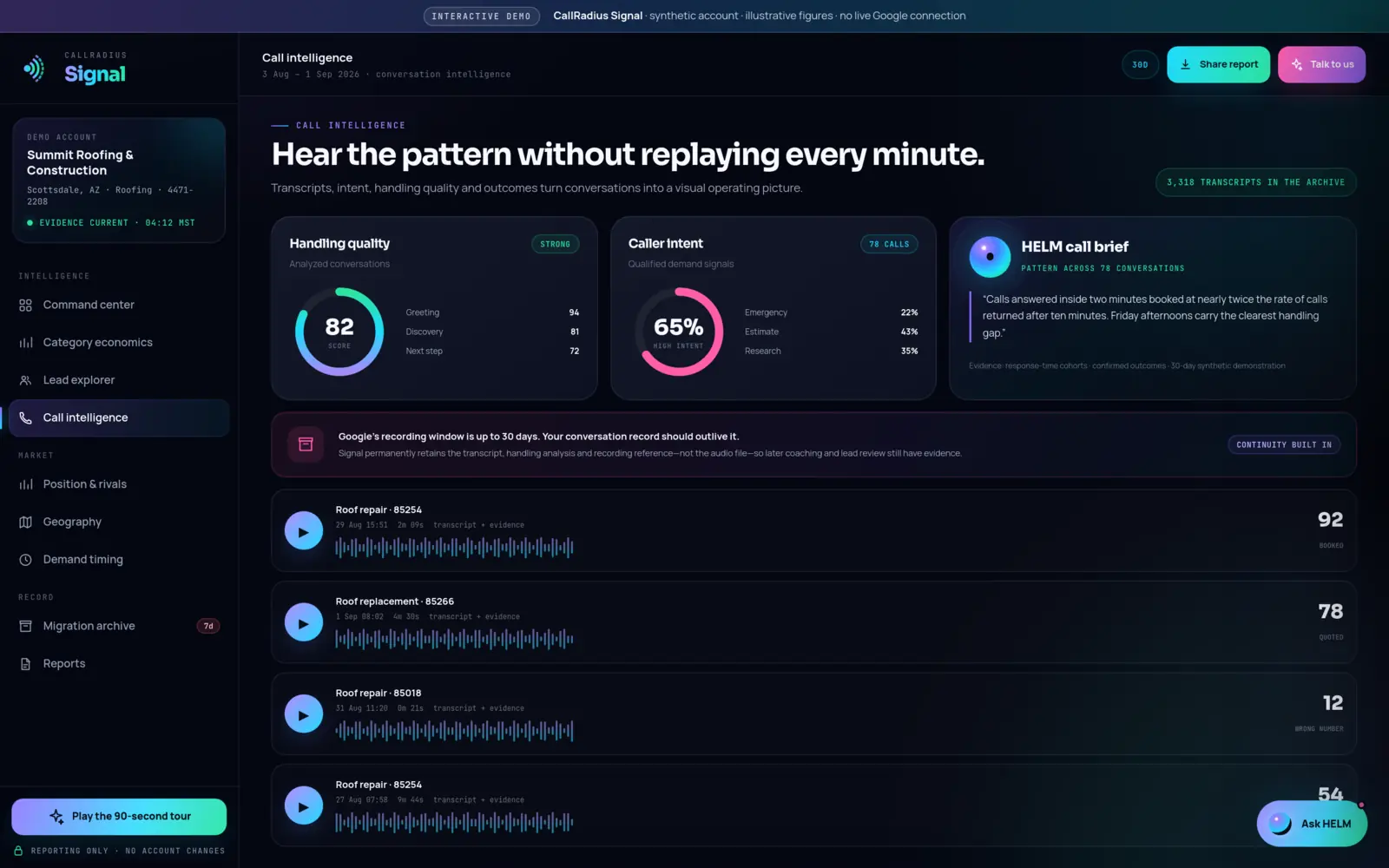
- It turns your Local Services calls into transcripts, a handling quality score, a caller intent mix and a HELM call brief.
- Handling quality looks at three moments in a call: the greeting, discovery and the next step.
- Signal keeps the transcript, handling analysis and recording reference, not the audio file, so your record outlasts Google's recording window.
- Use it to coach from specifics and to fix schedules, not to grade a person on a single call.
Most owners never replay their calls. There isn't time. Call intelligence in CallRadius Signal reads the conversations for you, so you can see the pattern without replaying every minute.
What call intelligence is
Call intelligence is one of the features that separates Signal Pro from the $29 Signal plan. Pro is $79 a month per connected Local Services account and includes unlimited HELM, call intelligence and rival tracking. If you're deciding between the two, CallRadius Signal plans, explained walks through the differences.
Like everything in Signal, it's read-only. Signal reads and archives your account data. It cannot change bids, budgets, campaigns or settings, and it does not touch how your calls are routed or answered. Enrollment is opening soon, and the live demo shows the full screen today with a fictional roofing company.
The four parts of the screen
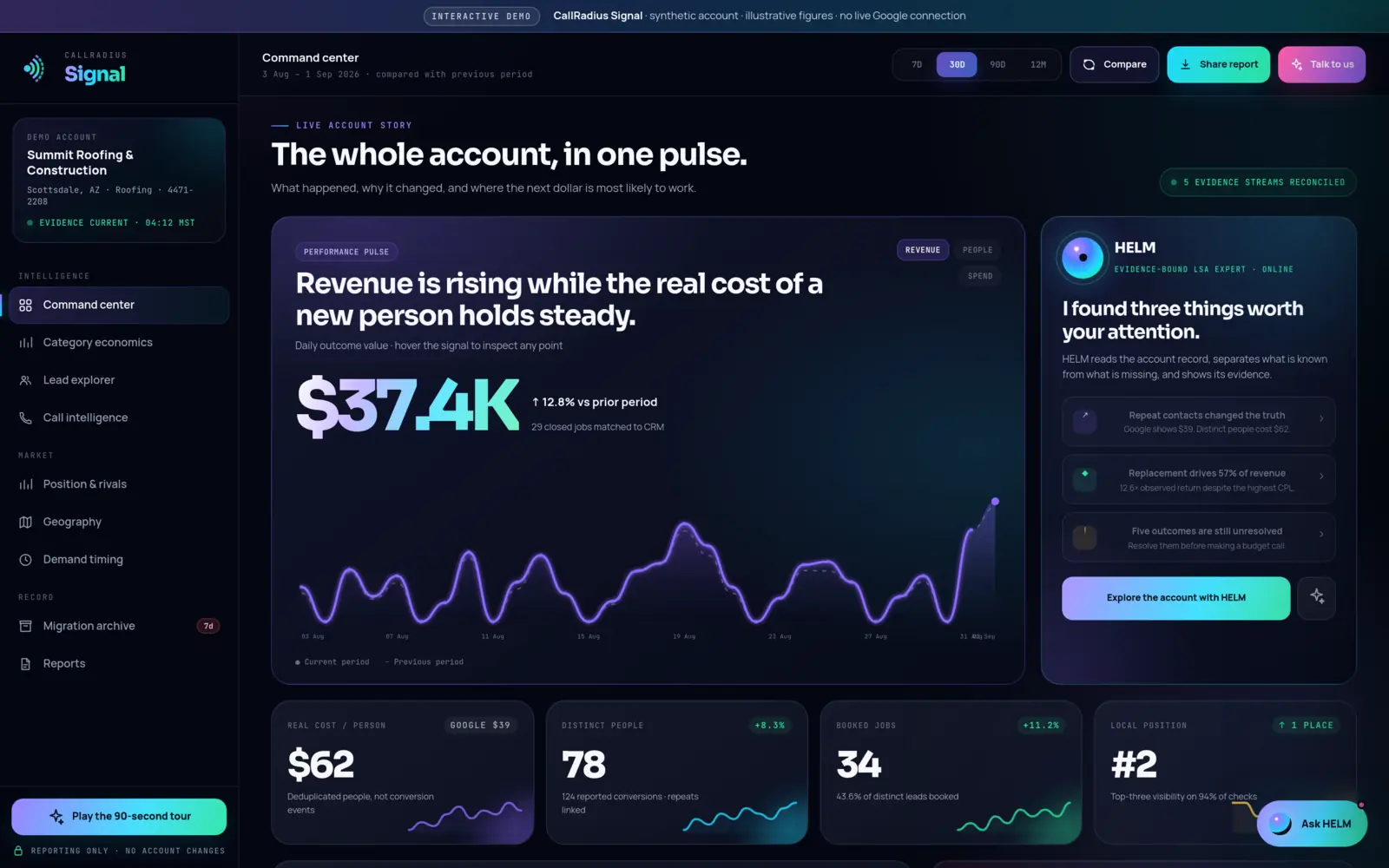
The figures below come from the public demo. Summit Roofing & Construction is fictional, and every number is synthetic.
| Part | What it shows | In the demo |
|---|---|---|
| Transcripts | The text of each conversation, kept as a record you can return to. | 3,318 transcripts in the archive |
| Handling quality | An overall score for analyzed conversations, broken into greeting, discovery and next step. | 82 overall: greeting 94, discovery 81, next step 72 |
| Caller intent | The share of calls by what the caller wanted. | 78 calls: emergency 22%, estimate 43%, research 35%, with 65% labeled high intent |
| HELM call brief | A pattern HELM found across the conversations, with the evidence it used named underneath. | A brief across 78 conversations |
Handling quality: greeting, discovery, next step
A service call has three moments that decide whether it turns into work. Signal scores each one separately, which is more useful than a single number because each points to a different fix.
Greeting
The first seconds of the call. Did the caller reach someone who answered clearly and made it obvious they'd called the right business?
Discovery
The questions in the middle. Did the person on the phone find out what the problem is, where the job is and how urgent it feels?
Next step
How the call ends. Is there an appointment, a promised callback time or a clear reason the job isn't a fit?
In the demo account, the greeting scores 94 and the next step scores 72. One way to read a pattern like that: the phones are answered well, but too many calls end without a firm next step. That's a coaching topic, and a specific one.
Caller intent: emergency, estimate, research
Not every call is the same kind of opportunity, and judging them all by one booking rate hides that.
- Emergency callers need help now. Speed of answer matters most, and a missed call often means a call to the next company.
- Estimate callers are ready to have someone look at the job. The win is a scheduled visit.
- Research callers are still learning. A research call that ends with good information and permission to follow up is a fair result, even without a booking.
The intent mix is most useful next to your service categories. If one category brings mostly research calls, its booking rate will look weaker for reasons that have nothing to do with your team. Category economics, explained covers how to read cost and return by category.
The HELM call brief
The brief is HELM's summary of a pattern across many calls. In the demo, it reads:
Calls answered inside two minutes booked at nearly twice the rate of calls returned after ten minutes. Friday afternoons carry the clearest handling gap.
Underneath, the demo names its evidence: response-time cohorts, confirmed outcomes and a 30-day synthetic demonstration. That brief is scripted from the demo's synthetic evidence, and the business is fictional, so treat it as an example of the kind of finding to look for, not as a benchmark for your trade.
Two things to keep in mind when you read a brief on your own account. First, a pattern between groups of calls is not proof that one thing caused another. Calls returned late may also be different kinds of calls. Second, the brief is strongest when the outcomes behind it are confirmed. If bookings aren't recorded, the comparison has less to work with. Slow responses also tend to produce repeat calls from the same person, which is one reason Google's cost per lead can look lower than the real cost per person.
What Signal keeps, and for how long
The demo states that Google's recording window is up to 30 days. It also notes that its Google retention statements are based on Google's published documentation as reviewed on 2 September 2026, so check Google's current documentation for your account.
Signal does not store the audio file. It permanently retains three things:
- The transcript of the conversation.
- The handling analysis: the scores and intent attached to it.
- The recording reference, which identifies the original recording.
Because the audio isn't stored, plan on the transcript and analysis being your record once Google's window has passed. That's usually enough for what matters later: coaching, reviewing a disputed lead or comparing this season with last.
Transcripts can include personal information about your customers. Under the Signal agreement, you remain responsible for your obligations to them, and CallRadius acts as your processor for that data. If you want your data deleted, you can ask, subject to any records we're legally required to keep. Your data, read-only access and the archive covers the rest.
Using it for coaching
Call intelligence earns its keep when it changes what happens on the next call. A simple monthly routine:
- Pick one stage. Start with the lowest of greeting, discovery and next step. One focus a month is plenty.
- Pull three transcripts. One strong, one weak, one typical, all from the same stage and ideally the same service.
- Review them together. Sit down with the person who took the calls and look for words worth reusing, not mistakes to count.
- Check the schedule as well as the script. If the brief points at a time of week, as the demo's points at Friday afternoons, the fix may be coverage rather than coaching.
- Recheck next month. Look at the same stage, measured the same way, and note what you changed and when.
Common questions
Is call intelligence included in the $29 Signal plan?
No. Call intelligence is part of Signal Pro at $79 a month, which also includes unlimited HELM and rival tracking. If you change plans during a paid billing period, the difference is prorated by our payment processor.
Does Signal store my call recordings?
No. Signal keeps the transcript, handling analysis and a recording reference. It does not store the audio file.
Can Signal change how my calls are answered or my ads?
No. Signal is read-only. It reads and archives your account data and cannot change bids, budgets, campaigns or settings.
Are the demo numbers typical for a roofing company?
No. Summit Roofing & Construction is fictional, and its figures are synthetic. They show how the screen works, not what your account should look like.
What if I want managed help acting on what the calls show?
That's CallRadius, the managed service, where call grading is one of eight engines and an experienced LSA manager owns the strategy.
Questions about anything in this guide? Talk to a person. We answer every message.