








- HELM answers from your account evidence, so the more specific the question, the more useful the answer.
- Name the period, the measure and the decision you're facing. "Should I cut budget?" gets better with a reason and a timeframe.
- Resolve unmatched outcomes before asking about return. HELM will flag them first anyway.
- On the $29 Signal plan you have five questions a month, plus one deep review per complete data window. Plan them.
- Unlimited HELM is a $14 add-on, and it's included in Signal Pro at $79.
HELM reads your account record before it answers. That makes it different from a general chatbot, and it changes what a good question looks like. This guide covers how to ask in CallRadius Signal so the answer helps you decide something. If you haven't read it yet, HELM: what it does and won't do explains how it reasons.
Start from the demo's prompts
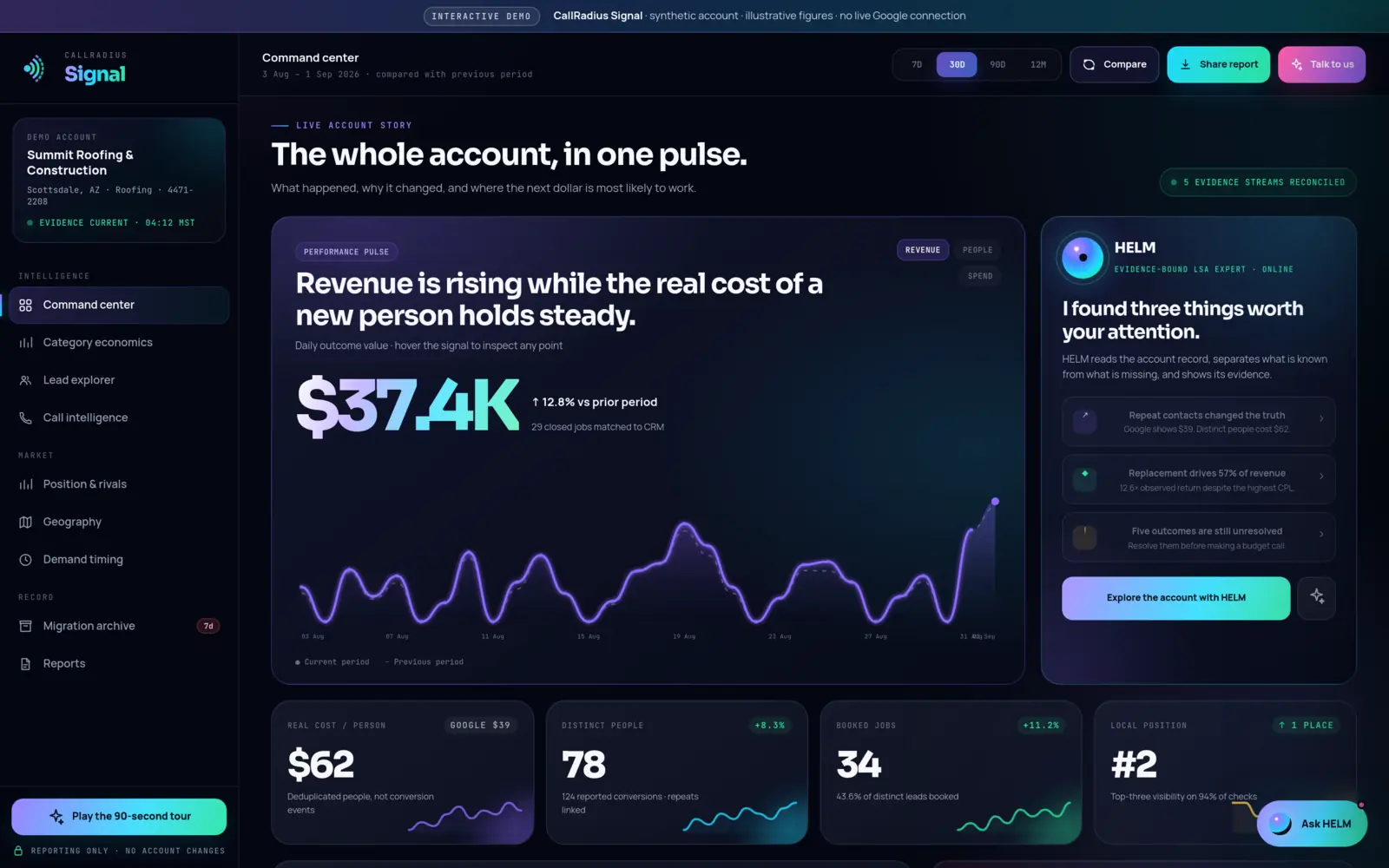
The CallRadius Signal demo offers four starter prompts. They're a good map of what HELM is for:
- Explain the CPL gap. Why the cost per lead Google reports differs from the real cost per distinct person.
- Should I cut budget? A decision question, answered against outcomes rather than lead counts.
- Best category. Which service category creates the most observed value.
- Migration impact. What a change to Google's reporting means for your history.
Each one ties to a decision or a number you can check. That's the pattern to copy. In the demo, the account is a fictional roofing company, every figure is synthetic, and HELM's answers are scripted from that synthetic evidence. No live account or model is queried.
What makes a question useful
A useful question usually has three parts:
- A period. "Last 30 days", "since I added the new service area", "this August compared with last August".
- A measure. Cost per distinct person, booking rate, cost per booked job, matched revenue. Not just "performance".
- A decision. What you're actually trying to choose: raise budget, drop a category, change hours, leave things alone.
| Vague | Better |
|---|---|
| How are my ads doing? | How did my cost per distinct person and booked jobs change over the last 30 days compared with the previous 30? |
| Is roof repair good? | Over the last 90 days, how does roof repair compare with roof replacement on cost per booked job and matched revenue? |
| Why is my CPL weird? | Why is my real cost per person higher than Google's reported cost per lead this month, and which categories have the most repeat contacts? |
| Should I spend more? | If I want more booked replacement jobs, does the evidence support raising budget, or is something else limiting bookings? |
| What's wrong with Fridays? | Is the Friday afternoon response gap linked to a lower booking rate, and how many leads is that based on? |
Asking how many leads a finding rests on is always fair. HELM shows its evidence, and the size of that evidence tells you how much weight a finding can carry.
How to frame budget questions
Budget is where a vague question costs real money. Before you ask, decide:
- What you're trying to protect or grow. Booked jobs, a particular category, a particular area or overall return.
- What you'd do with the answer. If no answer would change your plan, save the question.
- Which number you trust. Ask in terms of distinct people or booked jobs, not raw conversion events. Google says $39. The real number is $62. explains why.
Then ask it as a decision: "Given my last 30 days, should I raise, hold or cut budget for roof replacement, and what evidence would change your answer?" That last clause is worth adding to any budget question. It tells you what to watch next.
Resolve unmatched outcomes first
HELM flags unmatched outcomes before answering anything that depends on return. In the demo, it says: "I also found five booked outcomes that are not yet matched to revenue. I will show that gap before answering any question that depends on return." The demo's report preview ends the same way: "Resolve five unmatched outcomes before changing budget."
So before you spend a question on budget or which category pays, close the gaps you can. Signal works from Google's data together with figures you enter yourself, such as what a job was worth. Recording those values first means HELM's answer rests on more of your real results and less on what's missing. We go deeper on matching revenue from lead to job in a separate article.
Making five questions count
On the $29 Signal plan, HELM includes one deep review per complete data window and five questions per month. A simple way to use them:
- Read the deep review first. Let it set the agenda, and don't spend a question on something it already covered.
- Clean up outcomes. Record job values for booked work before any return question.
- Ask one "why". The biggest surprise in your numbers this month.
- Ask one decision. Usually budget or a category, framed with a period, a measure and a decision.
- Keep one or two in reserve. Something unexpected, like a sudden drop in position or a migration notice, deserves a question when it happens.
Write your questions down before asking. If you find yourself running out every month, the $14 Unlimited HELM add-on removes the limits, and Signal Pro at $79 includes unlimited HELM along with call intelligence and rival tracking. CallRadius Signal plans, explained compares them.
Questions HELM can't answer well
- Anything outside the record. HELM reads your account evidence and the figures you enter. It can tell you when evidence is missing; it can't invent it.
- Guarantees. "If I double budget, how many jobs will I get?" has no guaranteed answer. Ask what the evidence supports instead.
- Requests to make changes. On Signal, HELM recommends. It can't act on your account.
Common questions
Can I try HELM before signing up?
Yes, in the public demo. Its answers are scripted from synthetic evidence for a fictional business, so they show how HELM reasons, not what it would say about your account.
Why did HELM mention unmatched outcomes when I asked about something else?
Because the question depended on return. HELM shows the outcome gap before answering anything that depends on it.
What's the difference between the deep review and a question?
The deep review is HELM's review of your account for a complete data window. Questions are the things you ask it directly. The $29 plan includes one deep review per complete data window and five questions per month.
Does asking HELM change anything in my Google account?
No. Signal is read-only and cannot change bids, budgets, campaigns or settings.
Questions about anything in this guide? Talk to a person. We answer every message.