







- One observation pass asks 10 buying questions of 3 AI providers (ChatGPT, Claude and Perplexity): 30 intended observations.
- The proposed Report plan includes one pass a month. The proposed Pro plan includes three passes spread through the month, or 90 intended observations.
- Rates are calculated against retained, web-enabled answers. An unavailable answer is excluded, never counted as a "no".
- Brand mentions and URL citations are separate measures, and the method stays the same month to month.
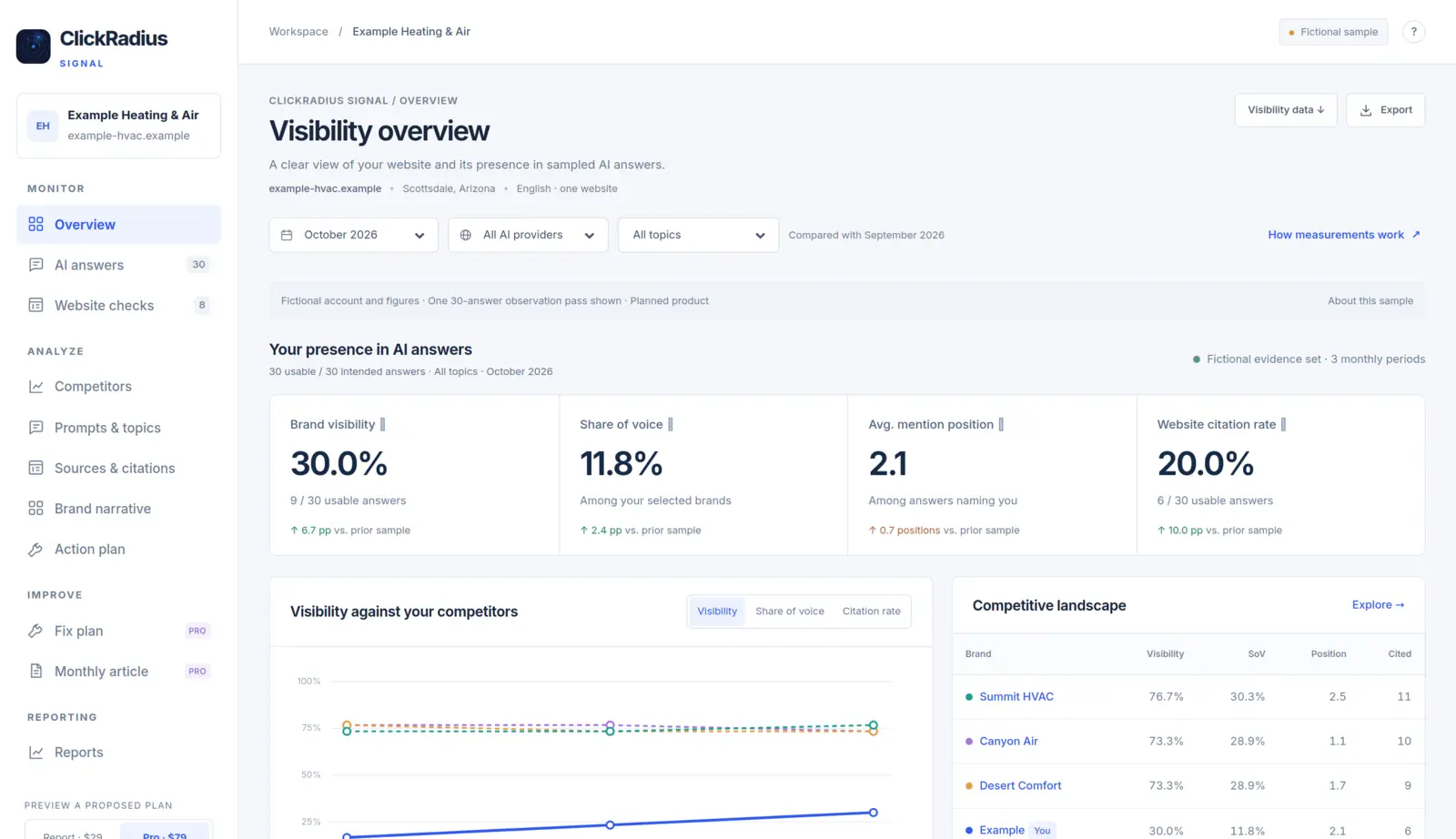
ClickRadius Signal is a planned product for 2027, and its prices are proposed (prices and delivery still require a paid pilot). This guide explains how its measurement is designed to work, using the public demo. The demo's business, Example Heating & Air, is fictional, and every answer and figure in it is synthetic.
The observation pass
The basic unit of measurement is an observation pass. In each pass, the same set of tracked buying questions is put to the same AI providers.
- 10 buying questions. Questions a potential customer would naturally ask before they know your name, grouped by topic. The demo's HVAC topics include AC repair, emergency service, heating, maintenance and replacement cost.
- 3 providers. ChatGPT, Claude and Perplexity.
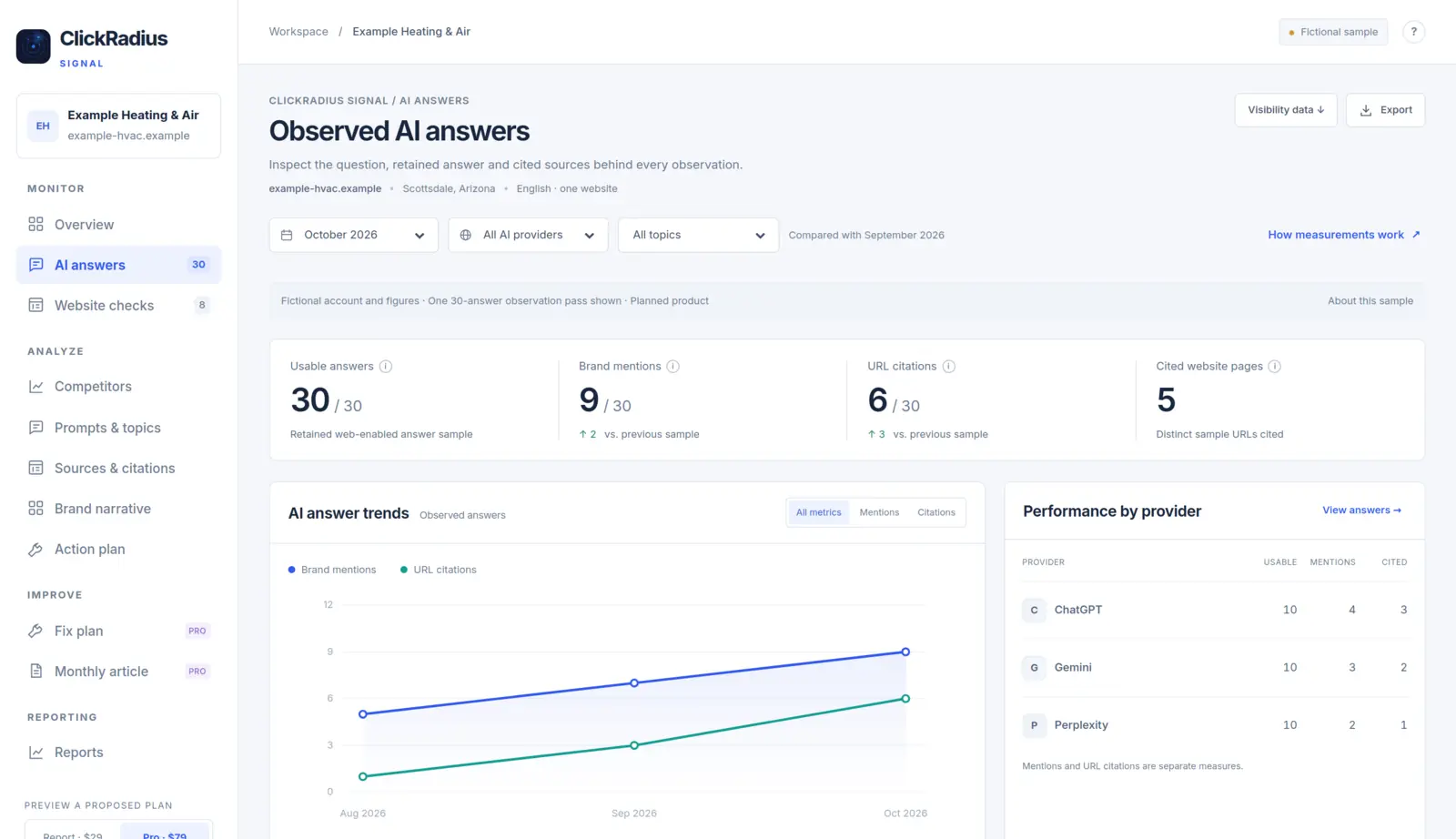
- 30 intended observations. Ten questions times three providers. The demo shows one row per intended observation.
For each observation, the demo records whether the answer named the business (a brand mention), whether it cited a page on the business's website (a URL citation) and which sources it relied on. You can click any question to read the answer and its sources.
What gets counted, and against what
Every rate needs a denominator, and this is where AI measurement most often goes wrong. ClickRadius Signal's demo states its rule plainly: the denominator is "the retained, web-enabled answers in the selected provider sample."
- Retained answers are kept with the observation, so you can open one and read what it said.
- Web-enabled answers are the ones produced with the provider's web search, the kind that can cite a page.
- Usable answers are the retained answers that count. The demo reports them next to the intended number, for example "30 usable out of 30 intended".
Unavailable answers are excluded
Sometimes a provider doesn't return a usable answer. ClickRadius Signal is designed to exclude that observation from the denominator and to say so. In the demo's words: "A provider without a usable answer is excluded from the denominator. It is never scored as a negative answer." The answers table even has an "Unavailable" filter, and a "Preview a provider outage" control that demonstrates the rule.
We cover the reasoning in more depth in Mentioned, cited or missing, and the wider principle in our evidence standard.
An unavailable answer is a gap in the sample, not a verdict on your business.
Mentions and URL citations stay separate
The demo defines the two measures this way:
| Measure | What it counts |
|---|---|
| Brand mentions | Usable answers naming the business |
| URL citations | Usable answers citing a page on its website |
An answer can do one, both or neither. The performance-by-provider table shows usable answers, mentions and citations for each provider, with the note "Mentions and URL citations are separate measures." Keeping them apart tells you whether the work ahead is about being known, being linked, or both.
The answers table can be filtered to all observations, URL cited, brand mentioned, brand not mentioned or unavailable, and sorted by question, by provider or with cited answers on top. That makes it quick to find, say, every Claude answer that didn't name you.
Consistency from month to month
A trend is only meaningful if the method holds still. The demo's trend chart is labeled "Monthly observation passes · Consistent questions and provider method". In practice that means:
- The same buying questions each month, so you compare like with like.
- The same providers, asked the same way.
- A record of each period kept in reporting history, with its readiness, brand mentions, URL citations and usable answers.
The demo also lets you add a buying question, which joins a pending queue. It is careful about what that means: "Adding a question does not invent answers or imply a provider request ran." A new question has no history until it has been observed.
Why one pass is a snapshot
AI answers vary. Ask the same question twice and you can get a different list of businesses. So a single pass tells you what the answers looked like at that moment, not what they will always say.
- Look at direction over several months rather than reacting to one pass.
- Check competitors at the same time. If everyone moved, the provider may have changed, not your business.
- Write down the dates of your changes. The demo itself reminds you that "a change after an action does not by itself establish that the action caused it."
This is one reason the proposed Pro plan spreads three passes through the month: more observations of the same questions give a steadier picture than one. It doesn't remove variation, and no measurement can promise that AI answers will name you.
Exports
The demo's export panel offers three formats, and every file identifies the sample period and coverage:
| Export | What it contains in the demo |
|---|---|
| Observed answers (CSV) | The selected period and provider, with answer flags and source URLs |
| Complete report snapshot (JSON) | Readiness, retained observations, findings and scope |
| A clean report layout, saved through your browser's print dialog |
The CSV is handy if you keep your own spreadsheet from the 20-minute AI self-audit, because it uses the same building blocks: question, provider, mention, citation and sources.
Common questions
Why these three AI providers?
The ClickRadius Signal demo observes ChatGPT, Claude and Perplexity. Managed ClickRadius monitors a wider set, adding Gemini and Grok, with weekly checks.
What happens if a provider is down during a pass?
Those observations are marked unavailable and excluded from the denominator. Your rates are calculated against the answers that were actually retained, and the usable count is shown next to the intended count.
Does a mention mean I got a lead?
No. The demo says it directly: "Mentions are not visits, leads or revenue." Connecting answers to business results needs website analytics and customer records, which the demo does not have.
Can I try this before ClickRadius Signal launches?
You can explore the demo, run the method by hand with the self-audit, or join the early-access list on the Signal page. Terms like these are explained in the glossary.
Questions about anything in this guide? Talk to a person. We answer every message.