







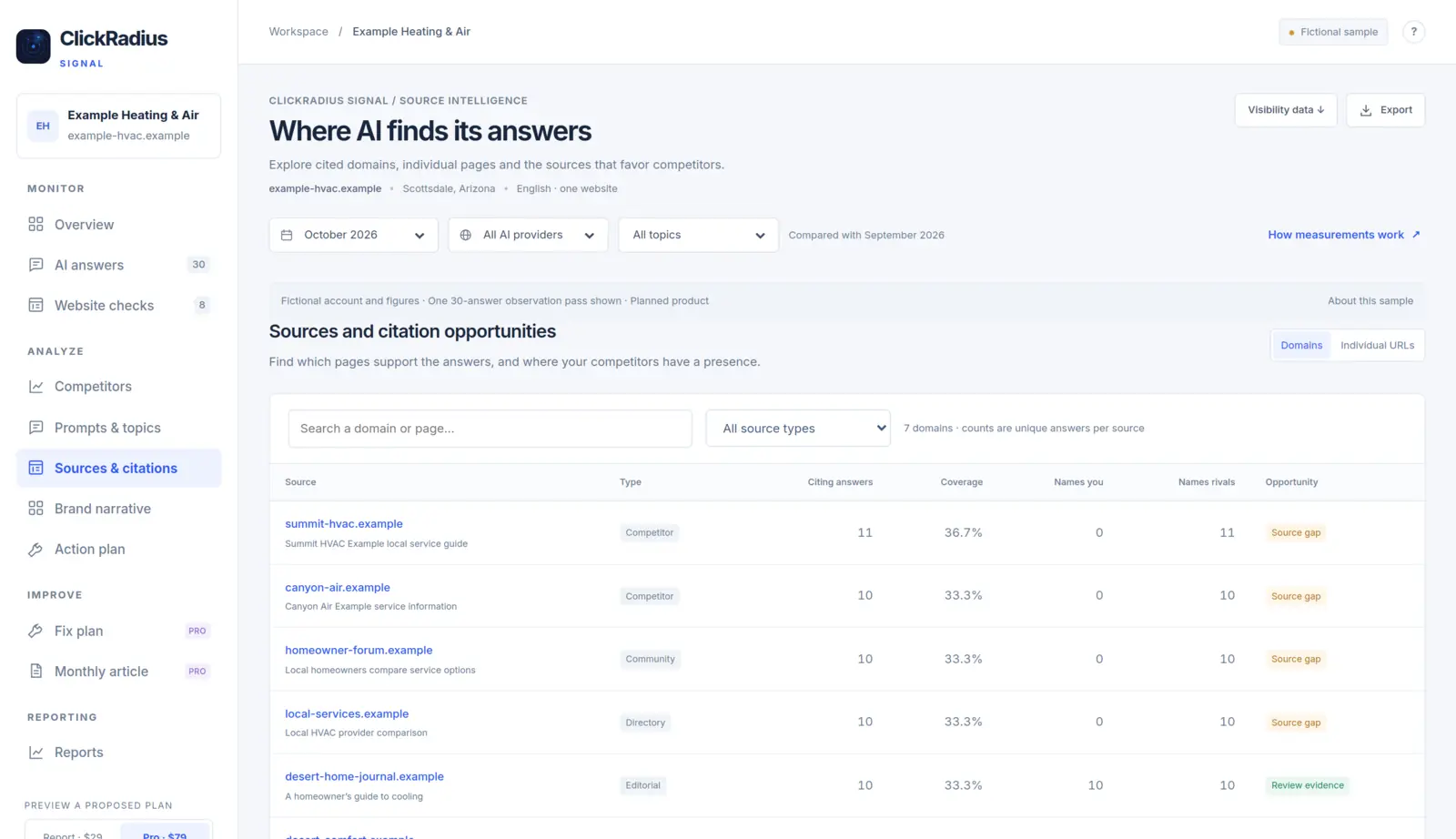
- The sources view shows which websites the observed AI answers cite, grouped into five types: your website, competitor websites, directories, editorial and communities.
- A domain counts at most once per answer, so one site with many links can't inflate its share.
- Competitor source gaps point to places where rivals are present in the evidence and you aren't.
- Brand narrative shows how your business is described. Flagged claims go to human review, and sentiment is separate from whether you were mentioned.
ClickRadius Signal is a planned product for 2027, at proposed prices that still require a paid pilot. This guide describes the sources and brand narrative views in the public demo. Its business, Example Heating & Air, and every competitor, source page and figure in it are fictional. The demo notes that its example source pages and their classifications are "authored fixtures", written for the sample.
Why sources matter
An AI answer that recommends local businesses usually draws on other websites: business listings, articles, community discussions and the businesses' own pages. Those sources shape who gets named and how they're described.
So when a competitor keeps appearing and you don't, the most useful question is often "what are the answers reading?" The sources view is built to answer it. Its heading puts it simply: "Find which pages support the answers, and where your competitors have a presence."
Five source types
The demo classifies each cited source into one of five types, and you can filter by any of them.
| Source type | What it means |
|---|---|
| Your website | Pages on your own domain |
| Competitor websites | Pages on a tracked competitor's own domain |
| Directories | Listing and comparison sites for local providers |
| Editorial | Articles and guides published by others |
| Communities | Forums and discussion sites where people compare options |
You can view the list by domain or switch to individual URLs to see exactly which pages were cited.
How sources are counted
Each row in the table shows a source with its type, the number of citing answers, its coverage, whether it names you, whether it names rivals, and an opportunity note. Two counting rules keep the numbers honest.
- A domain counts at most once per answer. If one answer links to five pages on the same directory, that directory still counts as one citing answer. Otherwise a single site with many links would look more important than it is.
- Coverage and mentions are different measures. Coverage is about how many answers cite a source. Whether that source names you or names your rivals is a separate question, shown in its own columns. The demo says it directly: "Citation coverage and mentions within a source are different measures."
For how the underlying answers are gathered, see how ClickRadius Signal measures AI answers. For the difference between being named and being linked, see Mentioned, cited or missing.
Competitor source gaps
A competitor source gap is a cited source that names your rivals but not you. The demo's fictional source list flags opportunities across several source types. Each type calls for a different response, and some call for none.
Acting on a gap honestly
- Read the source first. Open the cited page and see why it names your competitors. Is it a list of local providers, a comparison, a news story or a customer discussion?
- Directories: if it's a listing site relevant to your trade and you belong there, create or complete your listing with accurate information that matches your website.
- Editorial: you can't write yourself into someone else's article. What you can do is make your own site a clear, useful resource that a writer could reference, and tell relevant local publications when you have something genuinely newsworthy.
- Communities: take part as yourself, openly, where it's appropriate. Don't post fake recommendations or reviews. Beyond being wrong, it tends to damage trust when discovered.
- Competitor websites: you can't change their pages, but they show what kind of content the answers found useful. If they answer a buyer's question you don't, that's a page you may want to write.
Your brand narrative
The brand narrative view looks at what the answers say about you, not just whether they name you. Its heading: "See the language around your mentions and inspect claims that need context."
Start with the source of truth
The view begins with the business facts on file, the reference point for checking what answers say. The demo shows why this matters. Its fictional business serves Scottsdale, but no appointment hours, prices or credentials were supplied, so the demo notes that an answer "cannot confirm those facts from this sample." If you don't state a fact clearly anywhere, nobody can check an answer against it.
Claims to review
When an answer makes a claim that needs context, such as a detail your business facts don't confirm, it can be flagged in the "Claims to review" table with the claim, the provider, a status and the evidence. The demo labels this "Human review": a person reads the exact answer and decides what, if anything, needs correcting at its source.
Sentiment is separate
The demo is careful here: "Sentiment is an interpretation of language, separate from whether the business was mentioned." A warm description and a mention are two different things. Keep them apart when you read your results.
If you don't state a fact clearly, no answer can be checked against it.
Common questions
Should I try to get listed on every source that cites my competitors?
No. Read each one first. Some are a good fit for your business, some aren't, and fake or low-quality listings help nobody.
Can ClickRadius Signal get me into an editorial article?
No. It shows you where answers find their information. Earning a place in someone else's publication is up to you and that publication.
What should I do if an answer states something wrong about my business?
Correct the fact where it lives: your website, your listings and your profiles. Our 20-minute AI self-audit walks through this by hand.
Is there a managed option for this work?
Yes. Managed ClickRadius includes entity building on sources like Wikidata, Google Business Profile, Apple Maps, Data Axle and Yelp, alongside citation monitoring.
Questions about anything in this guide? Talk to a person. We answer every message.