







- Write ten questions your customers really ask before they hire someone like you.
- Ask each one in ChatGPT, Gemini and Perplexity, the same way every time.
- Record five things per answer: mention, citation, position, competitors and sources.
- Ask about yourself directly and correct any wrong facts at their source.
- Repeat on a schedule with the same questions, or the comparison means nothing.
You don't need a tool to find out what AI assistants say about your business. You need a list of questions, a simple sheet and twenty minutes of focus. Here's the method we'd use if we were doing it by hand.
Step 1: Write ten buying questions
Write the questions a real customer asks before they know your name. Mix the kinds of questions people ask at different moments:
- Urgent: "Who can fix a burst pipe tonight in Mesa?"
- Best-of: "Who's the best roofer in Scottsdale for storm damage?"
- Cost: "How much does a new AC unit cost in Phoenix?"
- Comparison: "Is it better to repair or replace a 15-year-old water heater?"
- Trust: "Which electricians near me are licensed and insured?"
Include your city or area in most of them, and keep your own business name out of all but one. You're testing whether AI finds you, not whether it recognizes you when prompted.
Step 2: Ask each assistant the same way
Consistency is what makes the results worth anything.
- Start a fresh conversation for each question so earlier answers don't steer later ones.
- Use the exact same wording in every assistant.
- Where an assistant offers web search, use it, since that's how most people now get local answers.
- Write down the date. Answers change over time.
Step 3: Record five things per answer
Set up a sheet with one row per question and assistant (ten questions times three assistants is thirty rows) and these columns:
| Column | What to record |
|---|---|
| Mentioned? | Yes or no: did the answer name your business? |
| Cited? | Did it link to your website? If so, which page? |
| Position | If named, were you first, second, third…? |
| Competitors | Which other businesses were named? |
| Sources | Which websites did the answer link to or rely on? |
If an assistant fails to answer, mark it "unavailable" rather than "no". Then calculate your rates against the answers you actually received. We explain why in Mentioned, cited or missing.
Step 4: Ask about yourself directly
Now ask each assistant: "What do you know about [your business name] in [your city]?" Then check every fact in the answer.
- Are your hours, service area and services right?
- Does it describe your credentials correctly, or make claims you can't support?
- Does it confuse you with another business with a similar name?
When something's wrong, don't argue with the chatbot. Fix the source: your Google Business Profile, your own website and the main directories in your trade. AI answers tend to repeat what the web says, so correct information in the right places is what eventually changes the answer.
Step 5: Read the sources
Look down your "Sources" column. Which websites keep appearing? Usually it's a mix of directories, review sites, local news, trade associations and competitors' own pages. Those are the places AI assistants are learning about your market from.
For each source that keeps appearing, ask two questions. Are we listed there, and is our information complete and accurate? Do our competitors have something there that we don't?
Step 6: Turn it into three fixes
Resist the urge to fix everything. Pick three things, based on what you found:
- One fact fix, correcting the most important wrong or missing information at its source.
- One page fix: a page on your site that directly answers a question where competitors appeared and you didn't.
- One presence fix: a listing or profile on a source that kept appearing in answers.
Write down the date you make each change. Then run the same audit next month and compare.
Doing it every month
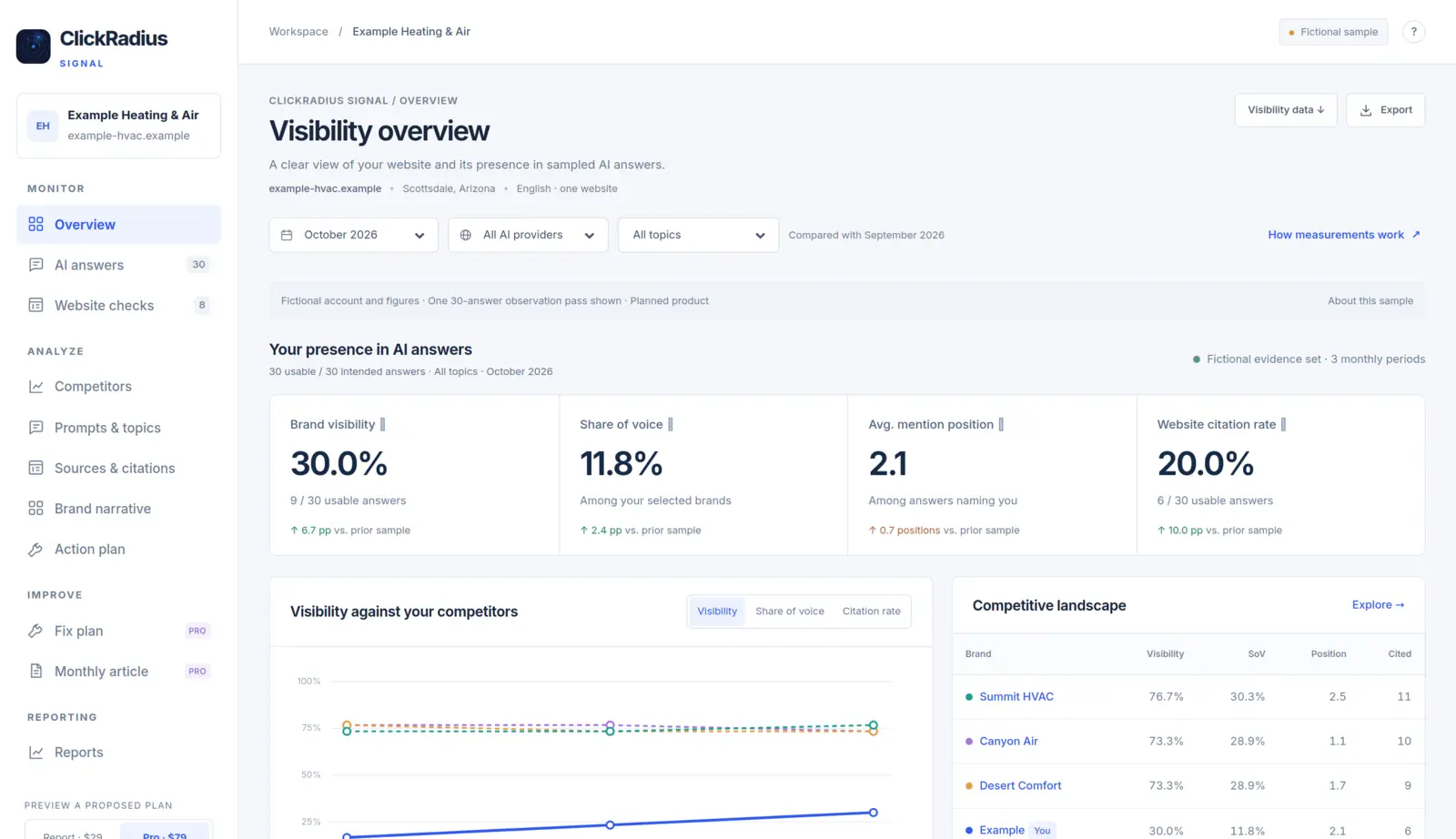
The audit is easy once. Doing it every month, with the same questions, the same method and an honest denominator, is where most people stop. That's exactly the work ClickRadius Signal is designed to take over: the observation passes, competitor comparison and source analysis, with prepared fixes on the Pro plan. If you'd rather have the fixes deployed for you, that's ClickRadius.
Either way, the free AI Readiness Score is a good companion to this audit. It checks your website side while you check the answer side.
Questions about anything in this article? Talk to a person. We answer every message.