







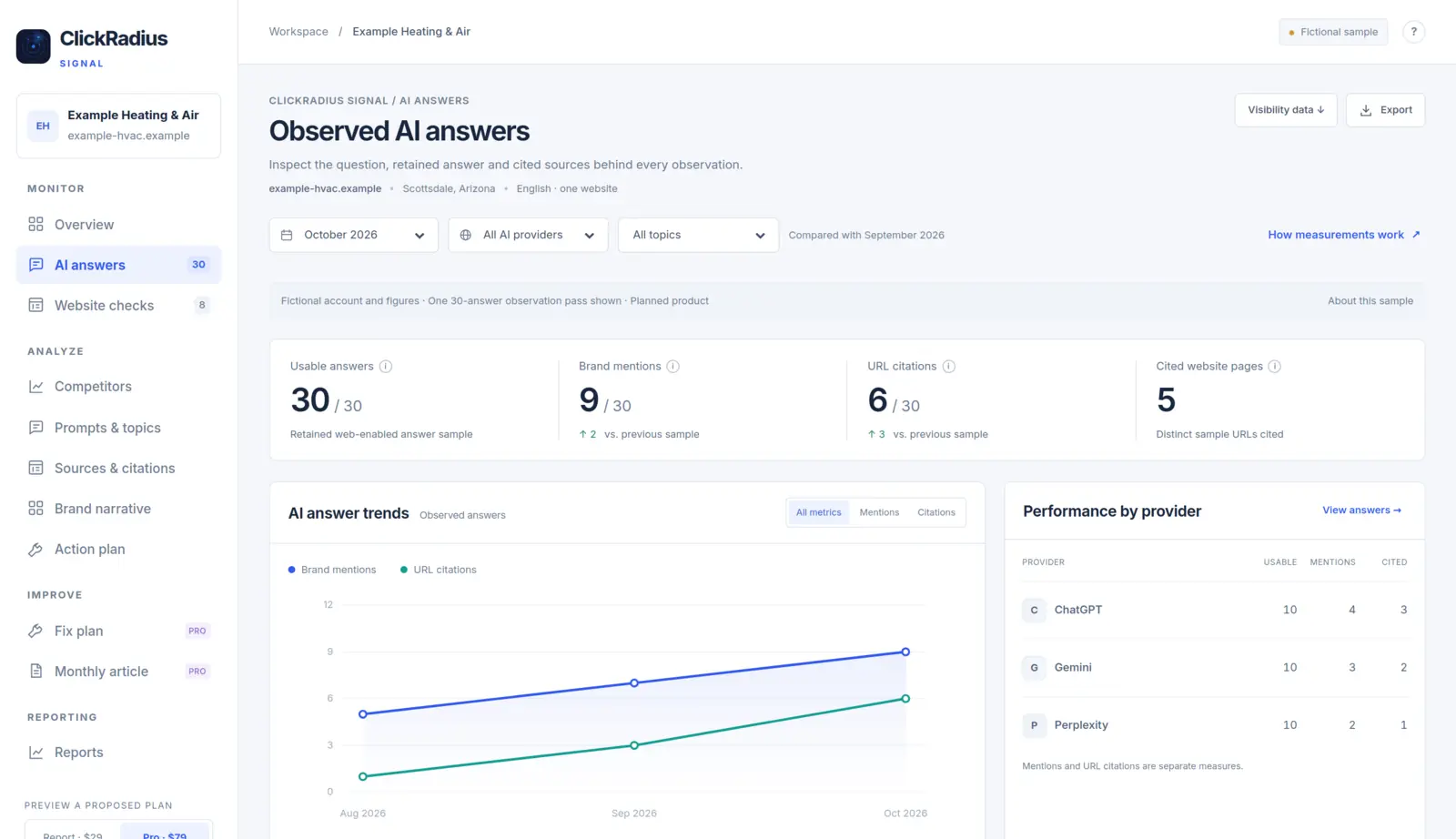
- A mention is an answer that names your business. A citation is an answer that links to a page on your website. They're different results.
- Count against usable answers. An answer that failed to load isn't a "no".
- Share of voice depends on which competitors you compare against. Change the set and the number changes.
- "Position" in an AI answer is the order of mention, not a Google ranking.
Four possible outcomes
Ask an AI assistant "who should I call for AC repair in Scottsdale?" and, for any one business, the answer lands in one of four places.
| Outcome | What it usually means | What tends to help |
|---|---|---|
| Mentioned and cited | The answer recommends you and links to your site as a source. | Keep the cited pages accurate and current. |
| Mentioned, not cited | The AI knows you, but relied on other sources such as directories, reviews or articles. | Make your own pages clear and specific enough to be worth citing. |
| Cited, not mentioned | Your page informed the answer, but the answer didn't recommend you by name. | Connect your helpful content clearly to your business and service area. |
| Neither | You're absent from this answer. | Find out who is present and which sources the answer trusted. |
Why mentions and citations shouldn't be blended
A mention works like word of mouth: the person hears your name. A citation is a path to your website, and it tells you which page an AI trusted enough to use. They respond to different work, so a single blended "visibility" number hides which one is moving.
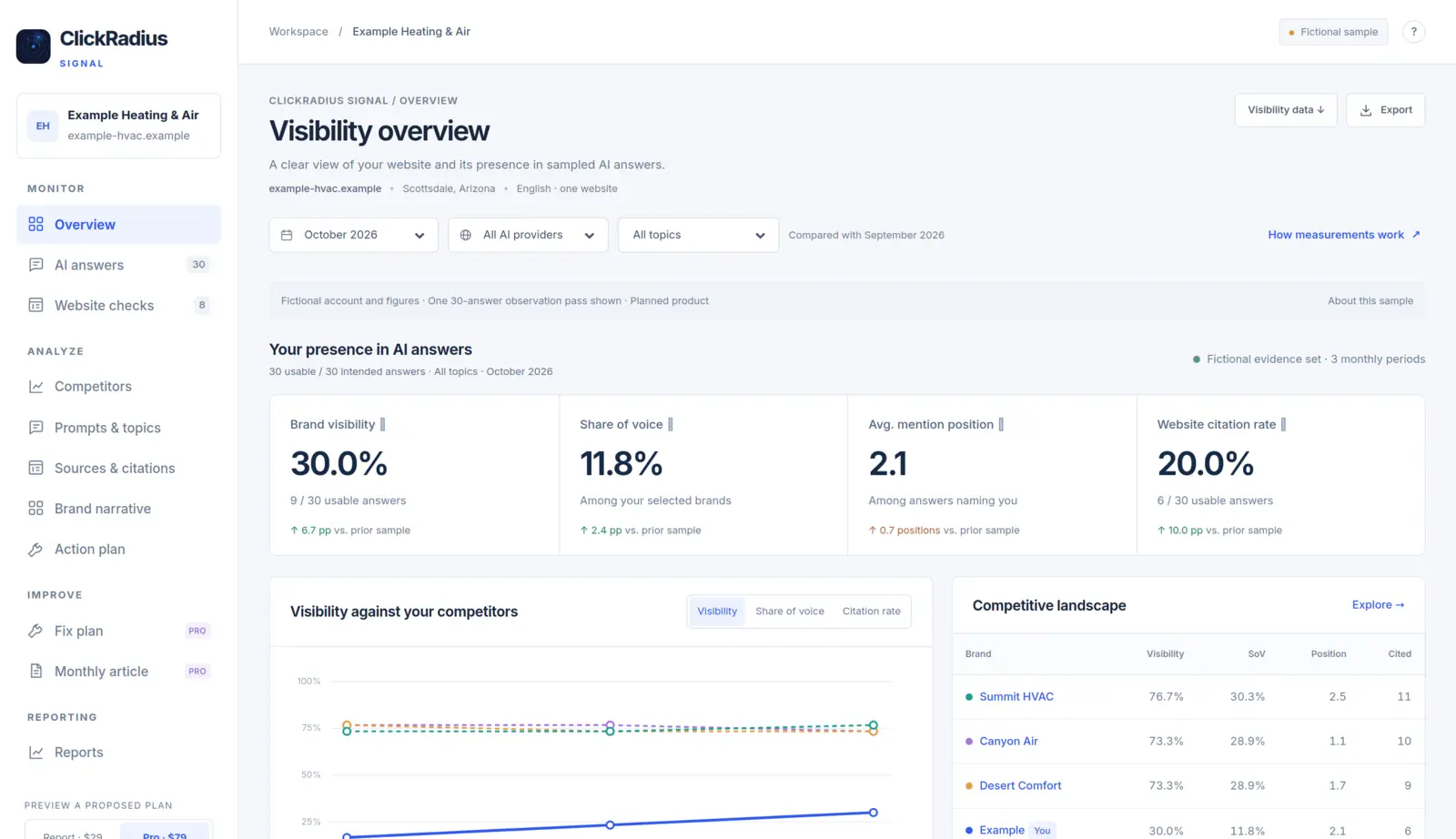
In the ClickRadius Signal sample workspace, the fictional Example Heating & Air was named in 9 of 30 usable answers, a brand visibility of 30%. A page on its website was cited in 6 of 30, a citation rate of 20%. Reported separately, those numbers point to different next steps. Blended, they'd point to nothing in particular.
Get the denominator right
AI providers sometimes fail to answer. A request times out, a provider is down, or an answer comes back without web results. If you count that as "not mentioned", you understate yourself. If you quietly drop it without saying so, nobody can tell how big the sample really was.
The fix is simple: report usable answers out of intended answers, and calculate rates against the usable ones. "9 of 30 usable answers, from 30 intended" is a number you can trust and compare. ClickRadius Signal is designed this way: a provider without a usable answer is excluded from the denominator and is never scored as a negative.
A failed answer isn't a "no". It's a gap, and it should be reported as one.
Share of voice is relative
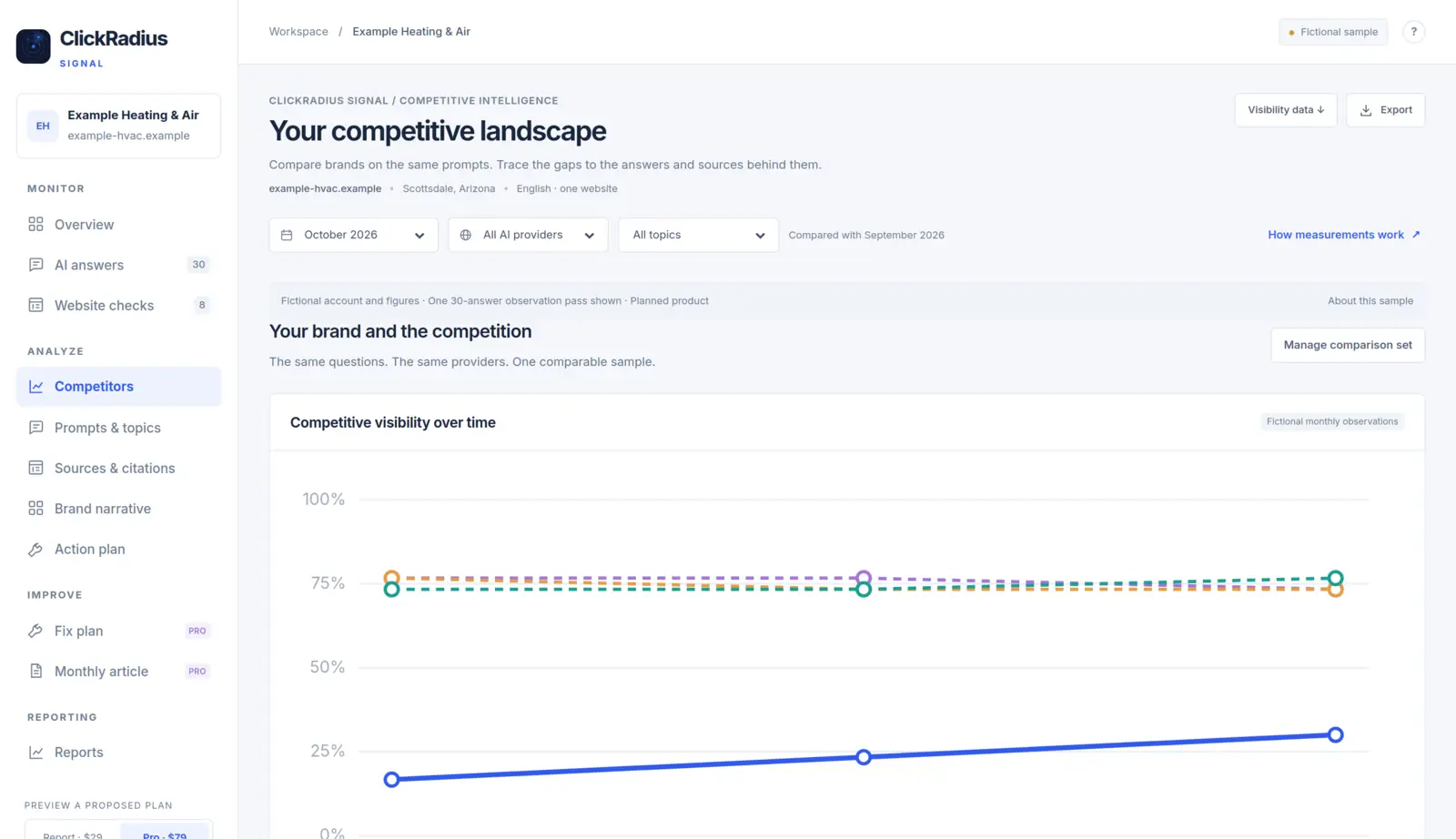
Share of voice is your mentions divided by the mentions of every business in your comparison set. In the sample workspace, Example Heating & Air holds 11.8% share of voice among its selected competitors, while the three fictional rivals each hold roughly 29 to 30%.
That number depends entirely on who's in the set. Add a large national brand and your share falls even though nothing about your business changed. Remove a competitor and it rises for no reason. So:
- Choose competitors your customers actually compare you with.
- Keep the set fixed from month to month.
- When you do change it, note the date so a jump isn't mistaken for progress.
Position isn't rank
When an answer names several businesses, the order matters a little. An average mention position of 2.1 means that, in answers that mention you, you're usually the second business named. It is not a Google ranking or a Maps position, and it only covers the answers where you appear. A business mentioned once, first, can have a better average position than one mentioned ten times, second.
One question, asked once, tells you very little
AI answers vary. Ask the same question twice and you may get a different list. That's normal, and it's why measurement needs structure:
- A fixed set of buying questions, written the way customers actually ask.
- The same providers every time.
- A regular schedule, so you're comparing like with like.
That's the shape of a ClickRadius Signal observation pass: 10 buying questions asked of 3 providers, or 30 answers. The proposed Pro plan runs three passes spread through the month for 90 intended observations, which smooths out some of that natural variation.
What to do with the results
Start by checking it yourself. Our 20-minute AI self-audit walks you through the same method by hand. Then read why website readiness isn't visibility before you decide what to fix.
If you'd rather have the fixes done for you, that's what ClickRadius does. If you'd rather see the evidence and act on it yourself, that's ClickRadius Signal.
Questions about anything in this article? Talk to a person. We answer every message.