







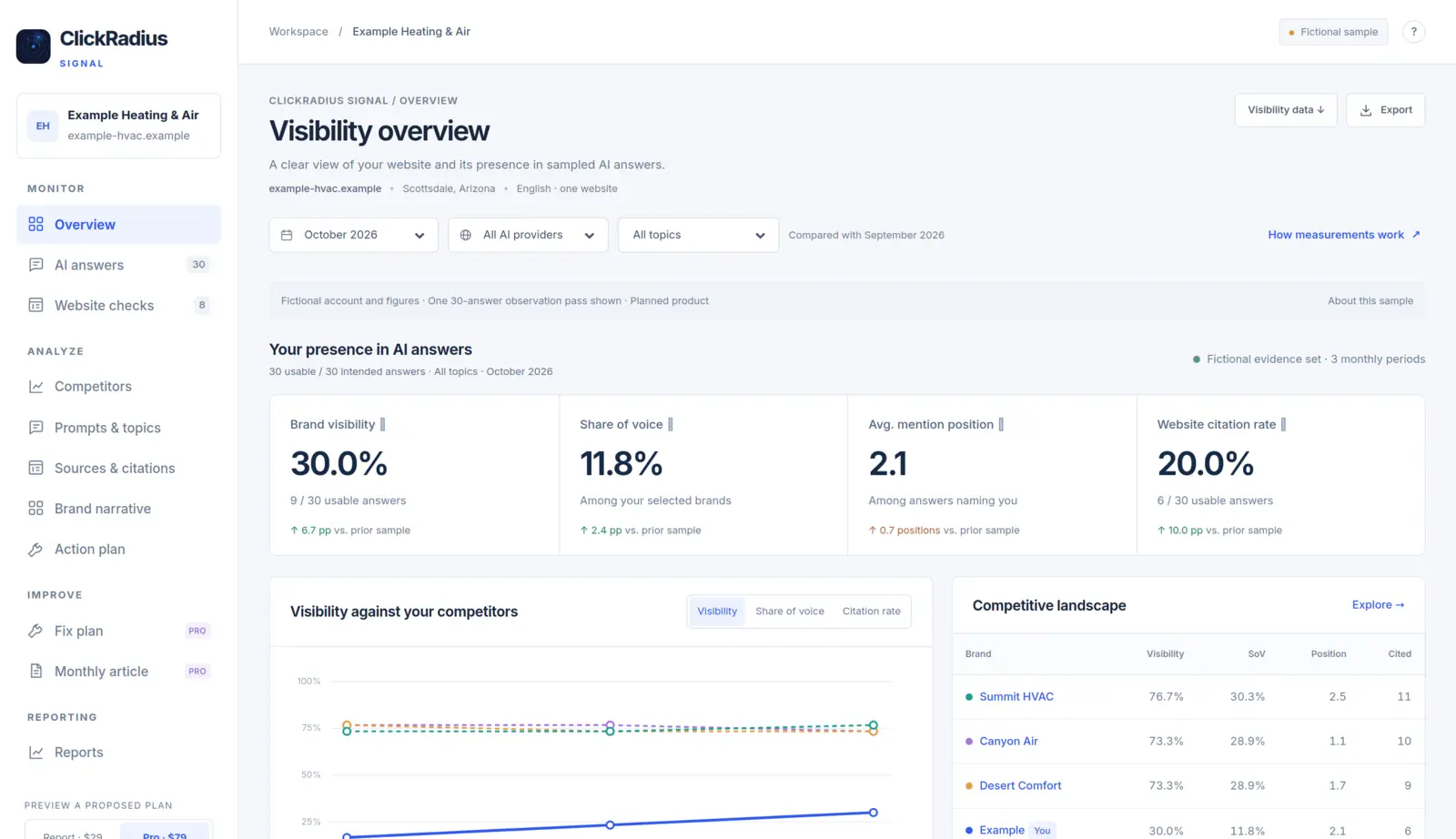


- Share of voice is your mentions as a share of all mentions in a comparison set. Change the set and the number changes, even when the answers don't.
- In our hypothetical example, identical answers produce anywhere from 14% to 29% share of voice.
- Choose a fixed, named set of the competitors your customers actually weigh you against.
- Keep it the same month to month. When you must change it, record the date and start a new series.
- Report visibility alongside share of voice. Visibility doesn't depend on the set.
A number that depends on a choice
Share of voice sounds like a fact about the market. It's really a ratio, and one side of that ratio is a list you choose.
The usual definition, and the one we use below, is your brand's mentions divided by the total mentions of every brand in your comparison set, yourself included. The ClickRadius Signal sample workspace puts it plainly on its competitors screen: "Share of voice changes with your comparison set." Its "Compare tracked brands" control keeps your own brand in the comparison and lets you select which competitors go into the share-of-voice denominator.
That's honest design. It also means the number is only as meaningful as the list behind it. We introduced the idea briefly in Mentioned, cited or missing. Here's what it looks like in numbers.
A worked example (hypothetical)
Imagine an HVAC company we'll call Your Business. One month, its tracked buying questions produce 60 usable AI answers. Your Business is named in 20 of them. Three local competitors, A, B and C, are named in 30, 25 and 25. Answers often name several businesses, so these overlap.
Now calculate share of voice four ways, without changing a single answer:
| Comparison set | Total mentions in set | Your share of voice |
|---|---|---|
| You + A + B + C | 20 + 30 + 25 + 25 = 100 | 20/100 = 20% |
| Add a national brand named in 40 answers | 100 + 40 = 140 | 20/140 = about 14% |
| Drop competitor A | 20 + 25 + 25 = 70 | 20/70 = about 29% |
| Swap A for a smaller rival named in 10 | 20 + 10 + 25 + 25 = 80 | 20/80 = 25% |
Same answers. Same 20 mentions. Share of voice ranges from about 14% to about 29%, purely from the choice of competitors.
Meanwhile, one number stayed put: visibility. Your Business was named in 20 of 60 usable answers, about 33%, in every row. Visibility is measured against answers, not against other brands, so the comparison set can't move it.
If you change the competitors, you've changed the ruler, not the business.
The month-to-month trap
The last row of the table is the one that causes real damage. Suppose the owner in our example decides in month two that competitor A "isn't really a competitor" and swaps in a smaller rival. Share of voice goes from 20% to 25%. The monthly report shows five points of progress. An agency might present it as a win. Nothing about the business's presence in AI answers changed.
It works the other way too. Add a dominant brand halfway through the year and your share of voice drops sharply, which can look like a failing strategy when it's really a new denominator.
This is the same discipline that applies to any before-and-after comparison: the method has to stay fixed, or the change you see is a change in arithmetic. We cover that in Did that change work?
How to choose a comparison set
Choose the businesses your customers actually weigh you against, not the ones that make your number look good. Good places to look:
- Your own AI answers. Which businesses keep appearing when you ask your buying questions? A competitor column in the 20-minute AI self-audit gives you this list for free.
- Your Local Services rivals. The businesses that sit next to you at the top of Google can be the same ones customers compare you with elsewhere.
- Lost jobs. When a customer chooses someone else, who did they choose? Your office staff often know.
- Your service area. A competitor who doesn't serve your area doesn't belong in the set, however well known.
Then apply three rules:
- Name every business. "Top competitors" isn't a set. Three or four named businesses is. The ClickRadius Signal sample workspace uses three fictional rivals: Canyon Air, Desert Comfort and Summit HVAC.
- Include the uncomfortable one. If one brand dominates answers in your market, leaving it out flatters you. Include it, accept a lower number, and track whether it moves.
- Write it down with a date. The set is part of the method, and it belongs at the top of every report that shows share of voice.
When you have to change the set
Sometimes you should. A competitor closes or merges, a new one opens down the road, or you expand into a new area. When that happens:
- Record the date and the old and new lists.
- Start a new series. Don't draw one line across the change. If your tool keeps the underlying answers, recalculate earlier months with the new set so the history stays comparable. If it doesn't, show the two periods separately.
- Lean on visibility across the change. Because visibility doesn't depend on the set, it's the measure that carries over cleanly.
Read it alongside the other measures
Share of voice is useful for one question: compared with these specific competitors, how much of the conversation do I get? It isn't a measure of how often AI recommends you (that's visibility), whether answers link to your site (that's citation rate) or where you appear in the answer. Position in ClickRadius Signal is the order of mention within an answer, not a Google or Maps rank.
Report them together, each with its denominator, and the set named. That's the standard in How we label numbers, and it's how the competitors screen in the ClickRadius Signal sample workspace is laid out. ClickRadius Signal is planned for 2027, at proposed prices that still require a paid pilot. The method is explained in Competitors and share of voice, and you can check your own website today with the free AI Readiness Score.
Questions about anything in this article? Talk to a person. We answer every message.