







- The competitors view compares your business with the competitors you choose, on the same questions, the same providers and the same sample.
- Four measures per brand: visibility, share of voice, average position and citing answers.
- Share of voice changes with your comparison set. Your own brand always stays in it.
- Average position is the order of mention within an answer, not a Google or Maps rank.
- The "competitors appear, you don't" view shows the questions where you're missing and rivals aren't.
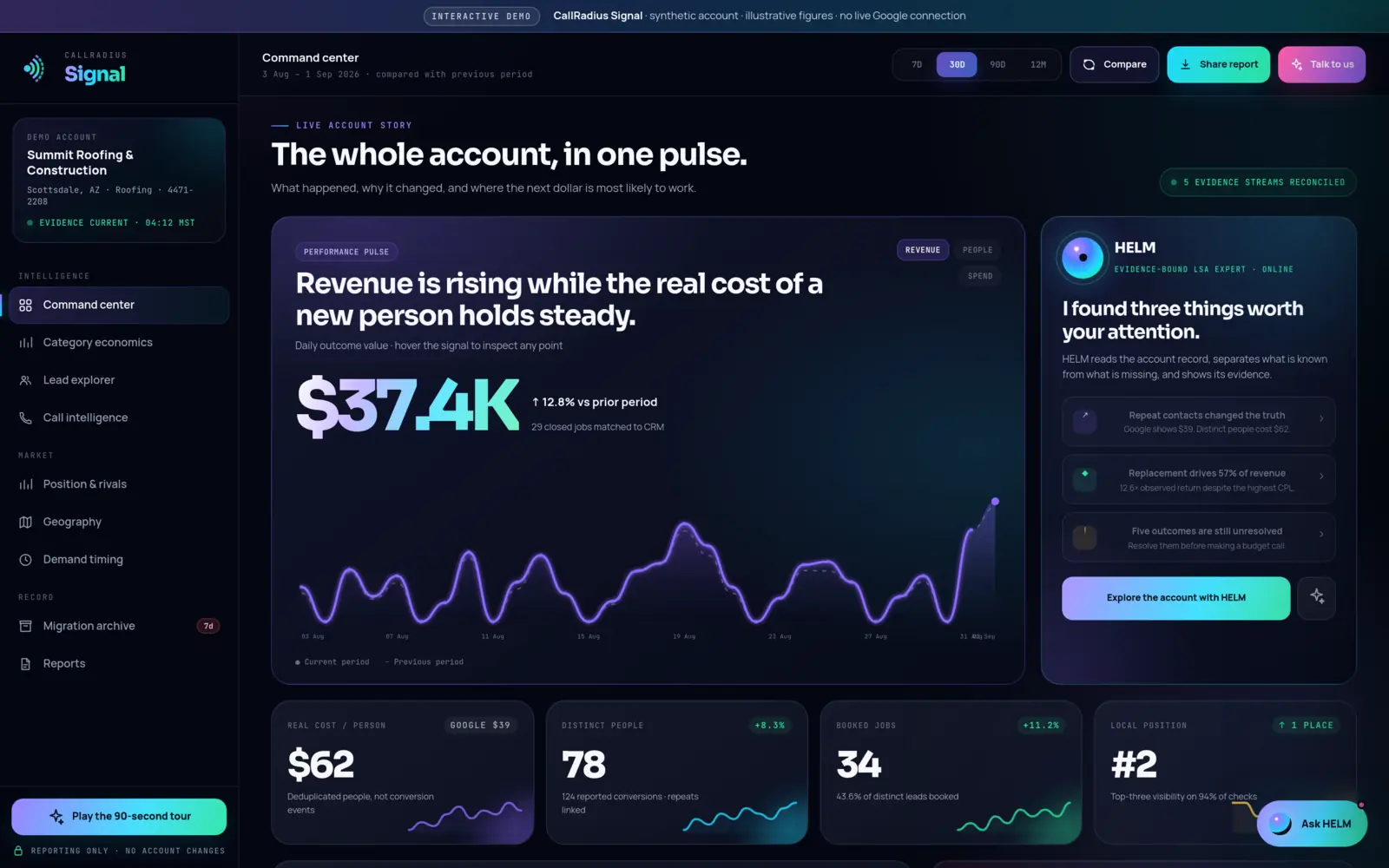
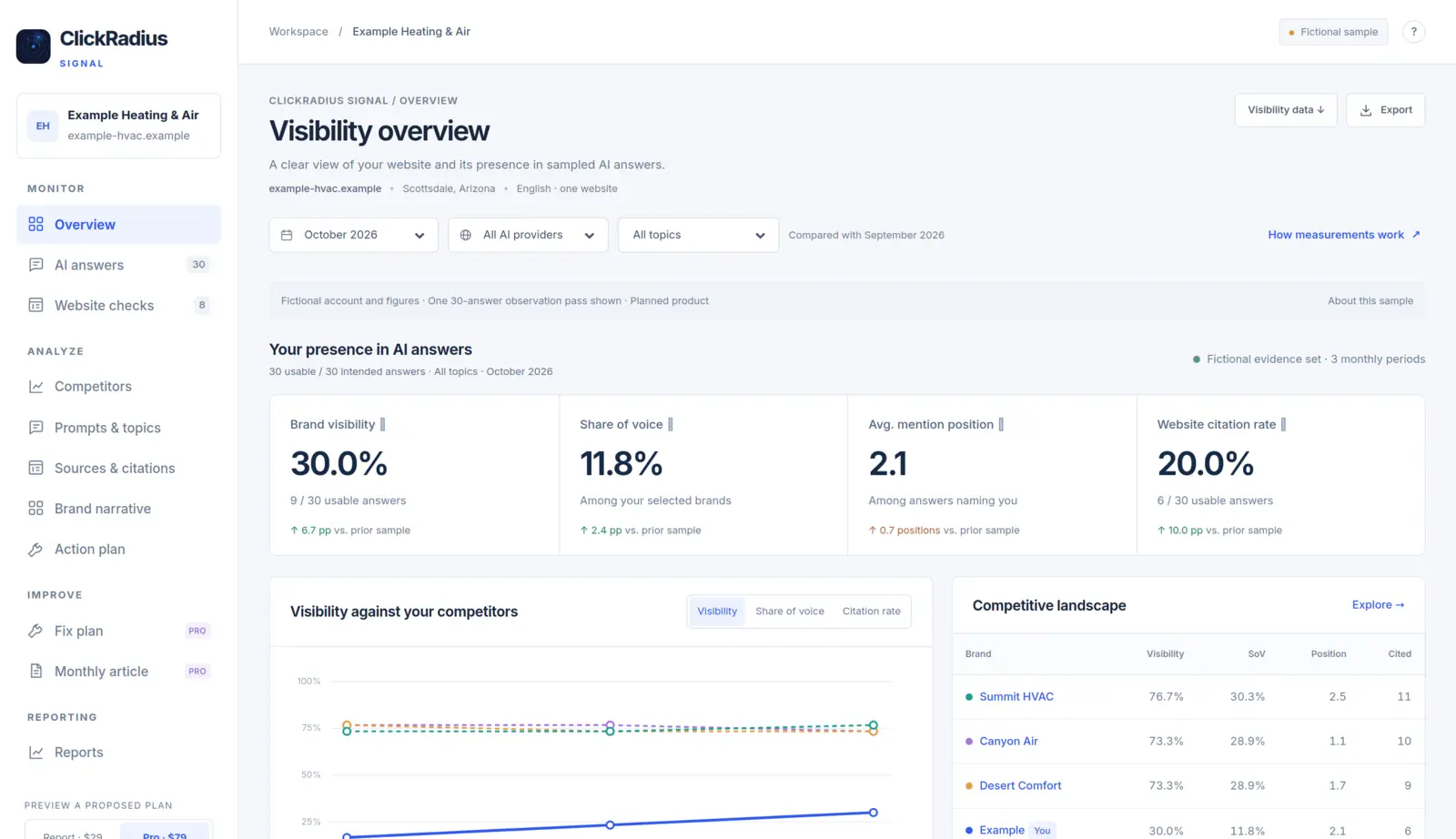
ClickRadius Signal is a planned product for 2027, at proposed prices that still require a paid pilot. Everything below is described from the public demo. Its business, Example Heating & Air, is fictional, and so are its competitors: Canyon Air, Desert Comfort and Summit HVAC. Every figure is synthetic.
One comparable sample
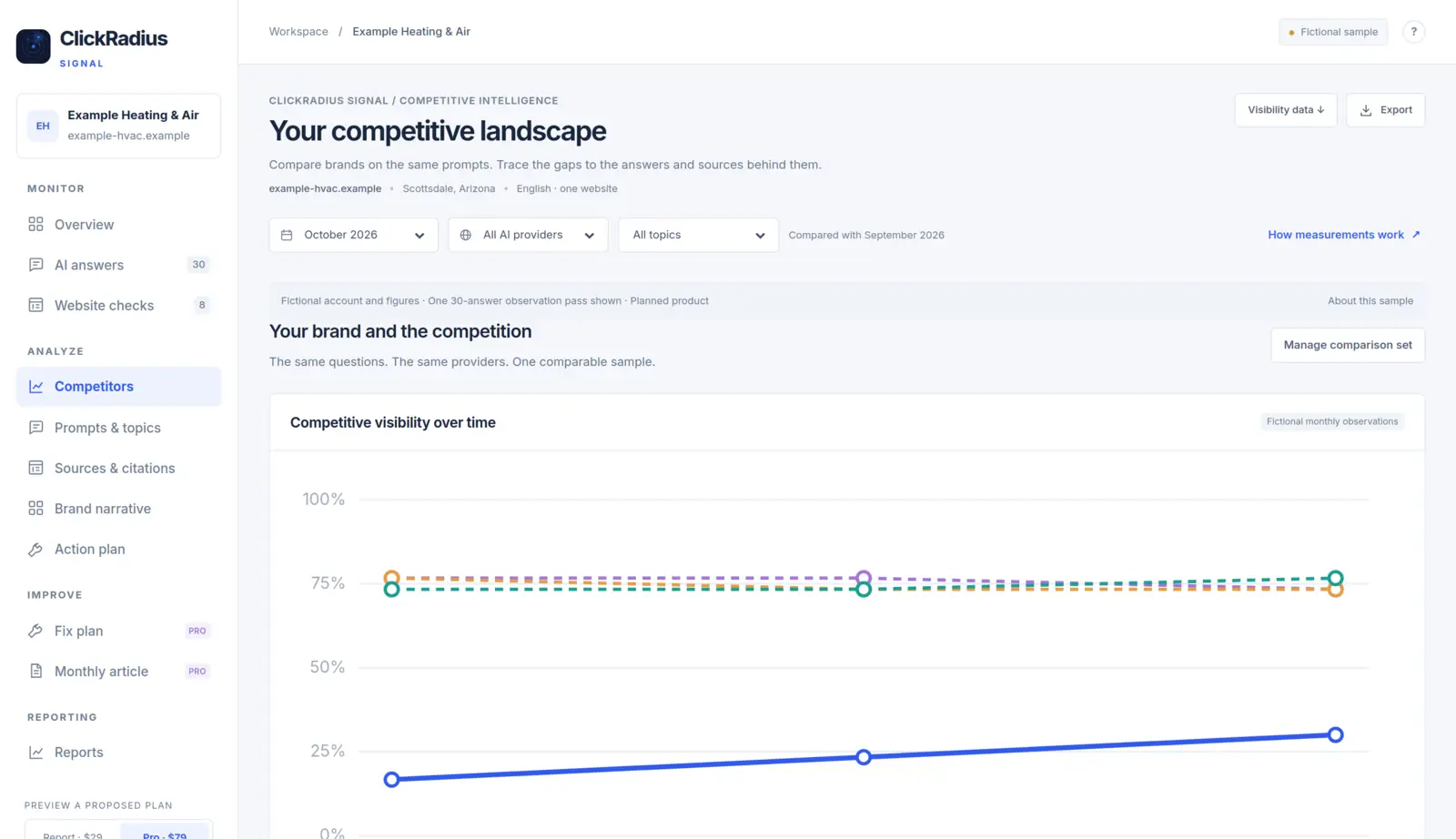
The competitors page opens with a promise about method: "The same questions. The same providers. One comparable sample." Your business and each tracked competitor are measured from the same set of observed answers. Nobody gets a separate, friendlier set of questions.
That's what makes the comparison fair. If you were measured on "AC repair" questions and a competitor on "furnace installation" questions, the numbers would describe the questions, not the businesses. For how those answers are gathered, see how ClickRadius Signal measures AI answers.
The four measures
The brand performance table shows each tracked brand with four measures. Select a brand to read the answers that name it.
| Measure | What it tells you | Watch out for |
|---|---|---|
| Visibility | How often a brand is named, as a share of usable answers | Unavailable answers are excluded, not counted against anyone |
| Share of voice | A brand's portion of all the mentions in your comparison set | It depends on which competitors you include |
| Average position | Where a brand tends to appear in the order of businesses named | Order of mention, not a Google or Maps rank |
| Citing answers | How many answers cite a page on that brand's website | Being cited and being named are separate results |
A chart of competitive visibility over time sits above the table, with one line per brand across the monthly observations. It answers the obvious question at a glance: is the gap between you and the leaders closing, holding or widening?
Reading average position correctly
When an answer names several businesses, they come in an order. Average position describes that order across the answers that name a brand. It only covers answers where the brand appears, so a business named once, early, can show a better average than one named often but later. The demo puts it plainly: "Position is order of mention within an answer, not a Google or Maps rank." We go further into this in Mentioned, cited or missing.
Managing the comparison set
The "Manage comparison set" control lets you choose which competitors are included. The demo explains what that choice does: you "select the fictional competitors to include in the share-of-voice denominator," and "your own brand stays in the comparison."
Because share of voice is a portion of the total, it moves whenever the set changes:
- Add a heavily mentioned brand and your share falls, even if your own mentions didn't change.
- Remove a strong competitor and your share rises, without anything improving.
- Visibility doesn't move when you change the set, because it's measured against usable answers, not against other brands.
Competitors appear, you don't
One of the most practical views in the demo, next to its tracked prompts, is titled "Competitors appear, you don't." It lists buying questions and topics where tracked competitors were named and your business wasn't, with visibility, a column for each provider (ChatGPT, Claude and Perplexity) and the evidence behind it.
This is where a vague feeling ("we never show up in AI") turns into a short, specific list. A good way to work through it:
- Open the evidence. Read the actual answer. Which businesses were named, and what did the answer say about them?
- Check the sources. Which websites did the answer rely on? The sources and citation opportunities guide explains how to read them.
- Compare with your website. Do you have a page that clearly answers this question? If not, that's a content gap.
- Pick one or two questions to work on, and record the date of any change.
A competitor gap is a question to investigate, not proof that the competitor did something you didn't.
What competitor numbers can't tell you
- Why a competitor is named. Answers reflect many sources. The evidence shows what was said, not the reason behind it.
- Whether they're getting more work. Mentions are not visits, leads or revenue, for you or for them.
- What will happen next month. Answers vary from pass to pass, so look at direction over several months.
If every brand rises or falls together in the same month, the change probably came from the provider, not from anyone's website. That's one reason the comparison is useful even when your own numbers look flat.
Common questions
Can I choose my own competitors?
In the demo, yes: the comparison set is managed from the competitors page, and your own brand stays included. The final plan details depend on the paid pilot.
Why did my share of voice change when nothing else did?
Most often because the comparison set changed. Check whether a competitor was added or removed before reading anything into the move.
Is a position of 1 the same as ranking first on Google?
No. It means being named earliest within the answers that name you. It has nothing to do with Google search or Maps rankings.
Where can I see this for real?
ClickRadius Signal isn't available yet. You can run the same comparison by hand with the 20-minute AI self-audit, or ask about managed ClickRadius, which tracks competitors as part of its citation monitoring.
Questions about anything in this guide? Talk to a person. We answer every message.