







- "AI search" means asking an assistant such as ChatGPT, Gemini, Perplexity or Microsoft Copilot, or reading Google's AI Overviews and AI Mode, and getting a written answer instead of a list of links.
- For questions about local businesses, these systems generally search the web, read what they find and write an answer that may link to its sources. Each provider documents this at a high level. None publishes exactly how it chooses which businesses to name.
- There's no rank to hold. An answer can mention you, cite your website, do both or do neither, and it can change the next time someone asks.
- You can control the inputs: accurate and consistent business facts, a clear website that crawlers can read, genuine reviews, and your presence on the sources answers cite.
- Nobody can guarantee you'll be named. Google and OpenAI both say so in their own documentation.
A homeowner whose air conditioning has stopped used to type "AC repair Scottsdale" into Google and scroll. Today she may ask ChatGPT "who can fix my AC today in Scottsdale?" and read a short answer that names three companies. If yours isn't one of them, you won't know she asked.
This guide explains how those answers come together, in plain English, using only what the AI providers say about their own products. When we use a term you haven't seen before, you'll find it in our glossary.
What "AI search" actually means
"AI search" is a loose name for several different products. What they share is that the person gets a written answer, often with links, rather than a page of ten blue links. These are the ones your customers are most likely to use, and what each provider documents about how it uses the web:
| Product | What its maker says about web results |
|---|---|
| ChatGPT search | OpenAI says ChatGPT can search the web for current information and links to relevant sources. It may search automatically when a question would benefit from current information, and answers may include citations and a Sources list. It can use an approximate location based on your IP address to find local results. |
| Google AI Overviews and AI Mode | Both are built into Google Search and show links to supporting websites. Google says both may use a "query fan-out" technique, issuing multiple related searches to build a response. AI Overviews appear only when Google's systems decide they add something to classic Search, and often don't appear at all. |
| Gemini | Google says Gemini apps may provide links to sources. When sources are available, a Sources button appears; when it doesn't, that response came without links. |
| Perplexity | Perplexity says its crawler, PerplexityBot, is designed to surface and link websites in its search results, and that it may visit a page while answering a question and include a link to that page in its response. |
| Microsoft Copilot | Microsoft says that when web search is enabled, Copilot can fetch information from the Bing search service, by turning the question into a short search query, to ground its response. |
How a local business ends up in an answer
None of the providers publishes its selection rules in detail. But their documentation describes the same broad pattern:
- The question is turned into searches. OpenAI says ChatGPT typically rewrites a question into one or more targeted queries, sometimes sent to partner search providers. Google describes AI Overviews and AI Mode issuing multiple related searches. Microsoft describes Copilot sending a short generated query to Bing.
- Location is added where it helps. OpenAI gives the example of "good restaurants near me" becoming a search for top restaurants in the city it estimates from your IP address.
- Pages are found and read. The results come from the provider's search systems and the pages their crawlers can reach. A page that can't be crawled, or that the provider's search can't find, isn't part of the material.
- An answer is written. The assistant summarizes what it found, often naming a few businesses.
- Sources may be shown. Each provider can show links to the pages behind the answer, though not every answer includes them.
The practical lesson: an AI answer about your trade is built from what the web says about your trade in your area. Your website is one input. Your Google Business Profile, directories, review sites, local news and competitors' pages are others.
Why it isn't the same as an SEO ranking
Classic search gives you a position. You're third in the map results or seventh in the organic links, and that position is fairly stable from one search to the next. AI answers work differently.
| Classic search results | AI answers | |
|---|---|---|
| What the person sees | A ranked list of links and a map | A written answer, usually naming a few businesses, sometimes with source links |
| What you can "have" | A position on the page | A mention, a citation, both or neither |
| Where the answer comes from | Mostly the ranked pages themselves | Several searches, read and summarized, often including other people's sites about you |
| Consistency | Fairly stable from search to search | Can change each time the same question is asked |
That doesn't make SEO irrelevant. Google says the same foundational SEO best practices apply to AI Overviews and AI Mode, and that there are no additional requirements, special optimizations or special schema.org markup needed to appear in them. To be eligible as a supporting link, a page must be indexed and eligible to show in Google Search with a snippet. Good fundamentals are the price of entry. They just aren't a guaranteed result.
Mentioned, cited or missing
Because there's no rank, you need different words for what happened. We use three:
- Mentioned: the answer names your business.
- Cited: the answer links to a page on your website as a source.
- Missing: neither.
The first two are different results that respond to different work, so they should be counted separately. And because answers vary, one question asked once tells you very little. We cover how to count them properly, including what to do when an assistant fails to answer, in Mentioned, cited or missing: how to read an AI answer about your business.
You can't own a position in an AI answer. You can own the facts it's built from.
What you can control
You can't control what an assistant writes. You can control most of what it reads. Four areas matter most for a local business.
1. Accurate, consistent business facts
Your name, address or service area, phone, hours, services and credentials should say the same thing everywhere. Google's own guidance for AI features lists "checking that your Merchant Center and Business Profile information is up-to-date" among the fundamentals, and its Business Profile help says businesses with complete and accurate information are more likely to show up in local results. We explain how to build one source of truth and keep every copy in line in Your business facts are infrastructure now.
2. A clear website that crawlers can read
- Let the right crawlers in. Google says to make sure crawling is allowed in robots.txt and by any CDN or hosting setup. OpenAI says a site must allow its OAI-SearchBot crawler, and allow traffic from OpenAI's published addresses, to be eligible for ChatGPT search results. Perplexity recommends allowing PerplexityBot. A security setting that quietly blocks these is a common, fixable problem.
- Put important information in text. Google lists this as a fundamental. Hours inside an image, or services only in a PDF, are harder to use.
- One clear page per service and area. A page that says "we do it all" gives an answer little to cite. A page that explains your water heater repair service in Mesa gives it something specific.
- Structured data that matches the page. Markup that labels your business facts helps machines read them. Google's advice is to keep it consistent with the visible text. It also says you don't need new AI text files or special markup to appear in its AI features.
Our guide to readiness versus visibility explains why a well-prepared site improves your odds without guaranteeing a mention.
3. Genuine reviews
Reviews are part of your public record in several places at once: your Business Profile, your Local Services Ads ranking and the review sites an answer may read. They have to be earned within Google's rules, which are stricter than many owners realize. We cover that in Reviews are read by machines now.
4. Presence on the sources answers cite
When an answer shows its sources, read them. For your own buying questions, you'll see which directories, review sites, local publications and competitor pages the answers lean on. If a source keeps appearing and you aren't on it, or your listing there is wrong, that's a concrete gap. The 20-minute AI self-audit shows how to collect this by hand.
What nobody can guarantee
This part is short, because the providers say it themselves:
- OpenAI: ChatGPT ranks search results using multiple factors, and "placement is not guaranteed."
- Google: even a page that meets every requirement and follows every policy isn't guaranteed to be crawled, indexed or shown.
- Google Business Profile: "There's no way to request or pay for a better local ranking on Google."
Answers also vary from one asking to the next, and providers change their models and features without notice. So be cautious of anyone who promises to "get you into ChatGPT" or guarantees a number of AI mentions. What a good provider can promise is work you can inspect: what was changed, when, and what the answers said before and after, measured the same way each time.
And remember that a mention isn't a customer. To connect AI visibility to calls and jobs, you need your website analytics and, ideally, a question at intake: "how did you find us?" Google notes that visits from its AI features are included in your overall Search Console traffic, within the Performance report's "Web" search type.
Practical first steps
- Write your source-of-truth sheet. One page of correct facts, dated, owned by one person.
- Check your Google Business Profile against it. Hours, categories, service area, phone and services.
- Ask your web person one question. "Do our robots.txt, firewall and CDN allow Googlebot, Bingbot, OAI-SearchBot and PerplexityBot?" Get a yes or no in writing.
- Run the self-audit. Ten buying questions, the same assistants, the same wording. Record mentions, citations and sources.
- Pick three fixes. One fact, one page and one source where competitors appear and you don't.
- Date every change and repeat monthly. Without dates, you can't tell your progress from a provider's update.
The free AI Readiness Score checks your website side in about a minute and pairs well with the self-audit.
Where ClickRadius fits
If you'd rather have this done for you, ClickRadius is our managed AI search visibility service. It finds what keeps AI from understanding and citing your business, writes the fix, puts it live and re-scans to check it worked. It runs weekly checks of your target questions across ChatGPT, Gemini, Perplexity, Claude and Grok, tracking mentions, URL citations and sentiment against competitors, and builds and checks your presence on sources such as Wikidata, Google Business Profile, Apple Maps, Data Axle and Yelp.
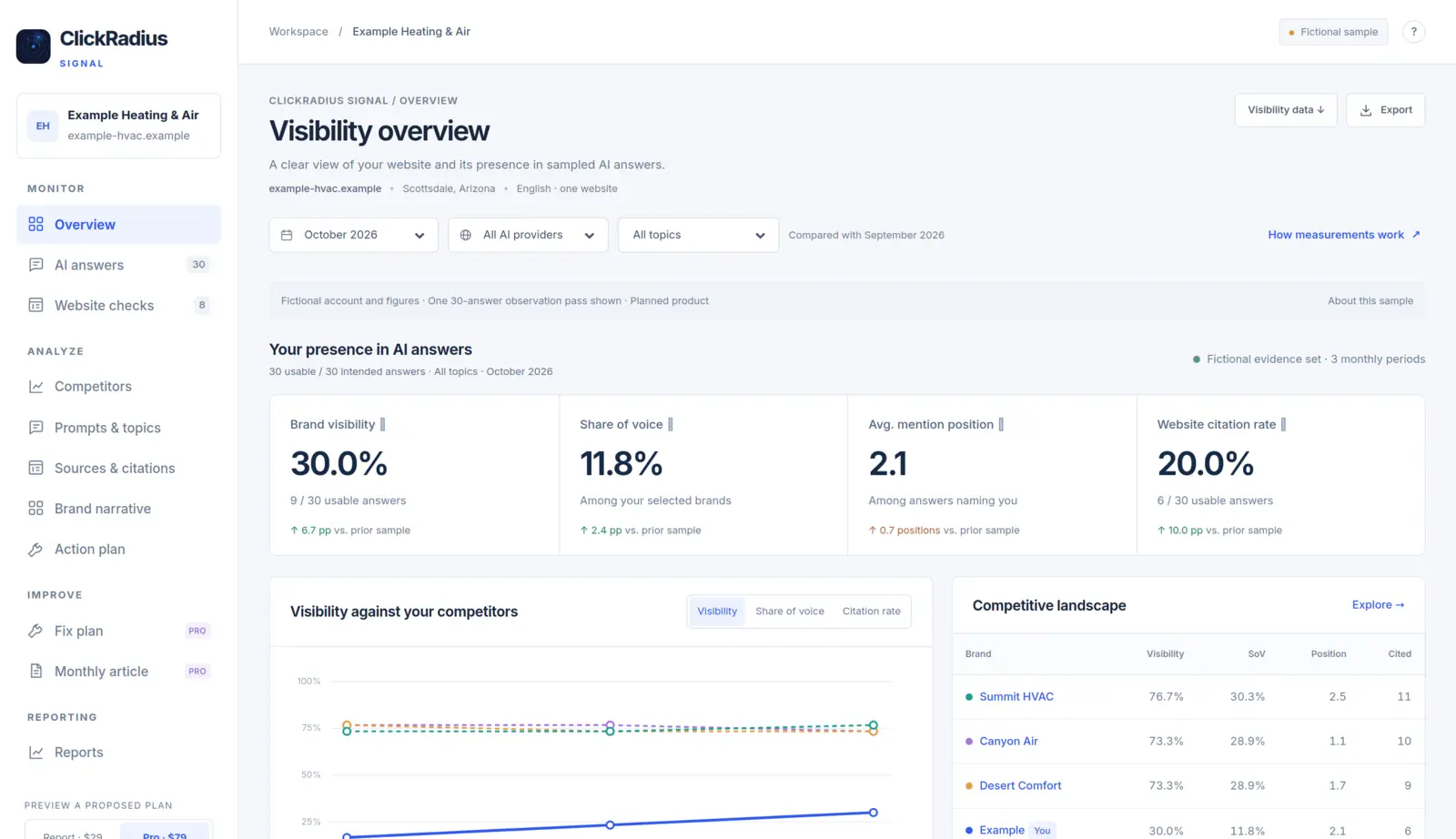
If you'd rather see the evidence and act on it yourself, ClickRadius Signal is the self-serve option. It's planned for 2027, at proposed prices, and you can explore its sample workspace today.
Next steps
- Run the 20-minute AI self-audit this week.
- Read Mentioned, cited or missing before you count anything.
- Look up any unfamiliar term in the glossary.
- Questions about your own situation? Talk to us.
Questions about anything in this guide? Talk to a person. We answer every message.