








- Your basic business facts now travel. Ads, maps, directories, review sites and AI answers all repeat them.
- Treat them like plumbing: one source of truth, written down, with every public copy fed from it.
- Include the facts people usually forget: services you don't offer, emergency hours, and exactly which credentials you can prove.
- An AI answer can't confirm a fact you never published. Missing facts get skipped, guessed or taken from someone else.
Facts used to be copy. Now they're inputs.
Ten years ago, your hours lived on a sign on the door and a line on your website. If they were slightly wrong somewhere, a customer might be annoyed. That was the cost.
Today the same facts get read by systems, not just people. Your Google Business Profile, your Local Services Ads profile, the directories in your trade, review sites and map apps each hold a copy. AI assistants then read across all of them when a customer asks "who can fix my AC today?" Every copy is an input to someone else's answer.
That changes how you should treat them. A phone number isn't marketing copy you polish once. It's infrastructure: something many other things depend on, and something that causes problems far downstream when it breaks.
What an answer can't confirm
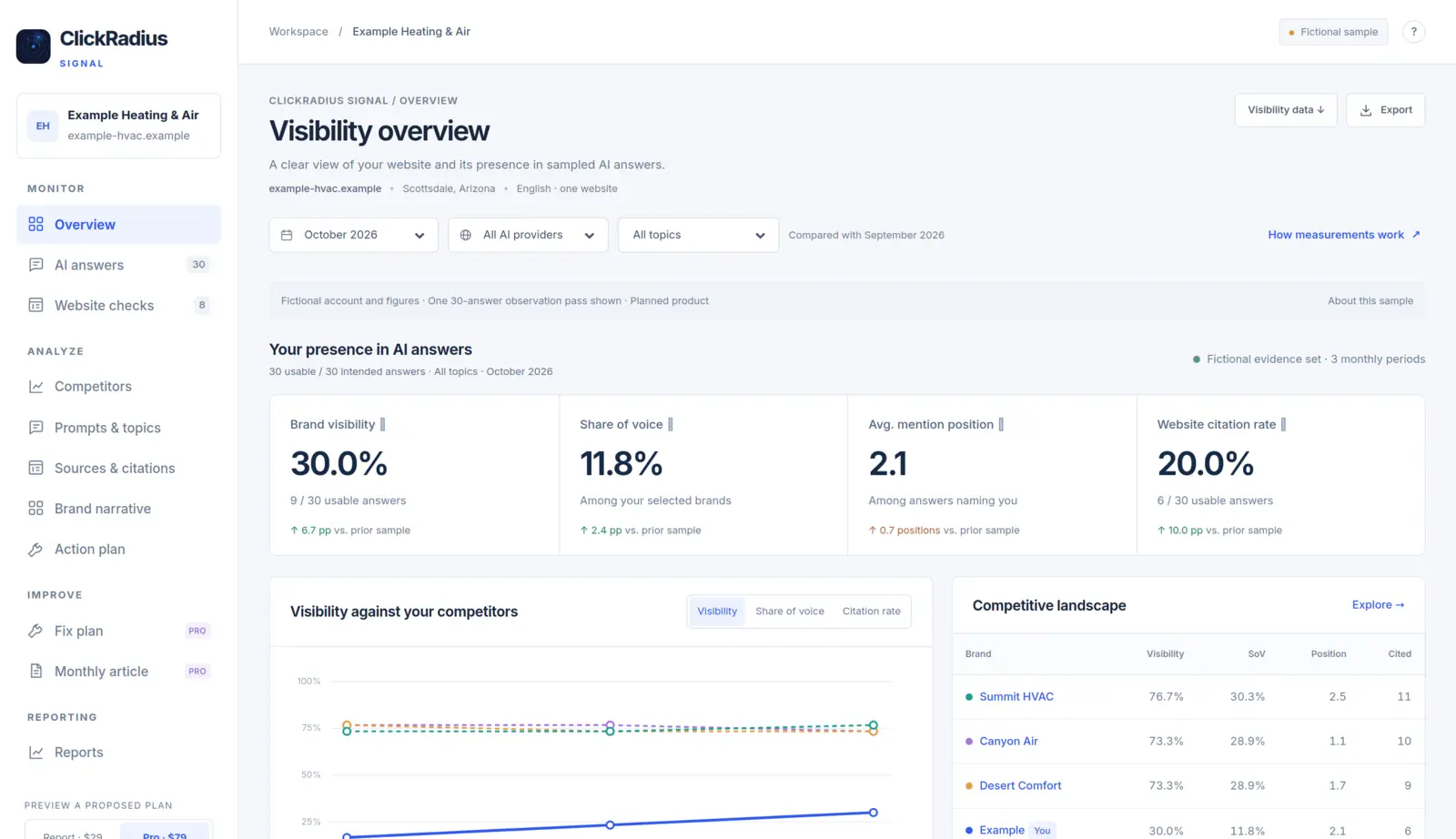
The ClickRadius Signal sample workspace makes the point well. Its brand narrative view starts with a panel called "Start with the source of truth", listing the business facts the fictional Example Heating & Air has supplied. It says the business serves Scottsdale, and then says plainly that actual appointment hours, prices and credentials are not supplied, so an answer cannot confirm those facts from this sample.
That's the honest position for any business. If you never published your hours, an AI answer that says "open 24/7" isn't confirming anything. It's guessing, or borrowing from an old listing, or mixing you up with someone else. The same view lists claims to review, marked for human review, each shown with its context and evidence.
You can't expect an answer to get right a fact you never wrote down anywhere.
Build a source-of-truth sheet
Before you fix any listing, write down what's true. One sheet, owned by one person, dated. It takes about an hour and saves many more.
| Fact | What to write down |
|---|---|
| Name | The exact name customers see, spelled one way. Note your legal name separately if it differs. |
| Address or service area | Your street address if customers visit, or the cities and ZIP codes you serve if they don't. |
| Phone | The main number, plus any tracking numbers and where each one is used. |
| Hours | Regular hours, emergency or after-hours availability, and holiday rules. |
| Services | Each service in the words customers use, and the services you don't offer. |
| Credentials | License numbers, insurance, certifications and memberships you can prove today, with expiry dates. |
| People | Owner, licensed professionals and anyone named on your site, with their correct titles. |
| Proof points | Year founded, warranties and guarantees you actually offer, in their exact wording. |
Two rows deserve extra care. Services you don't offer stop the wrong calls: if you repair but don't install, say so. Credentials should be limited to what you could show a customer on request. A claim you can't back up is worse than no claim, because it gets repeated.
Where the copies live
Once the sheet exists, check each place your facts appear against it. Most local businesses have copies in these groups:
- Your own website. The contact page, the footer, each service and area page, and the structured data (machine-readable markup) that describes your business.
- Google. Your Business Profile and, if you advertise there, your Local Services Ads profile.
- Maps and data providers. Apple Maps, and business data providers such as Data Axle.
- Directories and review sites. Yelp and the directories specific to your trade.
- Social profiles. Anywhere you list hours, a phone number or services.
This is the same off-site ground that carries the largest weight, 28%, in ClickRadius Signal's proposed readiness assessment. Readiness isn't a measure of whether AI recommends you, but it's a fair signal of how much of the work happens away from your own website. The managed ClickRadius service builds and checks presence on sources such as Wikidata, Google Business Profile, Apple Maps, Data Axle and Yelp for the same reason.
Keep it consistent over time
Getting everything right once is the easy part. Facts drift. A new phone system, a second location, summer hours or a lapsed certification each create a mismatch somewhere.
- Change the sheet first. When anything changes, update the source of truth before any public copy.
- Push the change out from the sheet. Keep a checklist of every place the fact appears, and work down it.
- Date every change. If AI answers or lead quality shift later, you'll know what changed and when.
- Review quarterly. Read your top listings against the sheet. It takes twenty minutes.
- Ask the assistants. Ask ChatGPT, Gemini and Perplexity what they know about your business, and trace any wrong fact back to its source.
Why this pays twice
Accurate facts are one of the few assets that help in both places customers find you. On Local Services Ads, a customer who calls about a service you don't offer, or at an hour you're closed, is a lead you may pay for and can't convert. In AI answers, consistent, published facts give an assistant something it can repeat with confidence. We cover the wider picture in Two front doors.
For a quick read on how ready your website is, run the free AI Readiness Score. To see the brand narrative panel described above, open the ClickRadius Signal sample workspace. Its business is fictional and every figure is synthetic.
Questions about anything in this article? Talk to a person. We answer every message.