






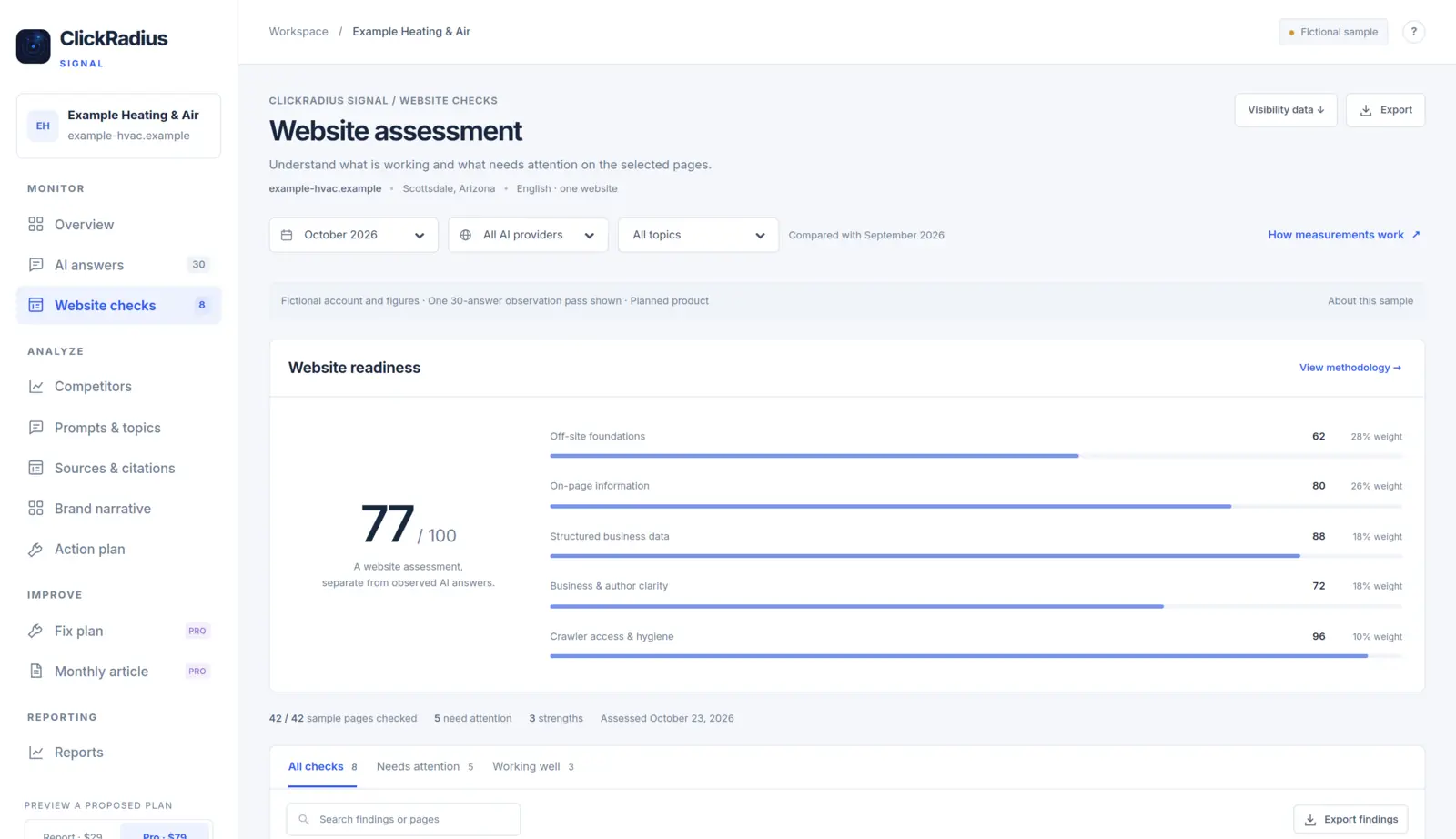
- Website readiness is a weighted assessment of five website foundations, scored out of 100.
- The weights: off-site foundations 28%, on-page information 26%, structured business data 18%, business and author clarity 18%, crawler access and hygiene 10%.
- Readiness is separate from observed AI answers. It is not a probability of being recommended.
- A change in readiness doesn't prove that a website change caused a change in AI answers.
ClickRadius Signal is a planned product for 2027, with proposed prices that still depend on a paid pilot. This guide explains its website readiness assessment as shown in the public demo, which uses a fictional business, Example Heating & Air, and synthetic figures.
What readiness measures
Readiness asks one question: how well do your website and your wider web presence support an AI system that is trying to understand, trust and cite your business? It is about inputs you can work on, not about what the answers currently say.
The demo describes it as "a website assessment, separate from observed AI answers." That separation matters. Your readiness can be strong while competitors still dominate the answers, and the reverse can happen too. We explain why in Website readiness isn't AI visibility, so this guide focuses on how to read the score itself.
The five families and their weights
The assessment groups its checks into five families. Each family carries a fixed weight in the overall score.
| Family | Weight | In plain terms |
|---|---|---|
| Off-site foundations | 28% | How your business is represented beyond your own website |
| On-page information | 26% | Whether your pages clearly say what you do, where and how |
| Structured business data | 18% | Machine-readable information that describes your business |
| Business & author clarity | 18% | Whether it's clear who the business is and who stands behind the content |
| Crawler access & hygiene | 10% | Whether automated systems can reach and read your pages |
Two things stand out. The heaviest family is one that isn't on your website at all, which reflects that AI answers draw on what the wider web says about you. And the most technical family, crawler access, carries the smallest weight. It matters a great deal if it is broken, but getting it right on its own doesn't make a business easy to describe or worth citing.
Reading the demo's 77 out of 100
In the demo, the fictional Example Heating & Air scores 77 out of 100. Around that number, the page shows:
- 42 of 42 sample pages checked, so the assessment covered every page in its sample.
- 5 findings that need attention and 3 strengths, eight checks in all.
- The assessment date, 23 October 2026 in the demo, so you know how current it is.
- A score for each family next to its weight, so you can see which foundations pull the total up or down.
Below that, a findings table lists each finding with its category, priority, affected page and status. You can filter to all checks, those that need attention or those working well, search by finding or page, and export the findings. The demo notes that evidence is retained with the assessment, so a finding can be traced to what was checked.
How to use it
- Start with the needs-attention list, not the headline number. The findings are what you can act on.
- Sort by priority and pick a small number of findings to work on this month.
- Look at the family scores to see whether your gaps are mostly on your site or off it.
- Record the date you make each change, so later months can be read against it.
On the proposed Report plan, the full diagnosis stays visible. On the proposed Pro plan, up to five findings a month are turned into prepared repairs for you or your developer to install. See prepared fixes and the monthly article.
What the score is not
The demo says it directly: readiness "is not a probability of being recommended." A score of 77 doesn't mean a 77% chance of being named, and a score of 95 doesn't promise anything about the answers.
- It isn't visibility. Visibility is observed separately, from real answers to your buying questions. See how ClickRadius Signal measures AI answers.
- It isn't a competitor comparison. Your score says nothing about how ready the businesses you compete with are.
- It isn't a ranking. It doesn't describe your position in Google search or Maps.
Readiness tells you what to work on. It doesn't tell you what the answers will say.
Change over time, and what it proves
The reporting history keeps each month's readiness next to that month's brand mentions, URL citations and usable answers. That's useful, because it lets you see the two lines side by side. It is also where the most common mistake happens.
The demo puts the rule in one sentence: "A change in readiness does not prove that a website revision caused a change in AI answers." Mentions can rise after you fix something for reasons that have nothing to do with the fix: a provider update, a competitor's change, or a new article elsewhere on the web.
- Give a change several months of observations before judging it.
- Check whether competitors moved at the same time.
- Keep a dated list of what you changed and when.
Common questions
What is a good readiness score?
There isn't a magic number. A more useful question is which findings need attention and which families are weakest. Fixing a high-priority finding usually matters more than chasing a few points.
Why does off-site carry the most weight?
AI answers often rely on what other websites say about a business, not just its own pages. A strong website with a thin presence elsewhere still leaves gaps.
Does ClickRadius Signal change my website to raise the score?
No. It is designed as a report. On Pro, repairs are prepared for you or your developer to install. If you want fixes deployed for you, that's managed ClickRadius.
Can I get a readiness score now?
ClickRadius Signal isn't available yet. The free AI Readiness Score gives you ClickRadius's six-category score today, and the glossary explains the terms used here.
Questions about anything in this guide? Talk to a person. We answer every message.