








- White-label means your brand on the work. It also means your name on every claim the work makes.
- Clients should see your brand, their outcomes, the gaps in the data and the evidence behind each number.
- They don't need tool noise, internal activity counts or your wholesale cost.
- Demo data is fine in sales materials when it's labeled as fictional every time it appears.
Your brand, and your name on every claim
White-label lets an agency offer a service it didn't build, under its own brand, at its own price. Clients get one relationship and one point of contact. That's the point, and it's a good one.
It also shifts responsibility. When a report goes out with your logo on it, every number and every sentence in it is now your claim. If a figure turns out to be a guess, the client doesn't blame the platform behind you. They blame you. So the question isn't just "how do we make this look like ours?" It's "would we stand behind every line of this ourselves?"
What clients should see
Your brand, consistently
Your logo, your colors and, where the product supports it, your domain, on dashboards, reports and emails. A report that's half your brand and half someone else's raises questions you don't need. In the CallRadius Signal demo's report studio, the report preview carries a "YOUR AGENCY" header where your brand goes. The account shown is fictional and every figure is synthetic.
Outcomes first
Booked jobs, cost per distinct person and per booked job, matched revenue and position against named competitors. For AI visibility, mentions and citations against usable answers. We set out the one-page structure in Client reports that get read.
The gaps
Booked jobs not yet matched to revenue, AI answers that failed to load, analytics that aren't connected. The demo's executive report shows how this reads in practice: its HELM summary ends by telling the reader to resolve five unmatched outcomes before changing budget. A gap stated plainly under your brand makes you look careful. A gap the client finds on their own makes you look like you were hiding it.
The evidence behind each number
Clients rarely dig, but they should be able to. When someone asks "where does that number come from?", you want to open the lead list, the call record or the observed answer, not promise to get back to them.
What clients don't need to see
- Tool noise. Optimizer runs, scan counts and system logs show effort, not results. Keep them available for your team; leave them out of the client view.
- Metrics you can't explain in a sentence. If you'd struggle to explain it on a call, it doesn't belong on page one.
- Your wholesale cost. What you pay your supplier is between you and your supplier. In the ClickRadius agency program, wholesale pricing is never shown to your clients, and under our partner terms pricing and client data stay confidential on both sides.
- Unlabeled estimates. If a figure is an estimate or an allocation, say so next to it, or leave it out.
Staying honest under your own brand
The habits that keep a white-label service trustworthy are mostly about what you say, not what the software shows.
- No guarantees. Don't promise a Local Services position or an AI recommendation. Ad results depend on Google, and AI answers depend on each provider.
- Describe the technology accurately. Our partners agree to no invented performance claims, and to say "patent pending", never "patented".
- Don't claim cause from coincidence. A better month after a change doesn't prove the change caused it. List what changed and when, and let the trend speak.
- Know who answers hard questions. Decide in advance how a client question about a number reaches someone who can answer it with evidence.
Put your name on work you'd stand behind, line by line.
Demo data in sales materials
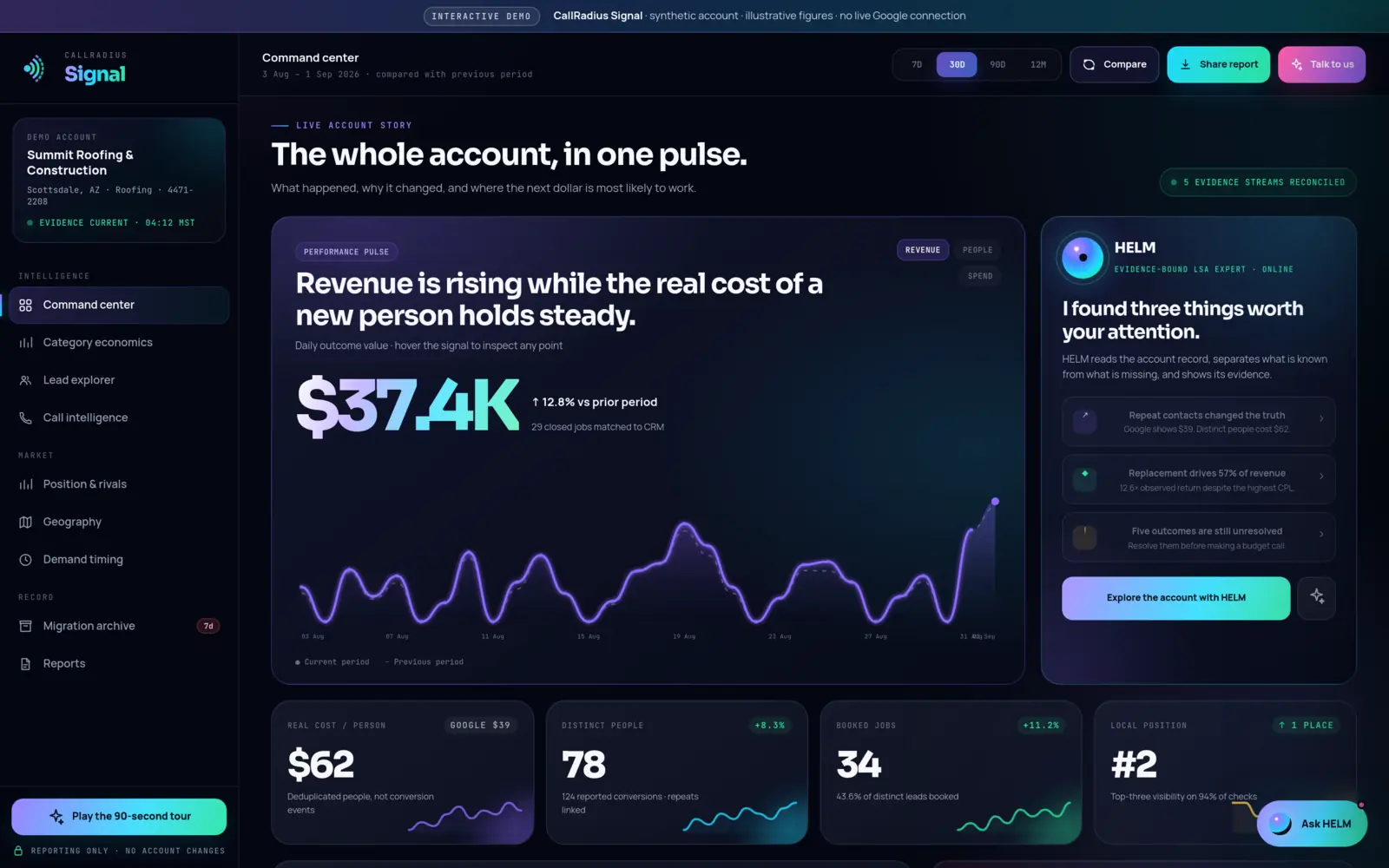
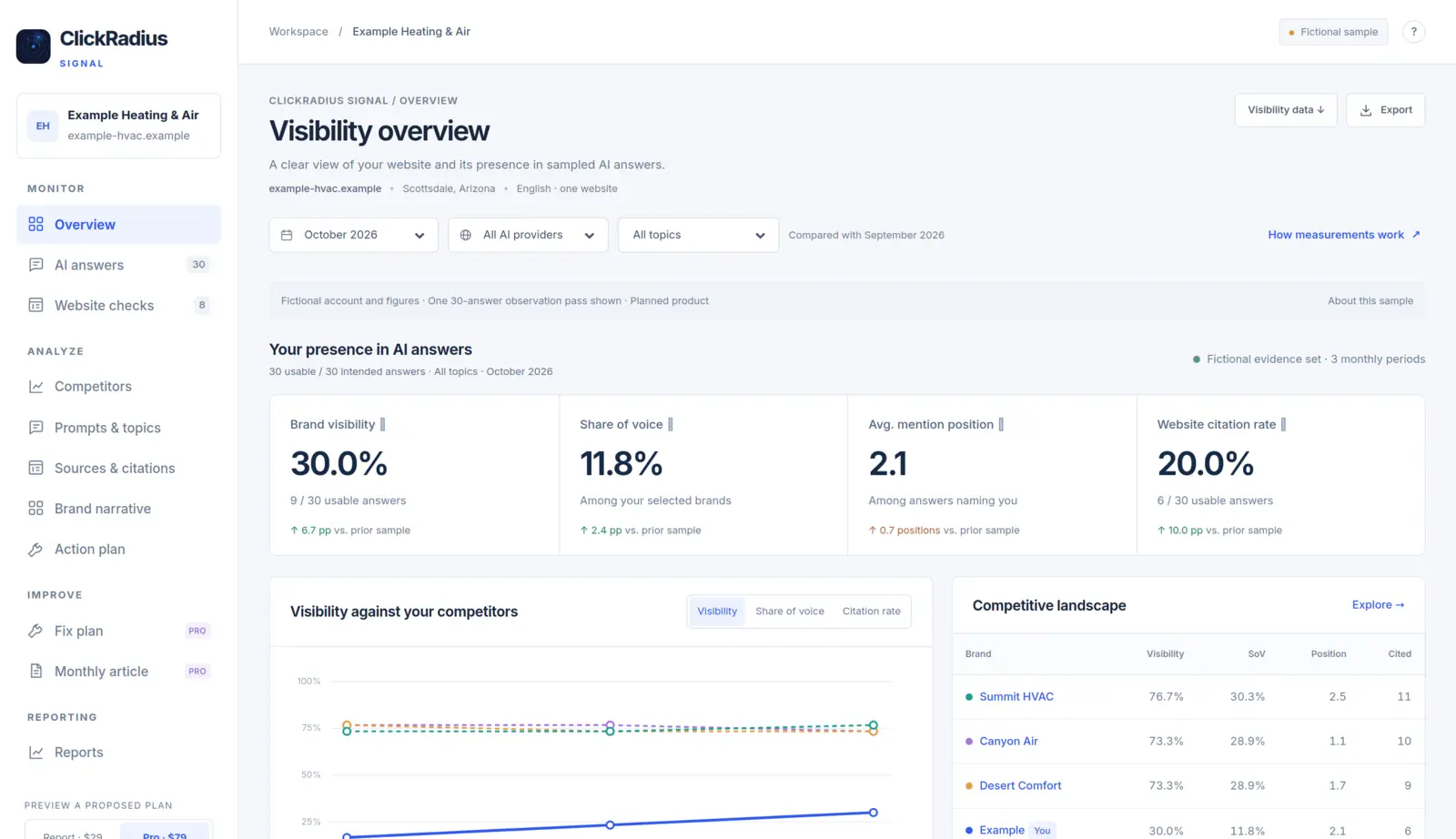
Showing prospects a polished dashboard is a fair way to sell. Our own public demos exist partly for this: the CallRadius Signal live demo uses a fictional roofing company, Summit Roofing & Construction, and the ClickRadius Signal sample workspace uses a fictional HVAC company, Example Heating & Air. Every figure in both is synthetic.
The rule for using them is simple: never let a demo be mistaken for a result.
- Label every screenshot. Put "fictional business, synthetic figures" in the caption or on the slide, every time.
- Don't rename the demo business. Swapping in a real-sounding client name turns an illustration into a fabricated case study.
- Don't quote demo figures as typical. "$62 per person" in the demo is illustrative. It isn't what a prospect should expect.
- Keep real client data out of marketing unless the client has agreed in writing. No client data appears on our own site, for the same reason.
Our evidence standard describes how we label measured, illustrative and proposed numbers. It works as well under your brand as under ours.
Which products you can white-label
The agency programs cover the managed products. CallRadius partners get white-label client dashboards and reports. ClickRadius agencies get their logo, colors and domain, and clients never see ClickRadius. In both, wholesale pricing is confidential and you set your own retail price.
CallRadius Signal is different. It's a subscription for an owner's own account, and its agreement doesn't allow reselling or redistributing Signal's output as your own product without a separate written agreement with us. If you'd like to discuss that, talk to our partnerships team.
Questions about anything in this article? Talk to a person. We answer every message.