






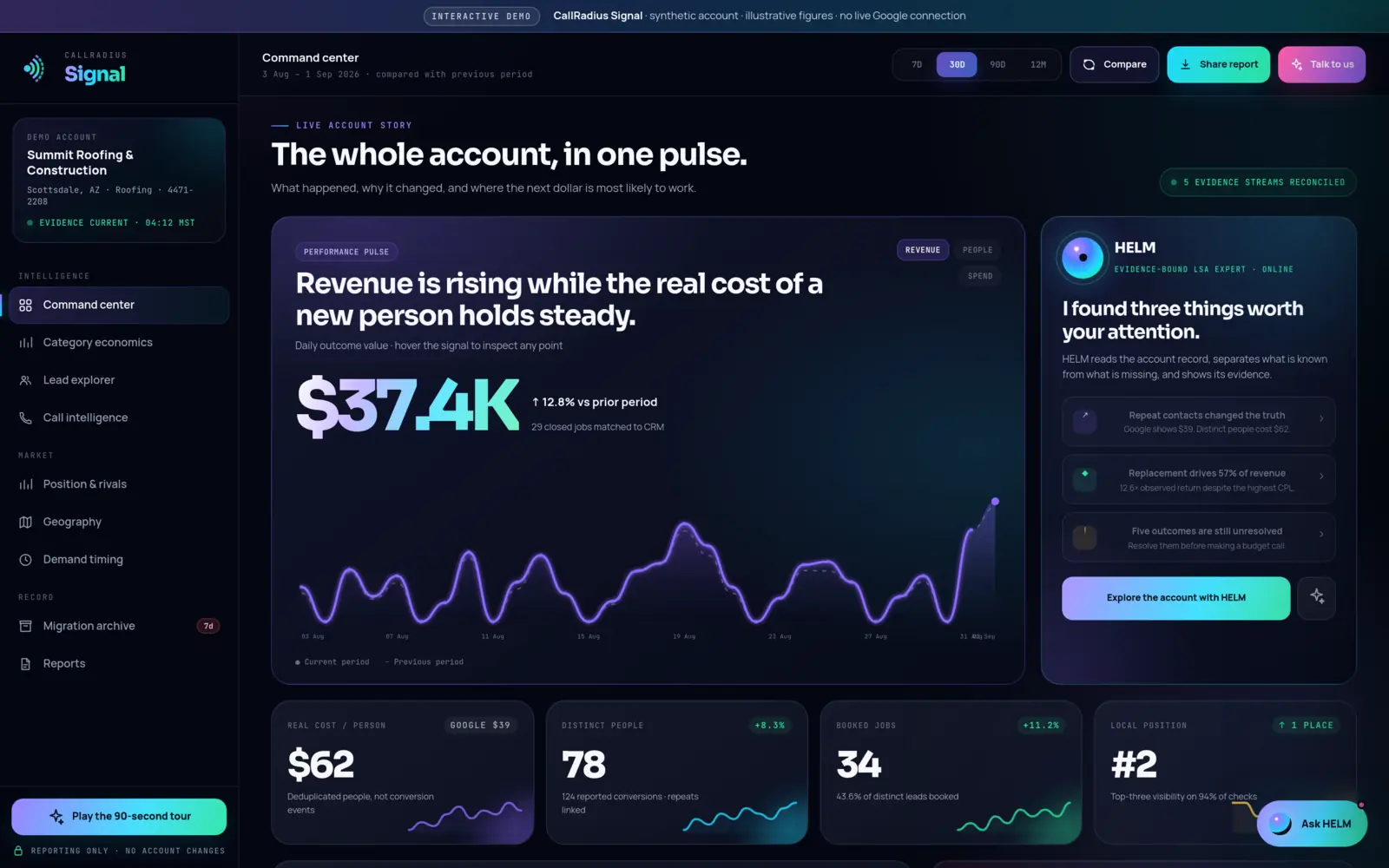

- Page one should answer three questions: what happened, why, and what we're doing next.
- Lead with outcome numbers such as booked jobs and cost per distinct person, not activity counts.
- Show gaps openly. A labeled gap builds more trust than a confident estimate.
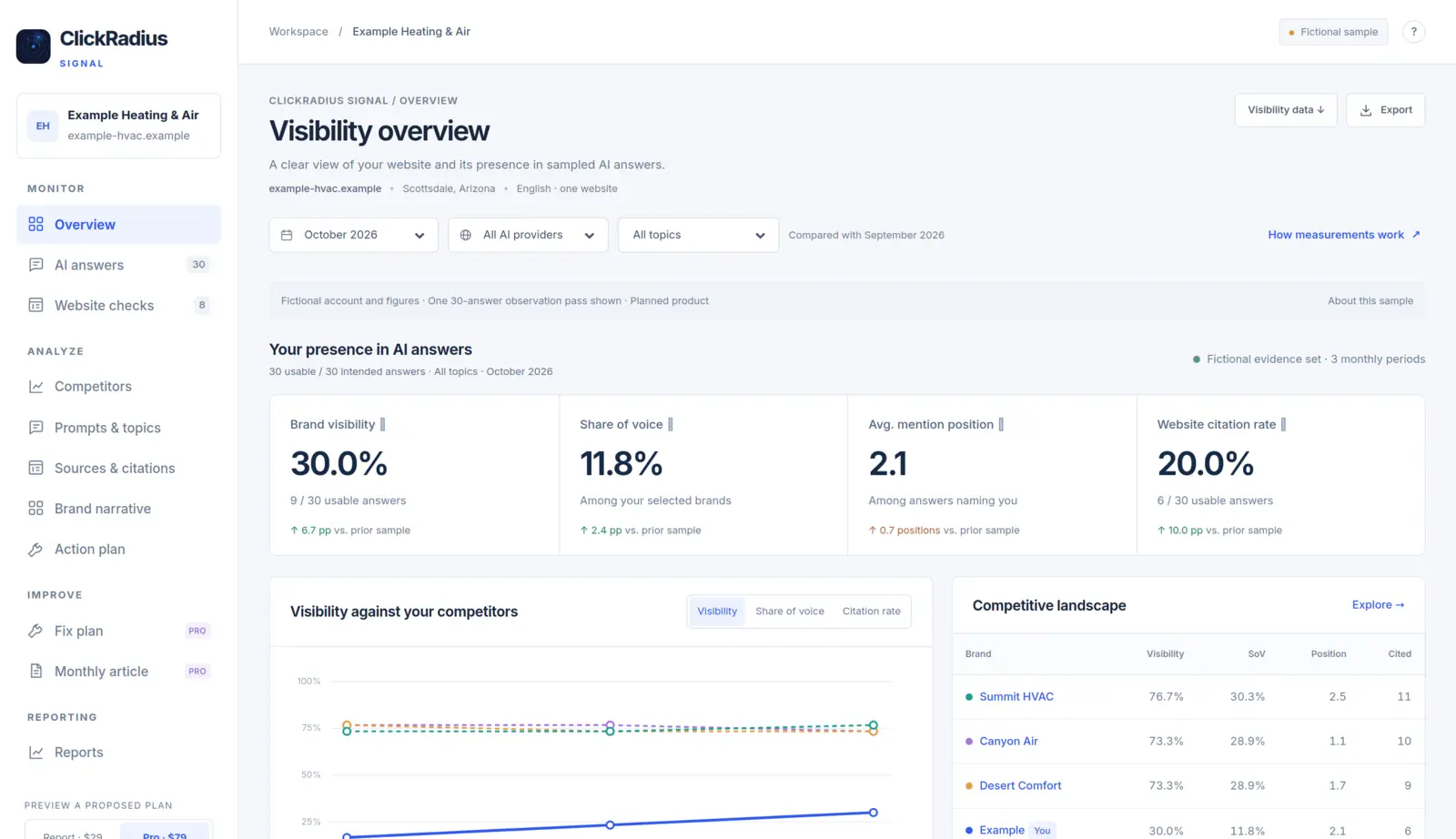
- Report AI visibility separately from ads, with its own honest denominators.
Why most reports go unread
A typical monthly report is twelve pages of charts, built because the software can produce them. The client looks for one number, usually spend or leads, and files the rest. Then, three months later, they ask "is this working?" as if they'd never seen a report at all.
The problem isn't the client. It's that the report answers questions they didn't ask and buries the ones they did. The fix is a one-page standard, with everything else available behind it for anyone who wants to dig.
Page one: three questions
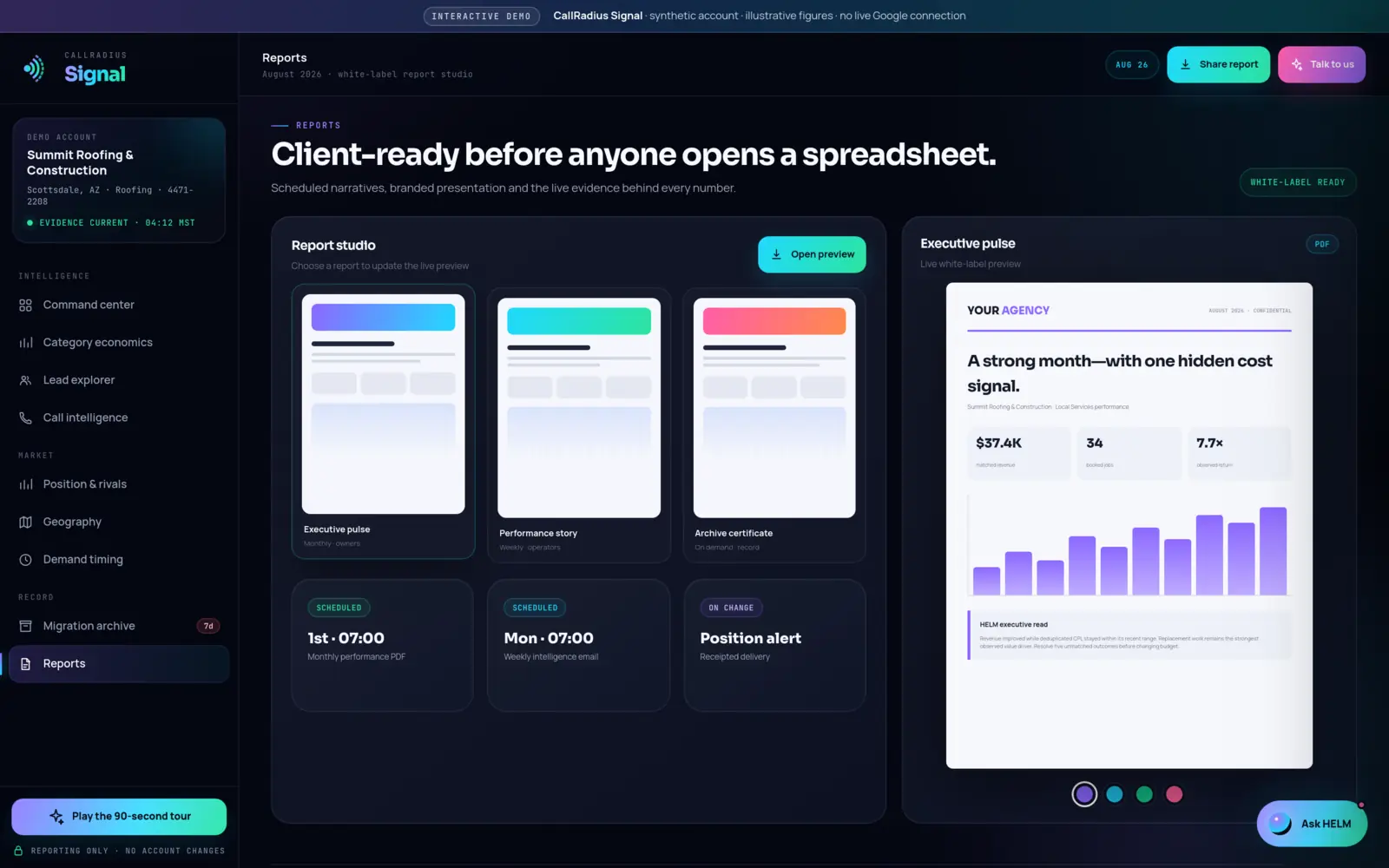
- What happened? One sentence, in plain English: "A strong month, with one cost signal worth watching."
- Why? The two or three facts that explain it: which service drove results, what changed in the market, what we changed.
- What next? The specific actions for the coming month, and anything you need from the client, such as answering calls faster on Friday afternoons.
The CallRadius Signal demo's executive report opens exactly this way: a headline, three outcome numbers and a short expert read that ends with a recommended action. Everything else is on the following pages.
Lead with outcomes, not activity
Clients pay for customers, not for impressions or optimizer runs. Put these first:
| Lead with | Instead of |
|---|---|
| Booked jobs | Total leads |
| Cost per distinct person, and per booked job | Reported cost per lead |
| Matched revenue, with how many jobs are still unmatched | Estimated revenue |
| Position against named competitors | Generic "visibility" scores |
Activity still matters, and it belongs on page two or three as the explanation, not the headline. If you're not yet counting distinct people, start with Google says $39. The real number is $62.
Show gaps before the client finds them
Every account has missing pieces: booked jobs not yet matched to revenue, a week of lost tracking, an AI provider that didn't answer. Agencies are tempted to smooth these over. Don't. A client who discovers a gap you didn't mention starts doubting every number you did.
Instead, say it on page one: "Five booked jobs aren't yet matched to revenue, so return could be higher than shown. We'll update it next month." That sentence makes the rest of the report more believable, not less.
The fastest way to lose a client's trust is a number they later find out was a guess.
Report AI visibility on its own terms
If you're reselling AI search visibility as well as Local Services Ads, give it its own section, with its own measures:
- Mentions and citations, separately, each as a share of usable answers.
- Share of voice against a fixed, named set of competitors.
- What was changed and when, listed next to the trend, without claiming cause.
- What isn't measured yet, such as visits from AI assistants if analytics aren't connected.
Don't invent a combined "local score" that blends ads and AI into one number. It's tidy, and it hides which channel is actually moving. We explain the measures in Mentioned, cited or missing.
What to cut
- Charts nobody has asked about in three months.
- Metrics you can't explain in one sentence.
- Percentage changes on tiny numbers. "Leads up 100%" from two to four is noise.
- Anything that's identical every month. Mention it only when it changes.
Make it yours
Clients should see your brand on every page, not ours. Our agency program provides white-label dashboards, portals and reports for CallRadius and ClickRadius. You buy at a confidential wholesale rate and set your own retail price, and your clients never see what you pay.
Want to see a report built on this standard? Open the report studio in the CallRadius Signal live demo, or talk to our partnerships team.
Questions about anything in this article? Talk to a person. We answer every message.