








- Good providers answer these questions plainly and in writing. Vague answers are an answer too.
- The most revealing questions are about counting: what a lead is, what success is, and what happens to the numbers you can't see.
- Ask exactly what they can change in your accounts, and what waits for your approval.
- A promised ranking, position or AI recommendation is a red flag, not a selling point.
Hiring help for Local Services Ads or AI search usually starts with a sales call, and sales calls are built around what the provider wants to tell you. These twelve questions turn the conversation around. Ask them of anyone you're considering, and ask them of us. Where it helps, we've put our own answer underneath so you can see what a specific answer looks like.
How they count
1. How do you count a lead?
A customer who calls twice and then sends a message can appear as three conversion events. If a provider reports events as leads, your cost per lead looks lower than the cost of reaching a new customer. Ask whether repeat contacts are linked to the same person, and whether you can see both numbers.
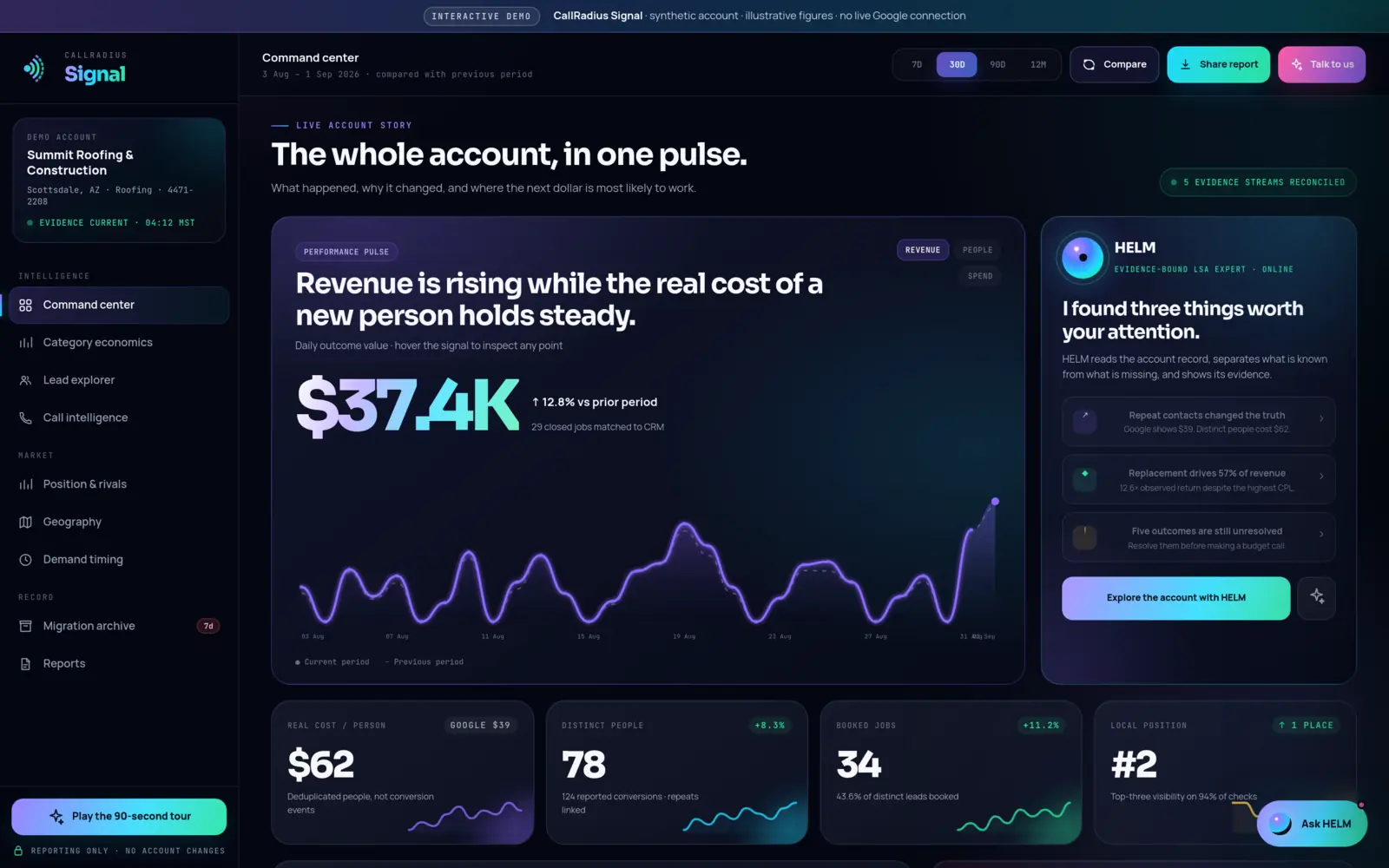
Our answer: CallRadius Signal links repeat contacts to the same person and keeps every repeat visible, so you see the reported figure and the cost per distinct person side by side. We explain the method in Google says $39. The real number is $62.
2. What number will you judge yourselves by?
Impressions, clicks and calls are activity. Booked jobs and the cost of each one are outcomes. A provider who leads with activity is asking you to grade them on effort. Ask which outcome number they expect to move, and how they'll show it.
3. How do you handle junk leads?
On a pay-per-lead channel, spam and wrong numbers cost real money. Ask who reviews them, how disputes are decided, and what happens to the unclear ones.
Our answer: CallRadius classifies every incoming lead with AI. Disputes with Google are limited to classifications above an 85% confidence threshold, and ambiguous leads go to a person.
What they can touch
4. What can you change in my account, and what needs my approval?
This is the question owners most often forget. Get the answer in writing, by type of change: budgets, targeting, website pages, listings.
Our answer: In CallRadius, routine, reversible adjustments run within approved guardrails and are logged. Large budget swings and structural changes wait for your LSA manager's approval, and ambiguous situations alert a person instead of acting. ClickRadius changes titles, meta descriptions, image alt text, internal links and structured data, and every change is versioned with one-click revert. CallRadius Signal changes nothing: it is read-only, enforced in our systems rather than merely promised.
5. Who actually works on my account, and how often?
Ask for a role, not a promise of attention. Is there a named person? How often is the account reviewed? What happens between reviews?
Our answer: In CallRadius, a rules engine reviews each account every two hours, and an experienced LSA manager owns strategy, client goals and every exception the system escalates.
6. How will I know a change worked?
Ask how they separate cause from coincidence. A change followed by a better month doesn't prove the change caused it. A careful provider records the date of each change and compares against a fair baseline. We walk through the method in how to tell whether a change worked.
Your data and your terms
7. What happens to my data and history if I leave?
Your account history is how you'll judge whoever comes next. Ask what you can download, what stays viewable, and whether anything is deleted when you cancel.
Our answer: CallRadius Signal retains the reports it collected after you cancel, so a restart doesn't begin from an empty archive. You can download the current month of lead data, earlier months stay viewable in Signal, and we provide a complete export on request when you close your account. If you'd rather we delete your data, ask and we'll process it, subject to records we're legally required to keep. Details are in your data, read-only access and the archive.
8. What are the contract terms?
Ask about minimum term, notice period, setup fees, cancellation fees and when billing starts. Then ask whether ad spend is included or paid separately.
Our answer: Every product is month-to-month. CallRadius is $499 per Local Services account a month, with no setup fee and 30 days' notice, and nothing is charged until Google approves your account and it can receive leads. ClickRadius has a 14-day trial and no cancellation fee. Google ad spend is separate and paid directly to Google. All of it is on our pricing page.
9. Will you contact my customers in my name?
Some providers send review requests, follow up with leads or reply to reviews on your behalf. That can be useful, but you should know exactly what goes out, under whose name, and with what checks. Ask to see the templates and the rules.
Our answer: CallRadius sends timed review requests and drafts review replies with AI. Before any guarded customer contact is considered, its lead-response readiness checks (account, sync, hours, channel, template and consent) must pass.
How they handle the truth
10. How do you report what you don't know?
Every real account has gaps: booked jobs not yet matched to revenue, an AI answer that failed to load, analytics that aren't connected. Ask how those appear in reports. A provider who never shows a gap is filling it with something.
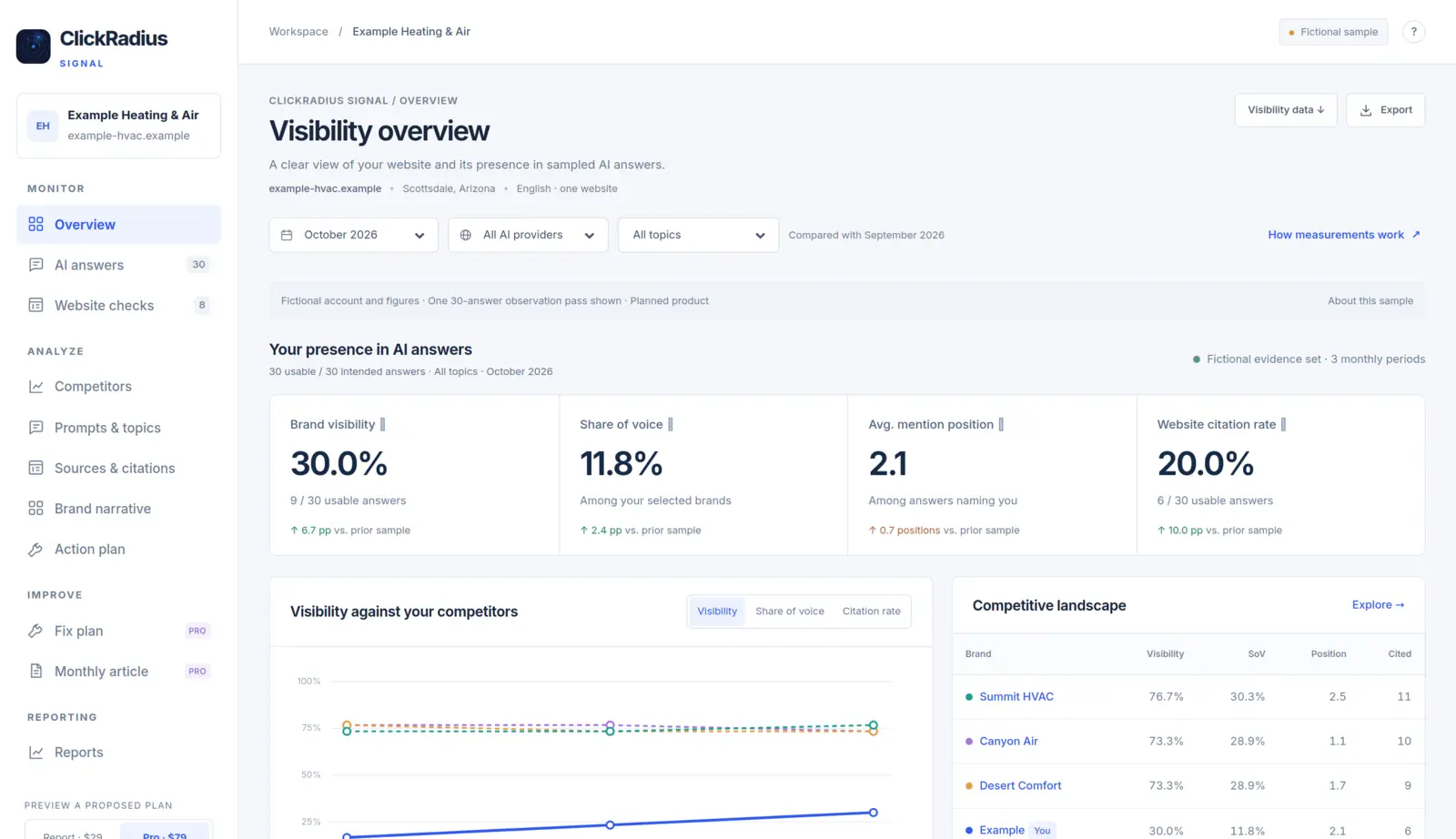
Our answer: HELM flags unresolved outcomes before answering any question that depends on them, and ClickRadius Signal is designed to exclude unavailable AI answers from the denominator rather than score them as a "no". Our evidence standard is written down.
11. Do you guarantee results?
Treat a yes as a warning. Nobody controls Google's ad placement or what an AI assistant chooses to say. A guaranteed position usually means a narrow definition of success, a contract clause you haven't read, or a promise that won't be kept.
Our answer: No. Ad results depend on Google, and AI answers depend on each provider. What we commit to is transparency about what the platform did and what changed.
A provider who can't tell you what they don't know will eventually tell you something that isn't true.
12. Are the examples you showed me real?
Screenshots of impressive dashboards are easy to make. Ask whether each example is a real client (with permission), a composite or a demo, and whether the figures are real.
Our answer: Our product screens come from public demos with fictional businesses and synthetic figures, and they're labeled that way. No client data appears on this site.
Red flags at a glance
| You hear | What to ask next |
|---|---|
| "Page one, guaranteed" or "top three, guaranteed" | Guaranteed how, measured where, and what happens if it doesn't? |
| "Leads are up 40%" | Leads or distinct people? And how many were booked? |
| "We handle everything, don't worry about it" | What exactly can you change without asking me? |
| "The report is proprietary" | Can I see the lead-level records behind it? |
| "There's a 12-month agreement, but it's standard" | What does it cost me to leave, and what do I keep? |
Using these questions
You don't need to ask all twelve on one call. Send them by email and compare the written answers side by side. The way a provider answers tells you as much as what they say: specific, checkable answers are a good sign, and so is "we don't know yet".
If you'd like to ask us, talk to a person. If you'd rather see the evidence before talking to anyone, explore the CallRadius Signal live demo, where the business is fictional and every figure is synthetic, or read Managed or self-serve? to decide what kind of help you need.
Questions about anything in this article? Talk to a person. We answer every message.