






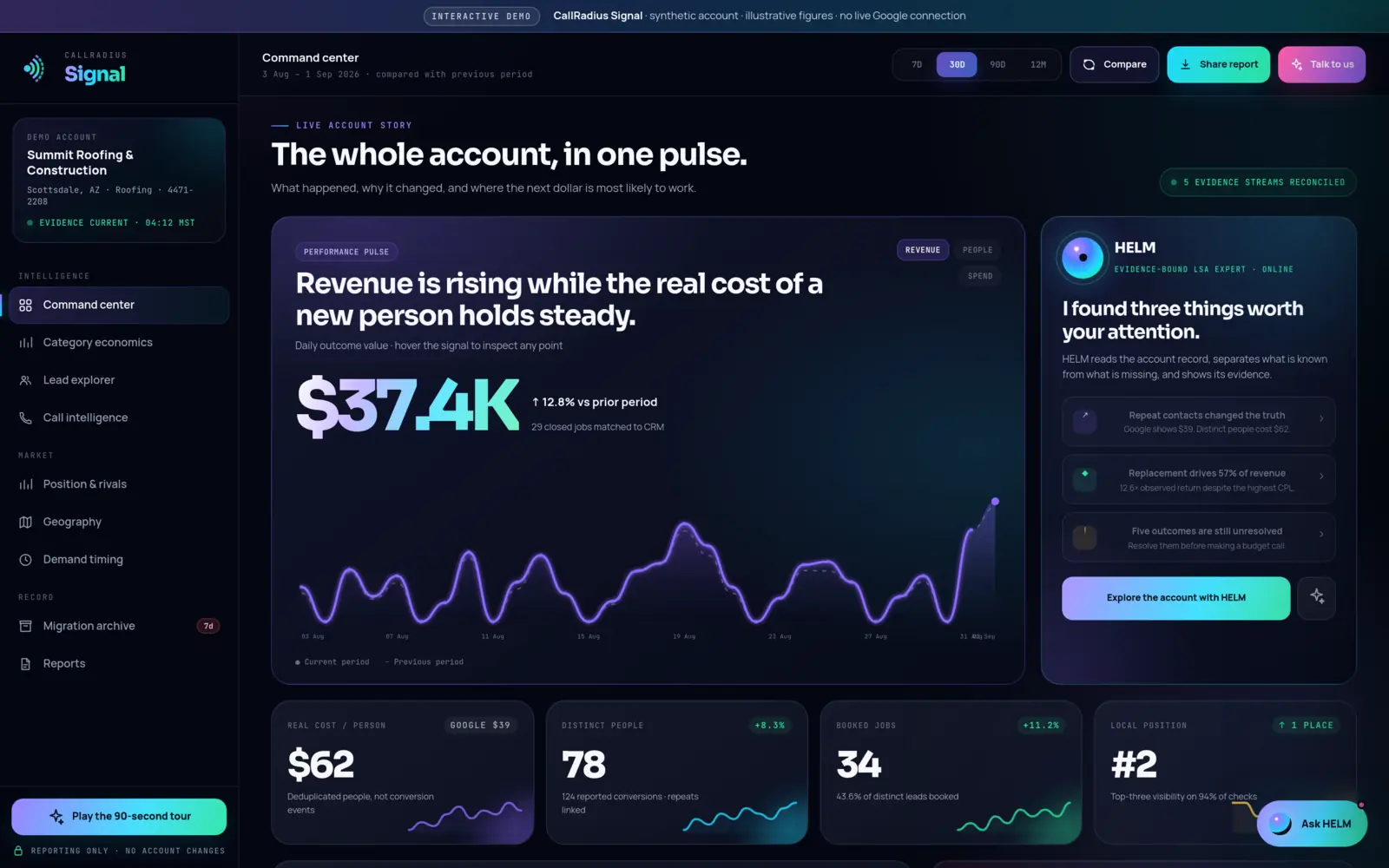
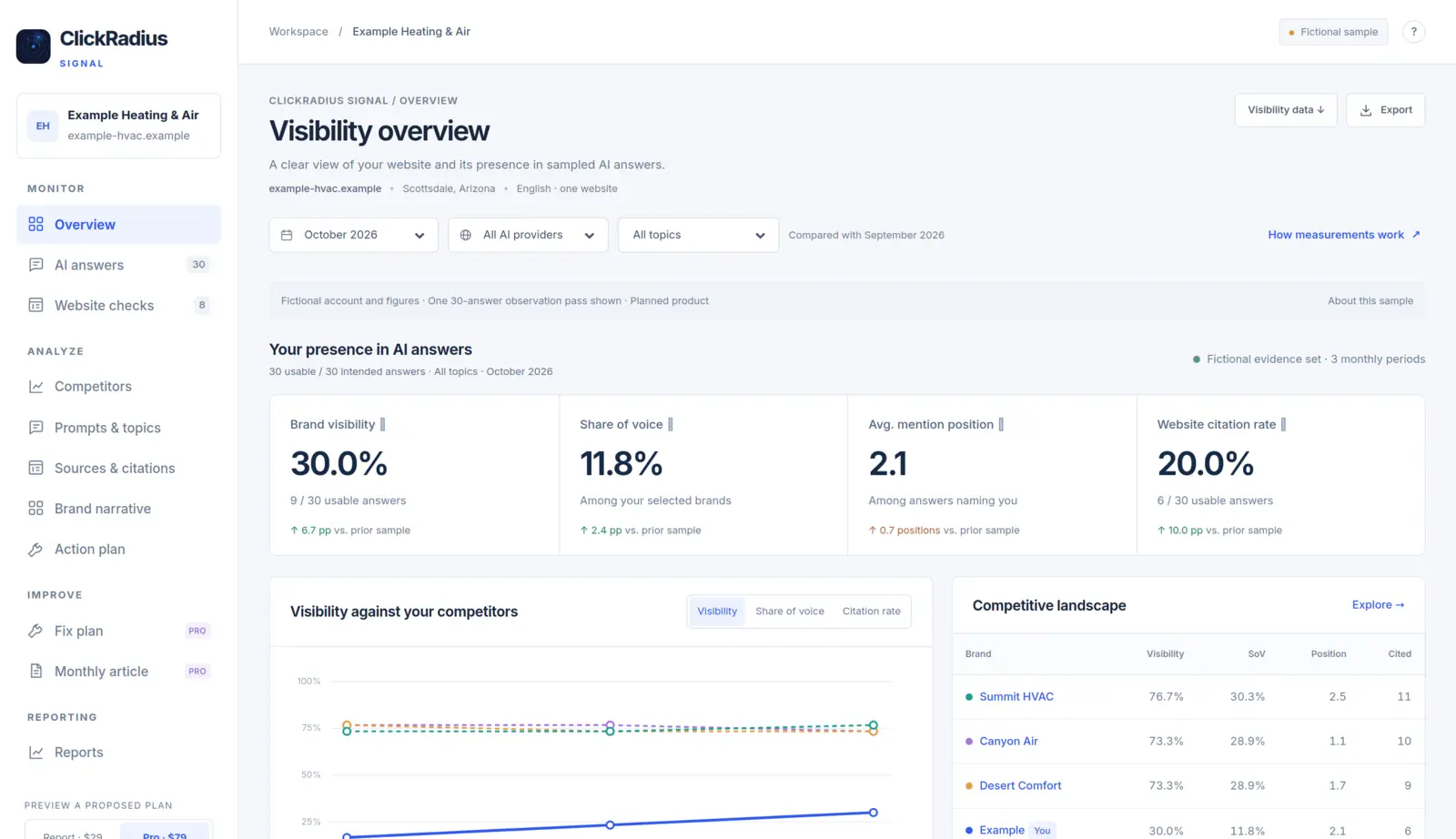


- Sell AI visibility as a measured service, not a promise. Nobody controls what an AI assistant says.
- Start every client with a dated baseline: fixed buying questions, fixed providers, a fixed competitor set and a website readiness check.
- Define deliverables you control (fixes, pages, listings) separately from outcomes you observe (mentions, citations).
- Report it on its own terms, next to your ads reporting, never blended into one score.
Why add it, and why measure it
If you already run Local Services Ads, search or listings for local businesses, your clients are starting to ask a new question: "When someone asks ChatGPT who to call, are we in the answer?" You can answer it with a guess, or you can turn it into a service.
The risk is selling it badly. AI visibility is earned, not bought, and it tends to build gradually. A package sold on "we'll get you recommended by AI" sets up a conversation you'll lose in month three. A package sold on "here is where you stand, here is what we'll fix, and here is how we'll measure it" gives you something to report every month, whether the trend is up or flat.
Start with a baseline
Before you change anything for a client, record where they stand. Date it and keep it. Every later report is compared against this.
- Write the buying questions. Ten questions the client's customers ask before they know a name, most of them including the city. Keep the client's name out of all but one.
- Fix the providers. Choose the AI assistants you'll check, such as ChatGPT, Gemini and Perplexity, and use the same ones every time.
- Fix the competitor set. Agree with the client on the competitors their customers actually compare them with. Share of voice depends entirely on this list.
- Record five things per answer: mentioned, cited, position, competitors named and sources used. Mark failed answers as unavailable, not as a "no".
- Check the website. Run a readiness scan so you have a starting point for the work you control.
The method is laid out step by step in our 20-minute AI self-audit, and the free AI Readiness Score covers the website side. Both work well as a sales conversation too: a prospect's baseline is a more useful opener than a pitch deck.
Define the service in measurable terms
Separate what you deliver from what you observe. Clients can hold you to the first. The second is evidence, not a promise.
| What you deliver | What you observe | |
|---|---|---|
| Website | Specific fixes installed and dated: structured data, page titles, service and area pages | Readiness score over time |
| Content | Pages that answer the buying questions, published and dated | Citations of those pages in AI answers |
| Off-site | Listings and profiles corrected or created | Which sources appear in answers |
| Answers | A monthly observation pass with the same method | Mentions, citations and share of voice against usable answers |
Write the left column into the proposal. Report the right column honestly. That split protects you when a provider changes its behavior and every business in the market moves at once.
Report it honestly
Give AI visibility its own section in the monthly report, with its own measures. We set out a one-page standard in Client reports that get read. Three points matter most for this channel:
- Mentions and citations stay separate. Being named and being linked respond to different work. Here's why.
- Changes are listed next to the trend, without claiming cause. A rise after a fix doesn't by itself prove the fix caused it. Check whether competitors rose too.
- Unmeasured means unmeasured. Mentions aren't visits, leads or revenue. Until analytics are connected, say the business impact isn't measured yet.
Sell the measurement and the work. Never sell the answer.
Package and price it
Most agencies choose one of two shapes:
- An add-on line item for existing clients, priced on its own so the client sees what it covers. This is the simplest way to start, and it keeps the measures separate from ads.
- A bundled local package that covers both Local Services Ads and AI visibility. This suits clients who think in terms of "getting found", as long as the report still shows each channel separately.
Whichever you choose, set expectations in writing: the baseline date, the deliverables, the measures, and a clear statement that no one can guarantee an AI recommendation. Clients may well hear that promise from someone else. Being the agency that didn't make it is worth something when the other promise falls through.
Where RadiusLocal fits
If you'd rather not build the tooling and staff the work yourself, the ClickRadius agency program lets you resell managed AI visibility under your own brand. The facts:
- Confidential wholesale pricing. Every site is scored and priced in your agency portal, and you see its exact price before you activate. No setup charges, and no surcharge for sites that score poorly or need repair.
- Your brand. Your logo, colors and domain. Clients never see ClickRadius, and wholesale pricing is never shown to them.
- You're the merchant. You bill your clients at your own price.
- Agency portal and API access.
- No minimums. No agency signup charge and no minimum number of sites. Each site has a four-month first term, then runs month-to-month.
Behind your brand, managed ClickRadius scans the site, generates fixes, deploys them through WordPress, Shopify, a JavaScript snippet or Cloudflare, and re-scans to verify them, with one-click revert. It checks target questions weekly across ChatGPT, Gemini, Perplexity, Claude and Grok, and each standard site includes 8 authority posts and 10 knowledge articles per monthly billing period.
Getting started
Run baselines for three existing clients this month. You'll learn more from those than from any pitch, and you'll have a real starting point for the next report. When you're ready to talk about the program, contact our partnerships team or see the full details on the agencies page.
Questions about anything in this article? Talk to a person. We answer every message.