






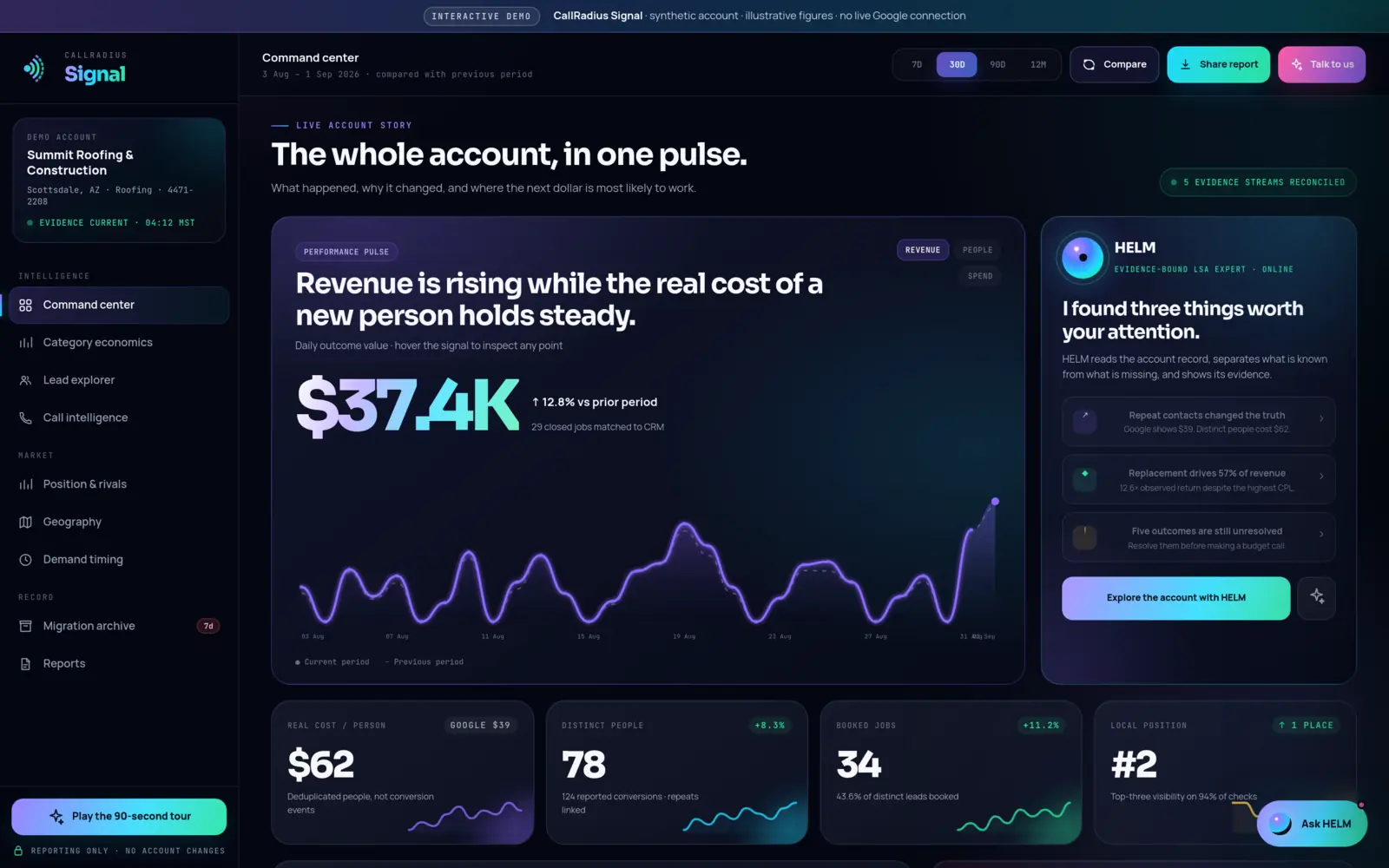


- CallRadius is managed Google Local Services Ads: a patent-pending AI platform runs the account 24/7, and an experienced LSA manager owns the strategy.
- You get approved by Google, answer your phone and do the work. We run budget, lead quality, call grading, position and the rest.
- Routine, reversible changes run within approved guardrails and are logged. Large or hard-to-undo changes wait for your LSA manager. Ambiguous situations alert a person.
- $499 per Local Services account a month, no setup fee, month-to-month on 30 days' notice. Nothing is charged until Google approves your account and it can receive leads.
What CallRadius is
Google Local Services Ads are the listings Google shows prominently in search results when people look for the services you offer. Google's own help center says you pay only when a customer gets in touch from your ad, and that leads come in as phone calls and messages sent through the ad.
Pay-per-lead sounds simple, but running it well is constant work. Junk leads cost money unless someone catches them. The budget level where your ads actually show moves. Calls that go unanswered cost jobs, and Google says regularly failing to answer calls or respond to messages can affect your ranking.
CallRadius is our managed service for exactly that work. The platform does the relentless part, every account and every lead, every few hours. Your LSA manager owns the judgment: strategy, your goals and every exception the system escalates. The people who build the platform are the people who run your account.
New to Local Services Ads? Start with What are Google Local Services Ads?
If you would rather run your own ads and just see the evidence clearly, that is CallRadius Signal, our self-serve, read-only product, which is opening for enrollment soon.
Getting started, step by step
- Get your free LSA Score. It reads your public Local Services position against your market in about a minute. No sign-up and no Google account connection. Find it on callradius.io or under free tools.
- Talk it through, if you like. You can discuss your account with an LSA specialist before you sign up.
- Sign up. Start on the CallRadius get-started page. A card goes on file at sign-up, but nothing is charged yet.
- Google approves your account. To advertise, Google requires businesses to complete its screening and verification. Google's help center says the checks can include identity, business registration, licenses and a verified Google Business Profile, and that some requirements depend on your business type and your state. Businesses that pass show the Google Verified badge.
- Your ad goes live and billing starts. CallRadius starts charging only when Google has approved your Local Services account and it can receive leads. If it never goes live, you are never charged.
- The platform and your manager take over. From here, the account is monitored every couple of hours, every lead is triaged and every recorded call is graded.
What we do, every day
CallRadius runs eight engines. Each does one job continuously and hands its results to the others.
| Engine | What it does |
|---|---|
| Lead triage and lead feedback | AI classifies every incoming lead within minutes. Only classifications above an 85% confidence threshold are flagged, and clearly invalid charged leads get honest feedback through Google's lead rating. Google decides any credit. Ambiguous leads go to a person. |
| Call intelligence | Every recorded call is transcribed on our own servers and graded: answered, handled, booked or lost. |
| Budget optimization | A rules engine reviews each account every two hours, which works out to 84 optimization cycles a week. Protective rules override growth rules. |
| Lead-response readiness | Shows the account, sync, hours, channel, template and consent checks that must pass before any guarded customer contact is considered. |
| Review engine | Timed review requests and AI-drafted replies. |
| Position and competitors | Position is checked on a regular cadence, and competitor movement feeds back into budget decisions. |
| Geographic evidence | Lead and outcome evidence compared ZIP by ZIP. Weak areas are surfaced for manager review; targeting changes stay human-authorized. |
| Seasonal and schedule tuning | Spend follows your trade's seasonal demand and the hours leads actually arrive, with cooldowns that prevent over-correction. |
How budget decisions are made
On Local Services Ads, budget buys eligibility. The engine probes up and down to find the level where your ads appear, waits 48 hours to confirm each move on real data, and settles just above it. If two probes come back with the ads not showing, it stops and alerts a person.
When one rule says "grow" and another says "pull back", the engine doesn't average them. Protective rules for overspend, poor return and low lead quality can suppress growth rules outright. Safety wins the tie.
Then every budget change is graded. About a week later, each one is scored as a win, a loss or neutral against real leads. A rule that starts losing more than it wins is demoted to advisory until its record recovers. Automation has to keep earning the right to act.
CallRadius has to show that a decision helps before it is allowed to keep making it.
How lead quality and budget connect
The credit rate on charged leads feeds back into the budget. Markets and hours that produce junk get less spend, and clean ones get more. Lead quality and budget become one signal instead of two separate jobs.
Who approves what
CallRadius sorts every action by confidence and by how easily it can be undone.
| Tier | Typical situation | What happens |
|---|---|---|
| Policy-controlled | High confidence, reversible | Prepared or carried out within approved guardrails. Every live change passes its account policy gate and is logged. |
| Approval required | Material, slower to undo | Large budget swings or structural changes wait for your LSA manager to approve them. |
| Alert only | Low confidence, high stakes | The system stops and pages a person, because sometimes the problem isn't budget at all. |
HELM, our expert AI, also reviews managed accounts, so its recommendations reach your manager with the reasoning attached. HELM recommends. Changes follow the same approval rules as everything else. See HELM: what it does and what it won't do.
What you do
Managed doesn't mean you disappear. Your part is the part only you can do.
- Complete Google's screening. Google decides what your business needs to provide, and only Google can approve your account.
- Answer the phone and reply to messages. Google lists your responsiveness to customer inquiries among the factors that affect ranking. Call grading shows where calls are being missed or lost, but someone at your business still has to pick up.
- Tell your manager your goals. Which services you want more of, where you want to work, when you are at capacity. Your manager owns strategy around what you tell them.
- Do great work and earn reviews. Google says your rating and number of reviews are part of what affects your ranking. The review engine times requests and drafts replies, but the jobs have to earn them.
- Pay Google directly for ad spend. Your Local Services ad spend is separate from the CallRadius fee and is paid to Google.
What you see: reporting
Every CallRadius plan includes a live client dashboard and reports, and you see exactly what the platform did and why. Every live change is logged.
We don't guarantee results, because ad results depend on Google. What we guarantee is transparency about what was done and what changed. Our reports follow the standard in How we label numbers: numbers are measured or clearly labeled as examples, and gaps are shown as gaps.
If you want to understand the measures that matter most, such as cost per distinct person rather than per conversion event, Google says $39. The real number is $62. and From lead to booked job to revenue explain the thinking.
Pricing
- $499 per Local Services account per month.
- No setup fee. Month-to-month on 30 days' notice.
- Nothing charged until your ad is live. A card goes on file at sign-up, but billing starts only when Google has approved your account and it can receive leads.
- Ad spend is separate. It is paid directly to Google.
- Included: all eight engines running 24/7, an experienced LSA manager, a live client dashboard and reports, and HELM expert review of your account.
Agencies can resell CallRadius under their own brand at confidential partner pricing. See the agency program.
Common questions
Will CallRadius change my ads without asking?
Routine, reversible adjustments run within approved guardrails and are logged. Material or hard-to-undo changes need your LSA manager's approval, and ambiguous situations alert a person instead of acting.
Is my business eligible for Local Services Ads?
Google decides which business types are eligible, and it varies by category. See Industries, or run the free LSA Score to see where you stand.
Do I need ClickRadius too?
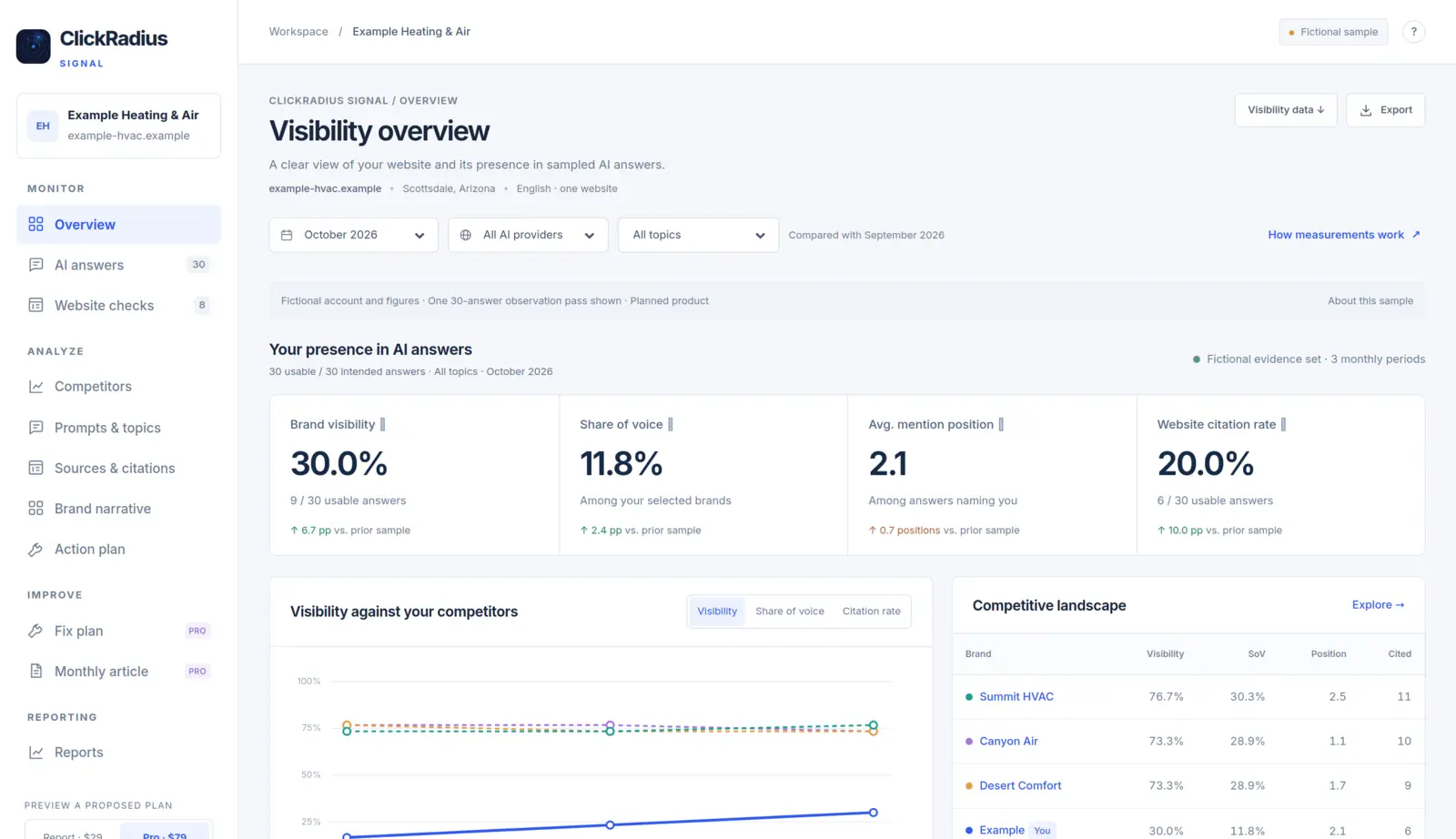
No. CallRadius covers Google Local Services Ads and ClickRadius covers AI answers. Each works on its own. Which RadiusLocal.ai product fits? helps you choose.
Are leads or rankings guaranteed?
No. Ad results depend on Google, and nobody can promise a position.
Next steps
- Get your free LSA Score.
- Read more on the CallRadius page or at callradius.io.
- Ready? Get started, or talk to an LSA specialist first.
Questions about anything in this guide? Talk to a person. We answer every message.