







- The ClickRadius Signal sample workspace uses a fictional business, Example Heating & Air, and invented answers. No website or AI provider was queried.
- ClickRadius Signal is planned for 2027. Report at $29 and Pro at $79 are proposed prices, and delivery still requires a paid pilot.
- Open the "?" guide first, then the overview, the observed answers and the competitors.
- The workspace keeps four things apart: website readiness, observed answers, prepared fixes and verified publication.
Before you click anything
Open the sample workspace and click the "?" button at the top of the workspace. That opens "How to read this workspace," and it's the most useful minute you'll spend in the demo. It says plainly that everything is fictional: the business, its competitors (Canyon Air, Desert Comfort and Summit HVAC), the answers, the sources and the history. It also explains the measures you're about to see.
Then notice the plan switch in the sidebar: "Preview a proposed plan," Report or Pro. ClickRadius Signal isn't available yet. It's planned for 2027, its prices are proposed, and prices and delivery still require a paid pilot. The switch lets you see what each proposed plan would include.
1. Overview: where do I stand?
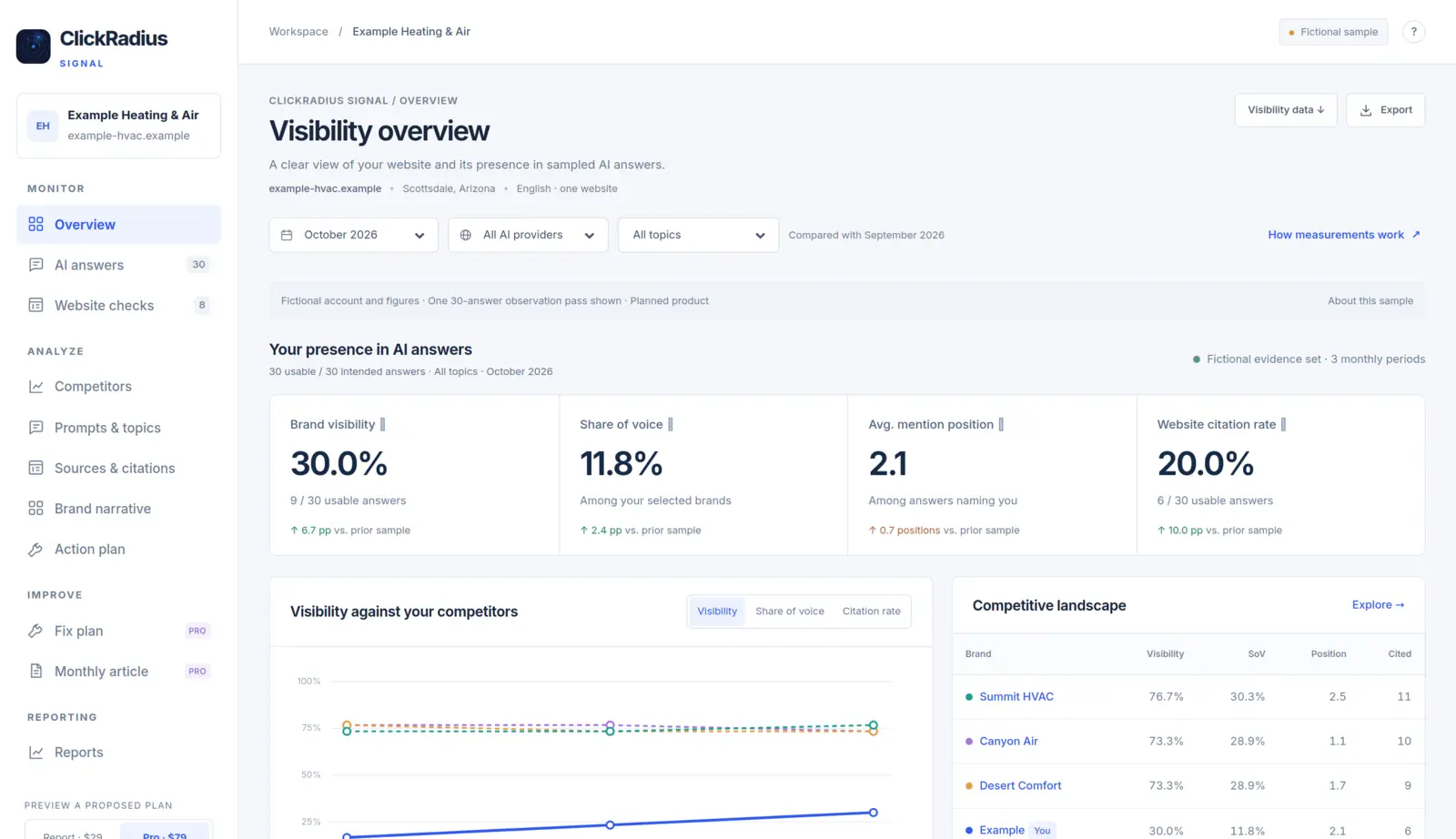
The overview answers the first question an owner asks: when customers ask AI assistants about my kind of business, do I show up? It puts your visibility, share of voice and citation rate next to the three fictional competitors, then breaks coverage down by topic and provider.
Use the filters at the top. You can change the month (August, September or October 2026), the provider and the topic, such as AC repair, emergency service or replacement cost. The topic-by-provider grid is where patterns jump out: a business can be visible for one kind of question and absent for another.
2. AI answers: what did each answer actually say?
This is the evidence underneath every number. Each row is one intended observation: a buying question, a provider, whether the brand was mentioned and whether a URL was cited. You can filter to cited answers, mentioned answers, answers that didn't mention you and unavailable answers, then export the table as a CSV.
Two things to look for:
- Mentions and URL citations are separate columns. Being named and being linked are different results, for reasons we cover in Mentioned, cited or missing.
- "Preview a provider outage." Click it. A provider without a usable answer is excluded from the denominator and never scored as a negative. The demo shows you what that looks like instead of asking you to trust it.
The method behind the numbers is in How ClickRadius Signal measures AI answers.
3. Competitors and prompts: who shows up instead of me?
The competitors screen compares brands on visibility, share of voice, average position and citing answers. Two lines on that screen are worth reading slowly: "Share of voice changes with your comparison set," and "Position is order of mention within an answer, not a Google or Maps rank." Try "Manage comparison set" and remove a competitor. Your own brand stays in the comparison, and the share-of-voice denominator changes with whoever you select. We work through why that matters in Share of voice depends on the comparison set.
The prompts and topics screen has a view called "Competitors appear, you don't," which is often the most actionable list in the workspace. You can also add a buying question. In the sample it joins a pending queue, and the demo says plainly that adding one doesn't invent answers.
4. Sources and brand narrative: what are answers built from?
Sources and citations shows which domains and pages support the answers, split by type: your website, competitor websites, directories, editorial and communities. Look for "competitor source gaps," places that name rivals and not you. A domain counts at most once per answer, so one heavily linked site can't inflate the count.
Brand narrative shows how answers describe the business, with flagged claims for human review. The demo makes a quiet but important point here: its fictional business never supplied hours, prices or credentials, so an answer can't confirm those facts. Sentiment is treated as an interpretation of language, separate from whether you were mentioned.
5. Website checks: is my site ready to be cited?
The website readiness assessment scores the fictional site 77 out of 100, with 42 of 42 sample pages checked, five findings that need attention and three strengths. The assessment uses five weighted families: off-site foundations (28%), on-page information (26%), structured business data (18%), business and author clarity (18%) and crawler access and hygiene (10%).
The thing to remember: readiness is a website assessment, separate from observed answers, and it isn't a probability of being recommended. We explain the difference in Website readiness isn't AI visibility, and the score itself in Website readiness score explained.
6. Pro screens: fix plan and monthly article
Switch the plan preview to Pro to see the two "Improve" screens.
- Fix plan. Up to five prepared repairs a month, each with the affected page, proposed text and exact steps. The screen says "None verified in this sample session" and that installation remains under your control. Prepared work is different from installed work, and the recheck preview is a simulation that changes nothing.
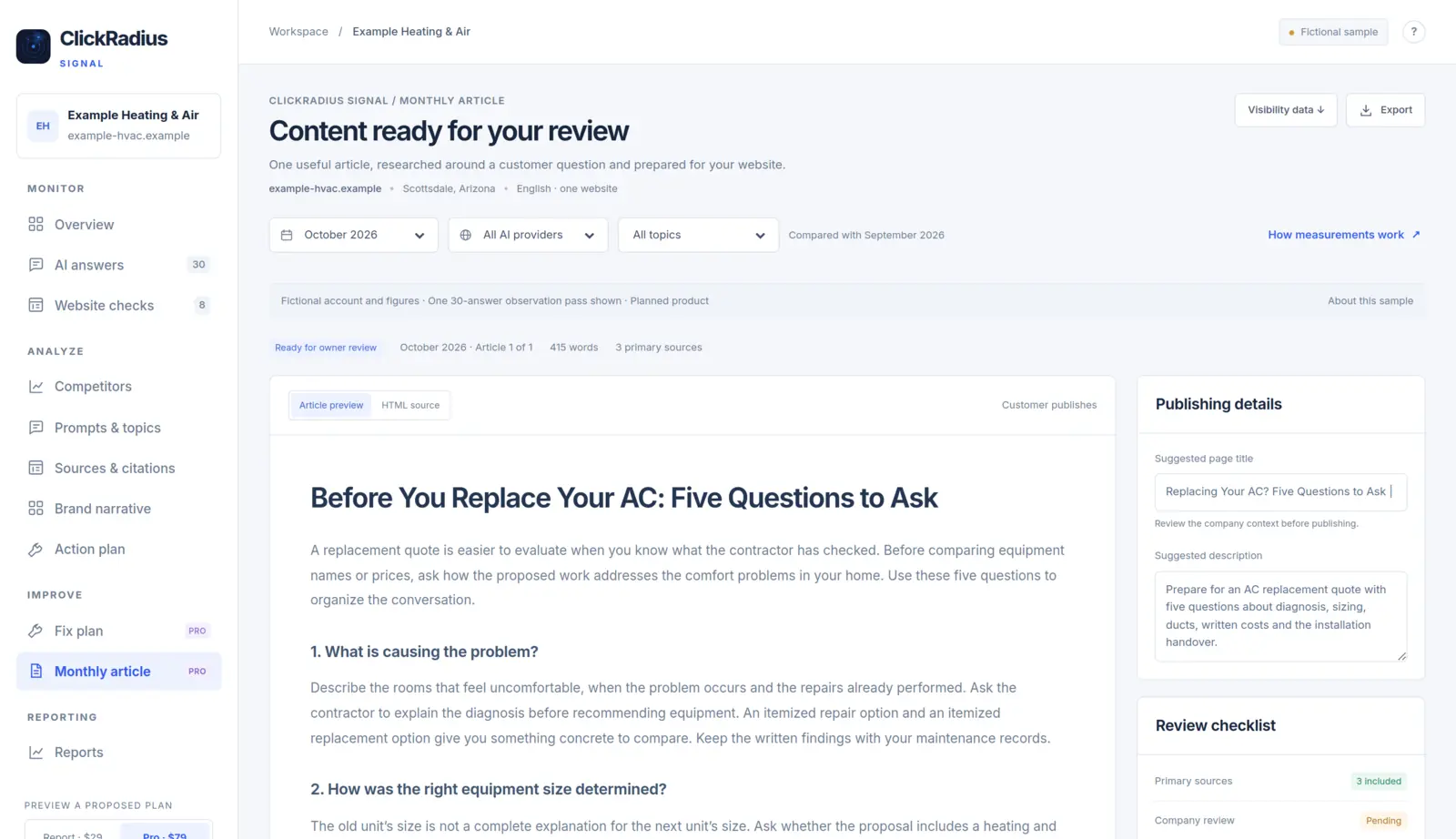
- Monthly article. One researched article a month with one revision round. The demo's draft, "Before You Replace Your AC: Five Questions to Ask," cites three primary sources, shows company review as pending and publication status as "Not published." You or your developer publish it.
Self-serve customers install fixes and publish content themselves. That's the core difference from managed ClickRadius, which deploys and verifies changes for you. More in Prepared fixes and the monthly article.
7. Reports: what changed, and what isn't measured?
Finish on the reporting screens. The monthly history keeps each period's readiness, mentions, citations and usable answers together, so months stay comparable. The traffic and outcomes panel reads "Analytics not connected" and says mentions are not visits, leads or revenue. It also carries the line we'd most like every owner to keep: a change after an action does not by itself establish that the action caused it. Our guide to judging before and after builds on exactly that.
If you'd like to hear when ClickRadius Signal opens, see the Signal page. In the meantime, the free AI Readiness Score checks your real website today.
Questions about anything in this article? Talk to a person. We answer every message.